
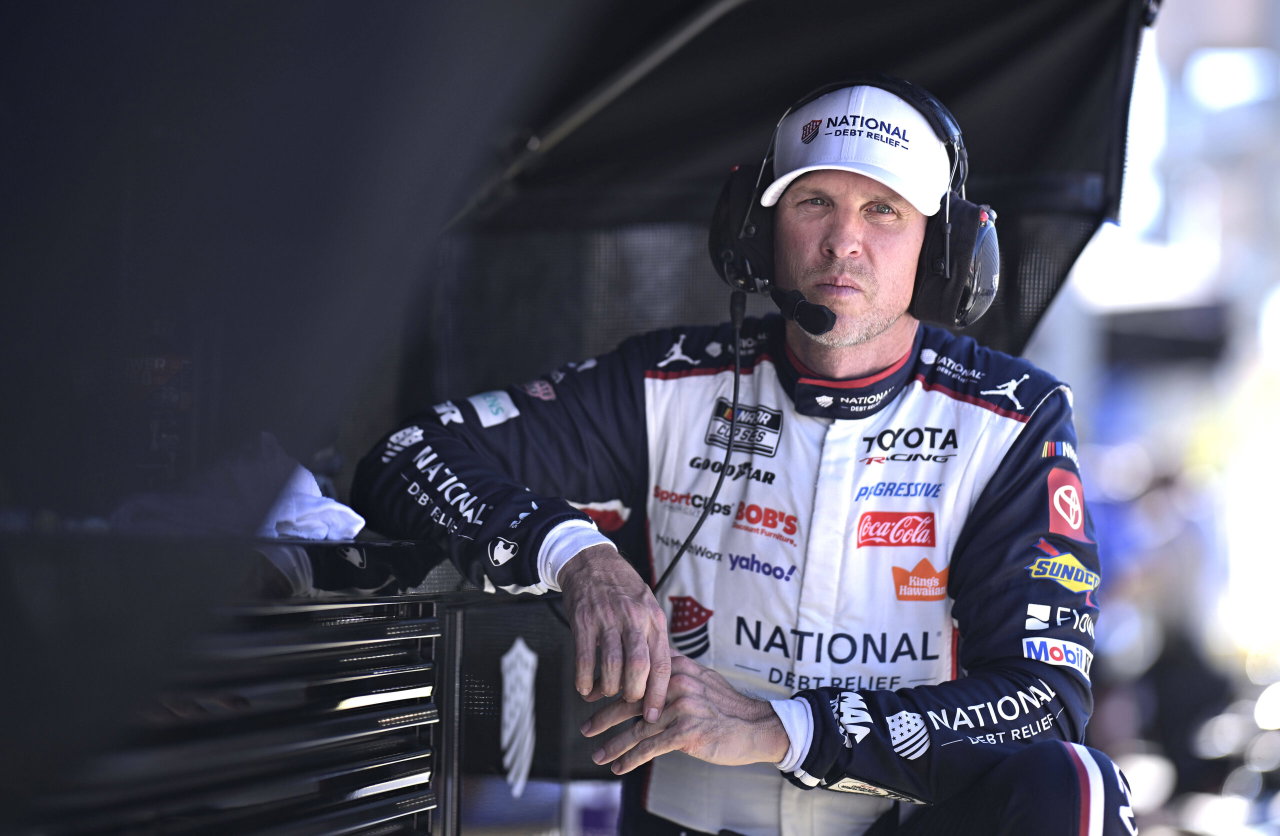
Denny Hamlin had the pole, a fast Toyota, and a championship rival who needed to be kept within reach. Martinsville offered the Joe Gibbs Racing veteran an opportunity to change the direction of his title campaign. Instead, an early decision put him on the back foot, and the problems that followed made recovering lost ground increasingly difficult.
Watch What’s Trending Now!
The No. 11 team needed to get almost everything right. With Kyle Larson carrying a 73-point advantage into the Xfinity 500, there was little room for another missed opportunity. But while Hamlin’s afternoon began with a chance to control proceedings, the race soon became a demonstration of how quickly things can unravel at Martinsville. Steve Letarte and Jamie McMurray discussed the decision that helped bring about that outcome.
“The most successful, the pitting group, William Byron pitted, drove up, won the first stage, never looked back, controlled the race, the rest,” Letarte said on Inside the Race. “The other side, the 11 of Denny Hamlin, got passed by the 60, and then that 11-car fell off the cliff. So now, wrong strategy with a car that was not good on that long run.”
The difference began with the teams’ approach to Stage 1. With 130 laps to cover, fuel was not necessarily a concern. Teams could make it to the stage break without stopping, but that did not mean staying out was the quickest way to get there.
Letarte explained that a green-flag stop around the middle of the stage, with fresh Goodyear tires, could save approximately 10 to 15 seconds over the course of the run. Pit-road traffic could affect the calculation, but the speed advantage was substantial enough to make the stop attractive.
There was, however, a gamble involved in taking that route. As McMurray pointed out during the discussion, staying out offered the possibility of benefiting from a caution. A yellow could bunch up the field and potentially neutralize the advantage of those who had stopped. Without one, drivers on older tires would have to defend against cars with considerably more grip.
That caution never came. Hamlin and Ryan Preece continued on their original tires while much of the field cycled through pit road. The consequences became apparent as the fresher-tired cars worked their way forward. Preece initially maintained the lead, but Byron steadily closed the gap and passed him with six laps remaining to win Stage 1.
Hamlin, meanwhile, had dropped to 17th. Larson, who had also stayed out, was 23rd and a lap down. Both championship contenders had surrendered valuable stage points, but Byron had turned the same stretch of racing into an opportunity to take control.
The No. 24 Chevrolet continued its advantage in Stage 2, with Byron sweeping the opening two segments before eventually winning the race. He led 362 of the 500 laps. Hamlin’s crew chief, Chris Gayle, had committed to a strategy that depended on making the original tires last, but the speed difference made that approach difficult to justify once the caution failed to arrive.
The problem was not simply that Hamlin had lost track position. His Toyota also struggled to maintain its pace over the longer run. That distinction matters because the No. 11 has often relied on its ability to remain competitive as a run develops. At Martinsville, that familiar strength was not there when the team needed it.
McMurray then highlighted why the performance drop was particularly concerning at a track where even a small loss of grip can have serious consequences.
“The thing that has played into the 11’s advantage a lot of times is that they’re exceptional in the long run,” McMurray said. “But you pointed out he got within, well, it was about 30 to go, and you could see it was going the wrong direction, and it’s that to me that at a place like Martinsville, where it’s this little small racetrack, when you lose drive or rear grip, you’re just out to lunch and you can get lapped and lose track position so fast.”
Martinsville leaves little room to hide a loss of rear grip. Drivers need their cars to drive off the corners cleanly, and once the rear tires begin to fade, maintaining momentum becomes difficult. Traffic compounds the problem, particularly when competitors can carry more speed through the corners and get better acceleration onto the straightaways.
Hamlin’s recovery was further complicated by an incident involving Christopher Bell and Joey Logano on Lap 215. The resulting spin and left-rear damage added another setback to an afternoon that had already gone away from the No. 11 team.
He nevertheless fought back to sixth, but the result did little to change his championship predicament. After the race, Hamlin admitted that the afternoon reflected a much larger problem with his campaign.
“I’d say it’s kind of the story of The Chase, where we just didn’t capitalize on the speed that we had,” Hamlin said.
That assessment carried weight. Hamlin had spent much of the Chase in contention, but having a competitive car had not consistently translated into the results needed to challenge Larson. Martinsville was another example. A strategy that failed to deliver, followed by an incident and damage, left the team trying to recover rather than dictate the race.
The numbers made the disappointment even harder to ignore. Hamlin entered Martinsville 73 points behind Larson and left 70 points back, despite finishing sixth to Larson’s ninth. With only Homestead remaining, he needed an enormous points swing to keep his championship hopes alive.
Martinsville was arguably Hamlin’s last best opportunity to put genuine pressure on Larson. Starting from the pole, he had the chance to capitalize on a rare opening against the points leader. Instead, the No. 11 team got the strategy wrong, the car could not sustain its pace, and the opportunity slipped away. Another season has brought Hamlin close to the championship without delivering the one result he has spent so long chasing.