
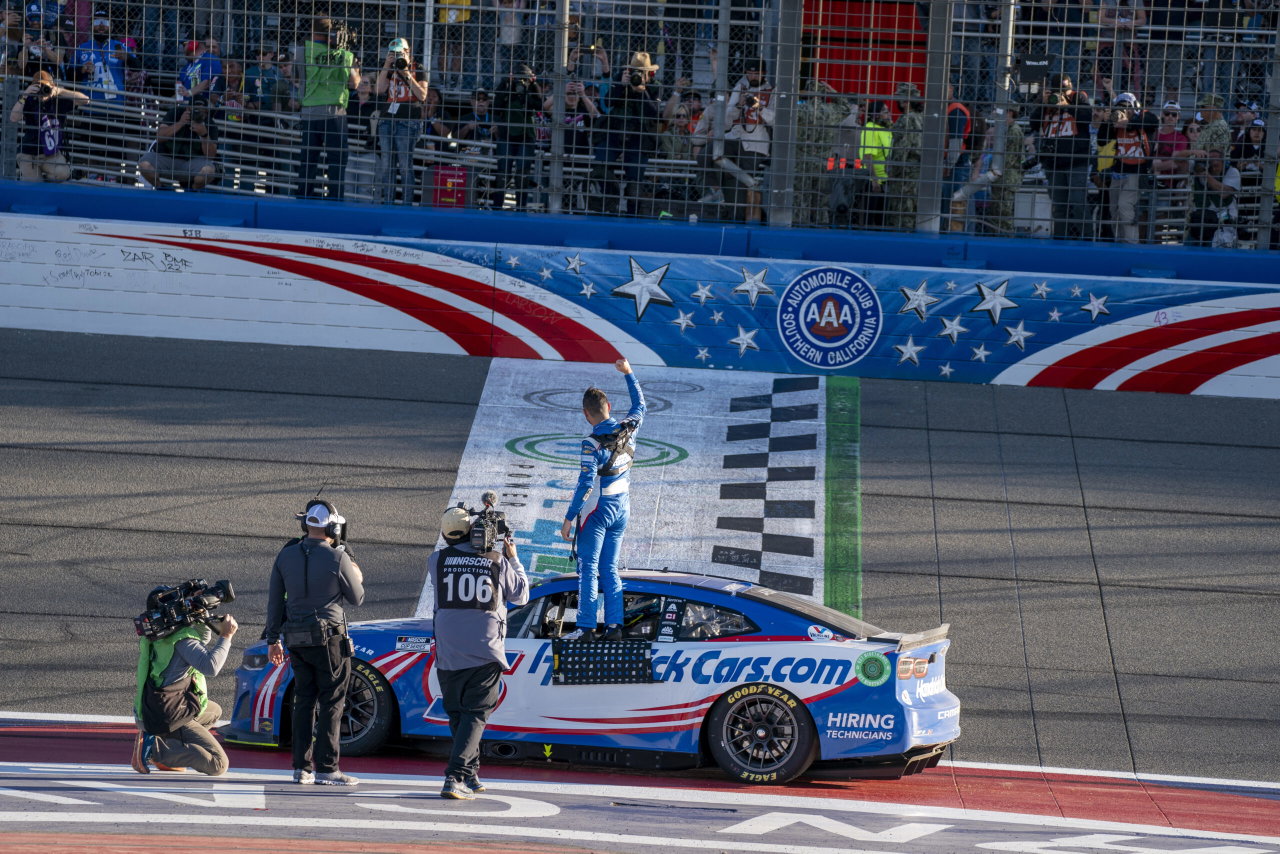
When Kyle Larson crossed the line at Homestead-Miami Speedway on November 8, he had already secured the championship. The No. 5 Chevrolet finished 12th, but seven points from the opening stage had done the job. For Hendrick Motorsports, the result was particularly satisfying. This was not a season in which everything had fallen into place.
Watch What’s Trending Now!
In fact, there were months when the organization looked nowhere near its usual standard. Accordingly, this was Jeff Andrews’ reaction after the race:
“We said this a lot internally. We said, ‘You can count us out. We understand that, but don’t ever, ever, ever count us out off this stage right here when there’s a chance to come back here.’”
Andrews was talking about the work that went into getting back to the championship stage. Hendrick had entered 2026 with four established Cup Series teams and a defending champion in Larson. Yet the opening months brought problems that kept the organization from establishing its usual control over the competition.
The latest Chevrolet Camaro ZL1 race car made its competition debut this season. Hendrick and Chevrolet had to learn how to get the most out of the new package, and the adjustment was not immediate. Larson himself acknowledged after the championship that the Chevrolet was difficult to get used to initially. The team was still building rather than simply carrying forward what had worked in previous seasons.
There were other complications, too. Alex Bowman missed four of the first seven races while dealing with vertigo symptoms. His absence forced changes around the No. 48 team at a time when Hendrick needed all four cars contributing. Meanwhile, William Byron struggled to convert strong performances into victories, and Larson went through the entire 26-race regular season without winning.
For Larson, that was an unusually long wait. His victory drought stretched to 51 races by the time he reached the Chase. The No. 5 showed speed, but good running positions did not always translate into strong finishes. There were also occasions when crew chief Cliff Daniels acknowledged that the team had pushed too hard in its search for speed.
That distinction matters. Hendrick was not short of talented drivers or experienced personnel. It was struggling to get the results expected from the resources it already had. Daniels’ response was to keep the group focused on improving its own work rather than worrying about what other teams were doing. After Charlotte, he described the approach simply: “I feel like it’s us against us, and it’s always been that way.”
The championship format gave Larson another opportunity to turn that work into something meaningful. NASCAR replaced its elimination-based playoffs with a modified Chase system for 2026. Sixteen drivers qualified through regular-season points, followed by 10 races without eliminations. Points were reset once, race wins became worth 55 points, and the regular-season champion received a 25-point advantage. The driver with the most points after the finale would take the title.
That change meant a difficult regular season did not automatically end Larson’s championship hopes. He entered the Chase as the seventh seed, 55 points behind top seed Denny Hamlin. More importantly, he had to prove that the speed missing from his results could return when the stakes increased.
It finally happened at World Wide Technology Raceway at Gateway. Larson ended his winless run in the second Chase race and immediately became a different championship threat. He followed that victory with a second-place finish at Bristol Motor Speedway, another win at Kansas Speedway and a runner-up result at Las Vegas Motor Speedway.
Kansas was particularly convincing. Larson swept both stages, led 235 laps and collected the maximum 76 points. Las Vegas presented a different challenge. A 26-second pit stop dropped him a lap down, but he and Daniels worked their way back to second. Across the first five Chase races, Larson averaged a 2.2 finish and collected 273 points. The team had finally found a way to combine speed with the consistency it needed.
However, the championship was not secured without another serious scare. At Phoenix Raceway, handling problems and a tire failure left Larson 34th. He collected just three points, and his championship advantage fell from 49 points to five. Suddenly, the work of the previous few weeks was under threat.
Then came Talladega Superspeedway. Larson had never won a superspeedway race in his Cup career, but he delivered when his championship campaign needed it most. He led 23 laps, collected 16 stage points and made a late charge to take the victory. His 71-point haul turned a five-point deficit over his closest rivals into a 73-point lead.
Martinsville Speedway brought another difficult afternoon. An unsuccessful opening-stage strategy left Larson a lap down, and he scored no points in either of the first two stages. A caution involving Hamlin and Christopher Bell allowed him to recover through the free pass. Larson eventually finished ninth, preserving a substantial advantage heading into Homestead.
He arrived at the finale 67 points ahead of Bell and 70 ahead of Hamlin. Nine points would guarantee the championship. When Chase Briscoe suffered an engine failure near the end of Stage 1, the resulting caution ended the segment early. Larson had finished fourth and collected seven stage points. With his guaranteed finishing point and tiebreaker advantage, neither Bell nor Hamlin could catch him.
The championship was settled, although the race continued. Larson later suffered nose damage after contact on pit road and finished 12th. Ryan Blaney won after passing Tyler Reddick with two laps remaining, while Byron finished third. The result also gave Byron another strong finish after his Martinsville victory the previous week.
Andrews made a point of recognizing the people responsible for getting Hendrick back to this position. He credited the leadership of Rick and Linda Hendrick and the employees in Charlotte who refused to let the difficult summer change their standards.
“Obviously, it starts with Mr. and Mrs. Hendrick and the leadership and the culture that they set for us, and then just the amazing teammates that we have back in Charlotte who just never gave up and refused to let our summer affect how we ran and the standard of what Hendrick Motorsports is used to.”
He also refused to make the championship solely about Larson’s No. 5 team. Byron finished eighth in the final Chase standings, while Bowman finished 16th and Chase Elliott finished 22nd. Their individual campaigns had different outcomes, but the organization had to keep working through all of them.
“I just want to say all four of our teams helped us get to this point tonight. It truly was a team effort.”
Hendrick Motorsports now has 16 Cup Series championships, while Larson joins the group of drivers with at least three titles. Daniels also became one of only eight crew chiefs to win at least three championships. The result is another major achievement for the organization, but Andrews’ comments point to something the books don’t show.
Hendrick had spent much of 2026 trying to understand why its usual standard was slipping. It finished the year with another championship, and a reminder that one difficult season does not erase what the organization knows how to do.