
The CARS Tour has drawn a firm line after Landon Huffman crossed one during a heated confrontation with Tyler Reif. Huffman was fined $500 and placed on probation after leaving his assigned pit area following an on-track incident with Reif. The penalty may appear straightforward. But Dale Earnhardt Jr. believes the bigger issue is what could happen if such confrontations are allowed to escalate. For him, the concern goes far beyond two angry drivers.
“We cannot have people, it’s mainly crew members you’re trying to keep from doing this because the crew members don’t know any better. They’ll go down there and swing. They’ll throw a wrench or jack handle. So, you have to penalize the guys when they do it to stop it from happening at the next race,” Dale Jr said on the Dale Jr Download podcast.
The incident involving Huffman and Reif began on the racetrack. Reif made contact with Huffman, sending the latter backward into the corner before he slammed into the wall. Both cars were heavily affected and ended up in the infield.
Huffman climbed from his damaged machine and walked toward Reif’s car. What followed quickly became more than a heated exchange between two competitors. Huffman kicked the door of Reif’s race car before officials and police intervened and separated the two drivers.
Later that night, Reif approached Huffman and appeared to apologize while taking responsibility for the incident. Huffman’s response was blunt.
“Yeah, pay for my racecar then.”
The exchange did not immediately settle things. Tensions began escalating again before Reif eventually walked away. On Tuesday, CARS Tour officials issued their response in the form of a penalty.
Dale Earnhardt Jr. understands why the series had little choice. He explained that drivers arguing after a crash is one thing. Crew members leaving their pits and entering another team’s area creates a completely different risk.
A driver might be furious after losing a race car. But crew members can bring tools and equipment into the confrontation. That is where a heated moment can become dangerous.
For instance, during a 2013 race at Martinsville Speedway, a Richard Childress Racing crew member threw a hammer at Kevin Harvick’s truck. That incident demonstrated exactly why officials cannot allow garage confrontations involving pit crew members to become normalized.
The CARS Tour’s penalty, therefore, is about more than Huffman and Reif. It establishes a boundary that Dale Earnhardt Jr. believes must remain clear: drivers can settle their differences verbally, but leaving an assigned pit area and allowing a confrontation to escalate cannot become routine.
How NASCAR draws the line on garage confrontations
NASCAR has its own framework for dealing with confrontations that go beyond the normal intensity of competition. Its personal-conduct policy updated in 2016 gives officials significant room to punish members when an incident crosses into physical violence, threats or endangerment.
Section 12.8.1.c specifically covers member actions that can result in 25-50 Championship driver and Team Owner points being lost, alongside a $50,000-$100,000 fine. Depending on the severity of the incident, NASCAR can also hand down a one-race suspension, indefinite suspension, or termination.
The policy includes “Member-to-Member confrontation(s) with physical violence” as well as other violent manifestations, including significant threats, abuse and endangerment.
The change came after several high-profile confrontations had shown just how quickly post-race anger could turn into something far more dangerous.
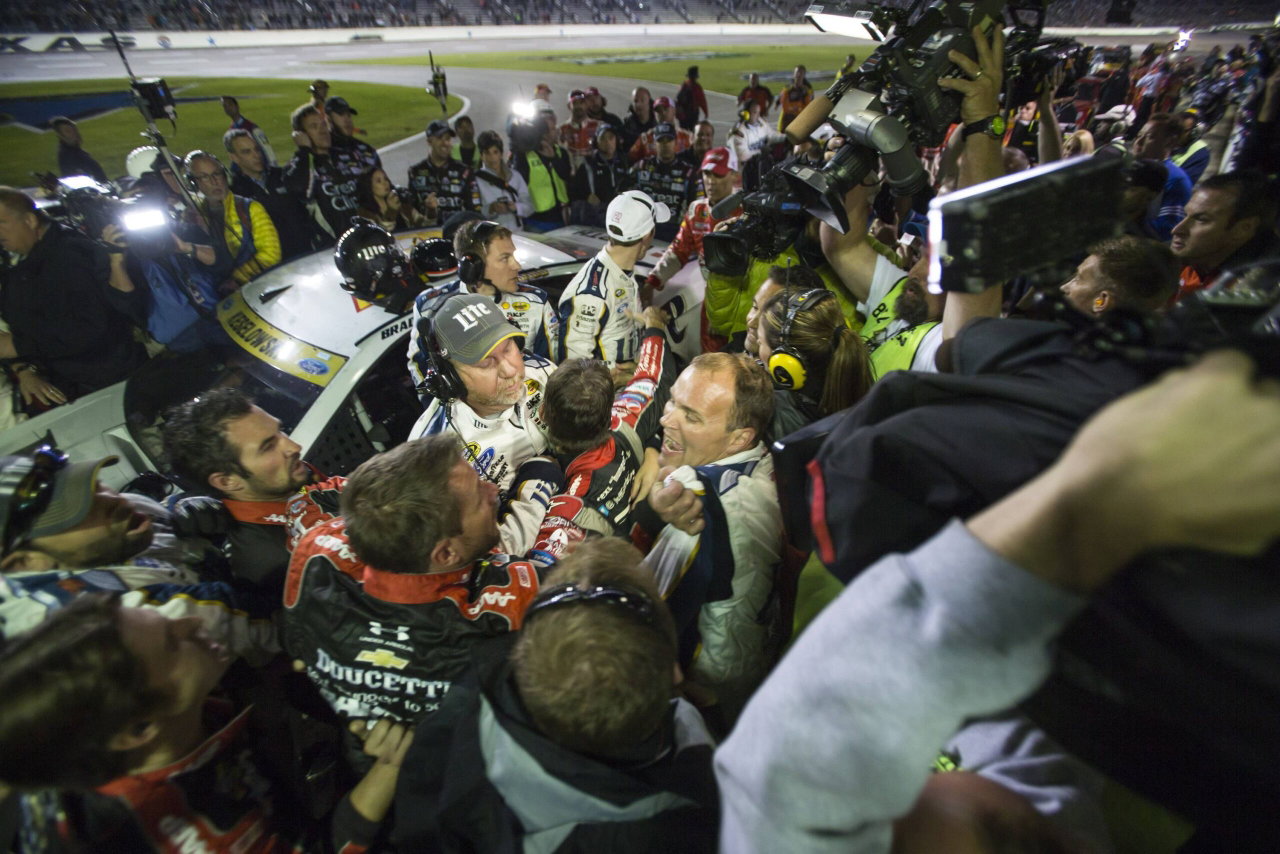
One of the clearest examples came at Texas Motor Speedway in 2014, when Brad Keselowski and Jeff Gordon became embroiled in a massive pit-road confrontation.
Keselowski made an aggressive move late in the race that cut Gordon’s tire and damaged his championship hopes. Gordon was furious and confronted Keselowski on pit road after the checkered flag.
The situation escalated almost immediately. Kevin Harvick approached from behind and shoved Keselowski toward Gordon, triggering a confrontation between the two drivers. Once Gordon and Keselowski grabbed each other, members of both pit crews rushed into the fight.
What followed was one of the most chaotic scenes NASCAR had seen in years. Dozens of crew members became involved as the confrontation turned into a massive rolling brawl. Fists were thrown, several people were bloodied and officials struggled to separate the two teams.
NASCAR subsequently fined and suspended several crew members involved in the incident, while both Gordon and Keselowski emerged from the confrontation bloodied. That incident was not an isolated example of tempers boiling over in the garage.
NASCAR’s eventual 2016 policy modification provided officials with clearer authority to punish conduct involving physical violence, threats and endangerment. The goal was not to eliminate the emotion that has always been part of stock car racing, but to prevent heated moments from turning into full-scale fights.
The policy has not stopped every confrontation. Drivers still argue. They still approach each other after controversial incidents. Emotions still occasionally spill over.
However, the sport has largely avoided the kind of enormous driver-and-crew melees that became increasingly common during previous eras.