
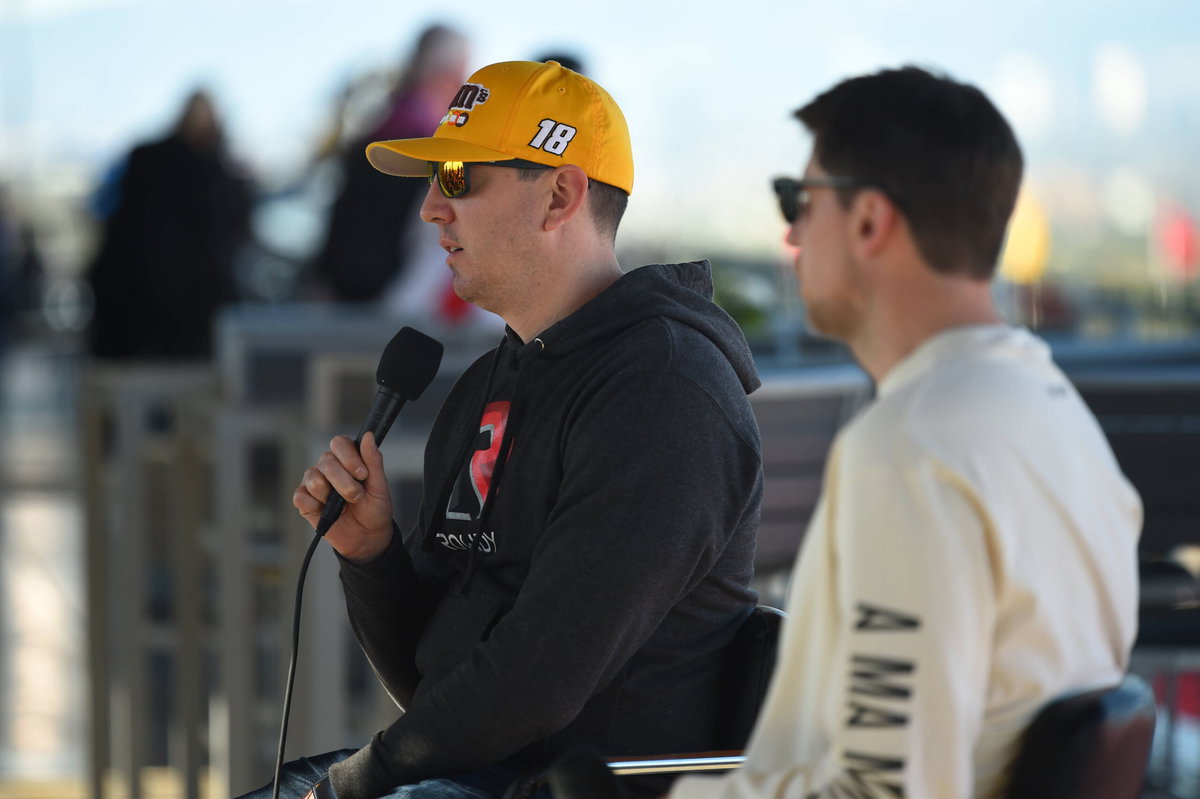
Kyle Busch could make a routine post-race interview feel like a high-wire act. A reporter might get a detailed explanation, or a one-line answer delivered with enough sarcasm to become a headline. That unpredictability made him one of NASCAR’s most compelling personalities, but also a difficult driver for journalists to approach.
Watch What’s Trending Now!
The reputation was built over years. In 2005, after winning at Phoenix, the 20-year-old Busch stormed out of the media room when a reporter challenged his claim that media reports about older brother Kurt were often false. He returned about 25 minutes later to finish taking questions.
Twelve years later, after finishing second in the Coca-Cola 600, he answered a question about Austin Dillon’s fuel-mileage victory with, “I’m not surprised about anything. Congratulations,” then dropped the microphone and walked out.
Longtime NASCAR reporter Wendy Venturini says that his public image did not tell the whole story. Looking back on her relationship with Busch during an appearance on PRN Fast Talk, she showed what his typical interview would look like.
“If you ask a dumb question, you’re going to get a sarcastic answer from Kyle Busch,” she said.
Does Sprint Car Racing Put Kyle Larson’s NASCAR Future at Unnecessary Risk?
That was expected, she said, and it taught her to be deliberate about how she worded questions.
Venturini acknowledged that Busch could be emotional, particularly early in his career, and that catching him on a bad day required care. But she separated sarcasm from disrespect.
“He never said anything inappropriate and never treated me poorly,” she said.
He knew she was doing her job and, in her experience, always took the time to stop, answer honestly, and avoid brushing her off as another media member. That respect stayed with her.
The 2017 Charlotte incident showed why the contrast was striking. Busch believed he had a chance to win the crown-jewel race, only for Dillon to stretch his fuel and claim his first Cup victory. Busch’s one-answer press conference was widely criticized.
Days later, he explained that disappointment had built while he sat in the car and grew as he processed what he had missed.
“Unfortunately for me, mine has never been very gracious,” he admitted. “I’m sorry, that’s just who I am.”
The response did not make the mic drop less memorable, but showed how closely his media demeanor could mirror the emotion of the race.
Another familiar example came after a frustrating 2019 race at Las Vegas. Busch fought back from early trouble and was in position for a strong finish before getting caught up with lapped traffic. He ended up 19th and gave reporters clipped answers, including “I’m just here so I don’t get fined.”
He also complained that he was answering the “dumbest” questions repeatedly. It became another viral exchange and reinforced the perception that an interview with Busch could turn combative.
Still, Venturini’s account was not simply a defense of his temper. She explained that she and Samantha Busch became friends when Samantha began traveling the NASCAR circuit. Venturini attended Samantha’s baby shower for Brexton, and their friendship continued.
That connection gave her another window into Kyle, but she stressed that he maintained a professional boundary: he understood she was a reporter and treated her accordingly.
Venturini also praised Samantha for using her platform to help young widows since Kyle’s passing. The grief remains visible. Six months after he passed away at 41 from complications of severe pneumonia and sepsis, Samantha wrote that “half of me is missing,” describing how difficult it was to move forward while raising their children.
Earlier in November, she accepted Kyle’s posthumous 2026 Cup Series Most Popular Driver Award, a fan honor he had never won during his career.
Busch’s reputation was never built on making every interview comfortable. He was emotional, sharp-tongued, and often impatient with questions he considered repetitive or poorly framed.
Venturini’s recollection adds a distinction worth remembering: he could be sarcastic without being disrespectful to every journalist. She remembered a driver who made her choose her words carefully, but still stopped, listened and gave her an honest answer.