
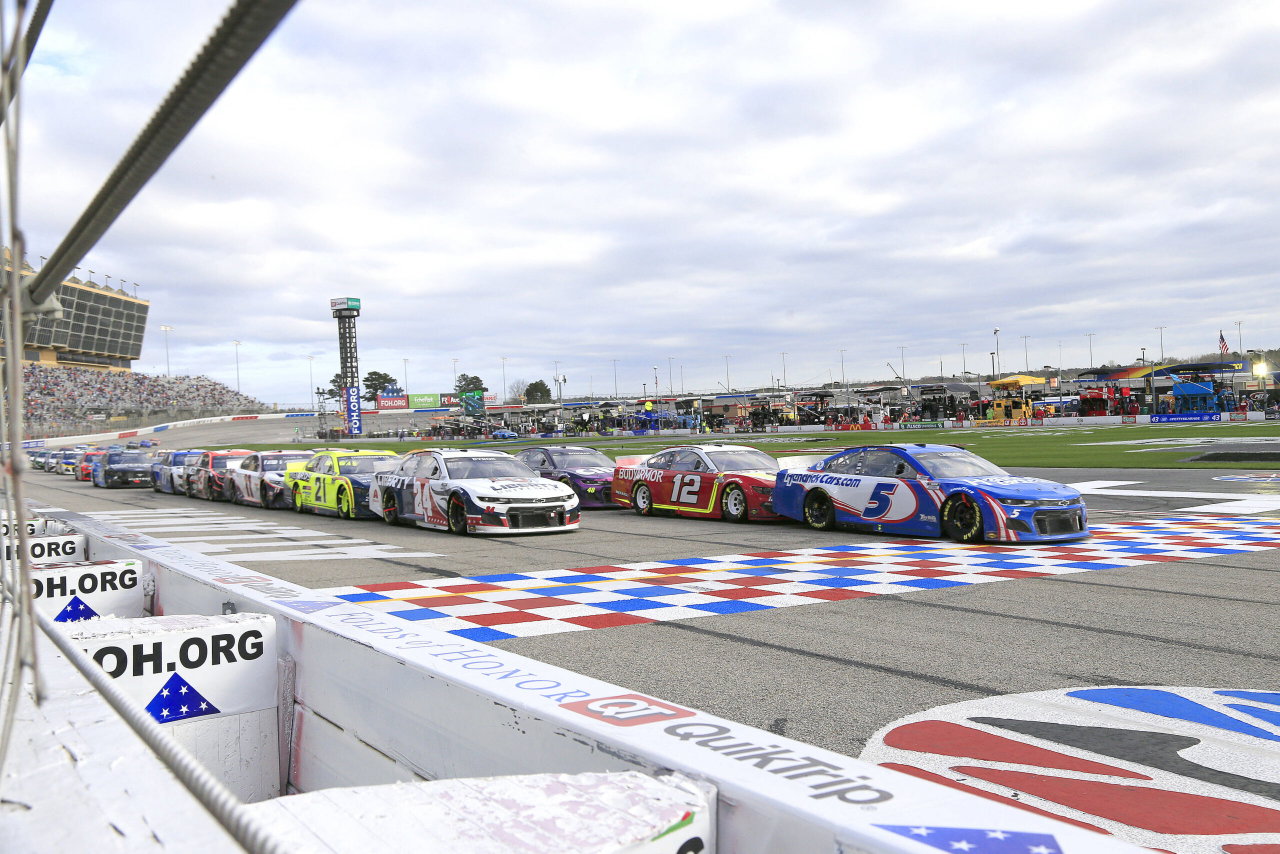
Forty engines fire up at once, the grandstand starts to shake, and before the green flag even drops, you can smell burnt rubber and race fuel in the air. That’s been NASCAR’s calling card for almost eighty years. Not a marketing line, just what the sport is.
Watch What’s Trending Now!
That identity is now getting picked apart in boardrooms by the same manufacturers whose logos ride around the track every Sunday.
“If you look out across the landscape, one thing that’s for certain is that change is accelerating all around us,” said John Probst, NASCAR’s senior vice president and chief racing development officer. “We, from a NASCAR perspective, want to be in the driver’s seat when it comes to where our future is going.”
The problem is nobody agrees on which direction to steer. The car industry is splitting into a handful of different technologies at once, while NASCAR is still built almost entirely around one of them. Sooner or later, that gap has to close.
What NASCAR Fans Are Actually Driving
Everybody wants to frame this as gas versus electric, but that misses an important part of the story. Battery electric vehicles made up about 6% of new U.S. light-duty vehicle sales in the second quarter of 2026, down from 7% a year earlier. That drop came after federal EV tax credits expired on September 30, 2025, following a surge in purchases before the credits ended. And according to the U.S. Energy Information Administration, EVs made up just 2% of all registered light-duty vehicles in the U.S. in 2024, the latest year with full fleet data. However you look at it, gasoline is still running the show.
The hybrid is the one quietly stealing the spotlight. Hybrids hit 16% of new U.S. light-duty sales in that same quarter, a record for the category. Throw in plug-ins and full battery EVs, and you get 24% of all new sales coming from something electrified.
Kelley Blue Book found hybrid sales climbed 9% in the first half of 2026 while the broader new car market actually shrank by 2.2%. The fastest-growing electrified vehicle in America right now isn’t the battery EV people keep talking about. It’s the plain old hybrid, and that one detail changes the whole conversation NASCAR needs to be having.
NASCAR has always marketed itself as a snapshot of American car culture, but that culture doesn’t look like one thing anymore. It’s hybrids and plug-ins and battery EVs and, still, plenty of straight gasoline, all running at once. NASCAR sticks to just one lane. Government policy isn’t helping clarify things either.
The current administration has walked back several aggressive EV policies, and a proposed fuel economy rule for 2031 would set the fleetwide average at roughly 34.5 miles per gallon, a big step down from the earlier 50.4-mpg target. Washington is no longer pushing the EV transition nearly as hard, and drivers aren’t buying battery EVs anywhere close to the pace many expected a few years ago.
Here’s the part NASCAR can’t shrug off, though. The manufacturers building its cars haven’t backed away from electrification at all. Ford Performance expects to lose about $4 billion on its Model e division in 2026 alone, and it’s pouring more than $1 billion into its EV platform anyway. General Motors is now the country’s second biggest EV seller. Toyota is projecting around 5 million hybrid sales this fiscal year while it keeps developing solid-state batteries.
Not one of the three manufacturers racing in NASCAR has walked away from electrification. None of them has walked away from combustion either. They’re running both at the same time because nobody actually knows which one wins in the end.
So the real question isn’t what happens once gas engines go away. It’s what happens once the companies bankrolling this sport stop believing there’s only one future to build toward.
The Stock Car Hasn’t Been “Stock” in Years
Before anyone argues NASCAR should stay put, it’s worth admitting where the sport already stands. The current Chevrolet Cup car wears a Camaro ZL1 body, except General Motors stopped making the Camaro after 2024. You can’t buy one new. It keeps racing anyway because the rulebook allows it, and Chevrolet actually needed special approval just to freshen up the car’s look for 2026 so it wouldn’t fall behind Ford and Toyota visually.
Put plainly, the link between showroom cars and race cars was never as literal as NASCAR likes people to believe. The Next Gen car, which debuted in 2022, was supposed to close that gap with manufacturer-specific body panels and more modern parts.
In reality, the chassis is heavily standardized and built largely from the same suppliers across every brand. It works more like a shared racing platform with different paint jobs than anything you’d actually find at a dealership.
That matters more than it sounds like it should, because it knocks out one of the strongest arguments against changing course. NASCAR’s connection to production cars has never been perfectly real, and the rules that decide what counts as “production relevant” have already been rewritten more than once. They can be rewritten again.
Ford’s situation right now makes that tension impossible to miss. The 2027 Mustang Dark Horse SC is set to debut in NASCAR Cup competition at the Daytona 500, built around a 5.2-liter supercharged V8.
Ryan Blaney, who got to drive the road version ahead of the announcement, said, “The supercharged V8 is unbelievable. When you get it on the track, you want to punch it hard, brake late.”
Ford Racing’s global director, Mark Rushbrook, went all in on the muscle car branding, calling it “America’s race team at America’s racetrack.”
At the very same time, Ford is building engines with Red Bull Powertrains for Formula 1 under the sport’s new 2026 rules, which pair a combustion engine making roughly 400 kilowatts with an electric motor adding around 350 kilowatts. Ford has said that program sits at the center of its future as a company going electric and software-driven. So Ford’s biggest global racing program runs on a hybrid power unit, and its NASCAR program is doubling down on a supercharged V8.
Nobody at Ford has really explained how those two identities are supposed to live under the same roof, and honestly, that’s the whole question this story is trying to answer.
NASCAR Built an Electric Car, but it Still Doesn’t Have a Series to Race it in
Back in July 2024, NASCAR and ABB rolled out an electric race car prototype, built together with Chevrolet, Ford, and Toyota. It runs on a 78-kilowatt-hour liquid-cooled battery with three electric motors, capable of 1,000 kilowatts at peak output.
That works out to roughly 1,360 horsepower, sent through all four wheels, with regenerative braking and Goodyear tires built specifically for it. The body is made from a sustainable flax-based composite on a modified Next Gen chassis, built by the same engineers who developed the Next Gen car itself and, before that, the Garage 56 car that raced the 24 Hours of Le Mans in 2023.
Former Cup Series driver David Ragan has been putting the prototype through its paces across several test sessions. Early on, he squeezed roughly 50 laps out of a single charge at Martinsville Speedway, then took the car out at the Los Angeles Memorial Coliseum, Charlotte Motor Speedway, and Phoenix Raceway.
“I think they did an outstanding job having the kinematics of the car similar,” Ragan said after one of those early runs. “The geometry of the car is similar.”
He kept working with it into 2026, demonstrating the prototype at Atlanta Motor Speedway that April and giving technical feedback at the University of Michigan-Dearborn in August.
So the car is real, and it runs well. Experienced drivers, with all three manufacturers watching closely, have taken it seriously across several different tracks. What still doesn’t exist is an actual series to race it in. Probst has confirmed there’s no current plan for an electric championship, though he stopped short of ruling it out for good. He also pointed out that shorter races might suit electric technology better than trying to swap it in for NASCAR’s long oval races right away, which might be the most honest thing anyone at NASCAR has said publicly about any of this.
The hard part was never building a fast electric car. That part’s basically solved already. The hard part is keeping that performance up across hundreds of miles. A 500 mile superspeedway race involves very little hard braking compared to a road course, which leaves fewer chances to recover energy through regenerative braking and puts far more strain on the battery itself.
Making the battery bigger to compensate adds weight, and that extra weight throws off tire wear, handling, and stopping distance in ways that stack up fast. Pit stops create a whole separate headache too, since NASCAR’s entire strategy revolves around fast fuel and quick tire changes. Parking an EV in a pit stall for a normal charging cycle would mean rebuilding how races work from scratch.
None of that is really a problem with electric racing itself, though. It’s a problem with long oval racing specifically. On a road course, or a short oval with lots of braking zones, the math flips entirely.
NASCAR has already called the prototype “ideal for road courses and short oval tracks,” because that’s exactly where regenerative braking earns its keep. IMSA’s top sports car class, GTP, already proves hybrid technology can hold up in serious competition. Four of its five manufacturers, Chevrolet included, are now running updated hybrid setups.
A regulated hybrid system at the Cup level would dodge the long-distance battery problem completely. Keep the combustion engine, add an electric motor for assist and regenerative braking, and you preserve the sound fans actually show up for while giving the racing an entirely new strategic layer it doesn’t have today.
The Sound Isn’t a Small Detail, Neither is what Fans Actually Think
This is usually where the argument skips something important. The roar of forty V8 engines isn’t some background detail at a NASCAR race. It’s the product, just as much as any logo stitched onto a hood. The rumble through the grandstand, the smell of fuel, the sheer noise of full throttle through a banked corner. Those are the reasons people drive hours and sit outside in August heat, and that experience built NASCAR’s fan base just as much as the racing itself did.
The ABB prototype is legitimately fast, with instant torque and smart energy management, but it doesn’t sound or smell like a Cup car. For a sport built entirely on those sensations, that’s not something you can just wave off.
Still, the other side of this deserves a fair shot too. GM’s global motorsports chief, Eric Warren, pointed to an internal survey worth taking seriously. More than half of avid NASCAR fans said watching EV technology race would actually make them more interested in buying an electric vehicle themselves. Racing has always worked as a way to make unfamiliar technology feel exciting instead of strange, and that’s exactly why manufacturers spend money on motorsport in the first place.
That logic doesn’t just disappear because the technology changed. And NASCAR has already moved further than most casual fans probably realize, on almost every front except the engine itself. Its current Sunoco Green E15 race fuel already contains 15% zero-carbon bioethanol, and a February 2026 deal with POET made NASCAR the first major racing series anywhere to use zero-carbon bioethanol in its fuel.
In 2025, NASCAR put in 30 ABB charging stations at its Daytona Beach headquarters. Hybrid power units ran the event operations at the 2024 Chicago Street Race, and a temporary microgrid built with ABB powered the 2026 San Diego Street Race. The sport has also set a 2035 net zero target covering everything it owns and operates. Take the engine out of the equation, and this shift is already well underway.
Three Roads Forward, and Why Only One Actually Makes Sense Right Now
NASCAR doesn’t have to choose between protecting its V8 and going fully electric, and neither does the car industry it’s supposed to reflect. Ford, Chevrolet, and Toyota are all running multiple powertrains at once because nobody knows yet which one will ultimately win. A sport that depends so heavily on their money should probably recognize that.
A staged approach makes more sense right now than any single, tidy answer. Keep the combustion program going with lower-carbon fuels while working toward regulated hybrid systems at the Cup level. Add shorter electric races on road courses and short ovals, giving manufacturers a real competitive EV platform without touching the 500-mile oval races that define the sport. Then build out the hybrid rules as the technology and market mature, letting the change happen on NASCAR’s timeline rather than one forced from outside.
A race weekend featuring both formats isn’t some far-off idea. Toyota, Chevrolet, and Ford already use multiple powertrain technologies in other forms of racing. A sport this dependent on their money should probably show that it’s paying attention before the manufacturers start setting the terms themselves.
None of this was ever really about which engine spins the wheels. Manufacturers spend money on motorsport for marketing, brand image, and technology development, full stop. That math only works if what happens on the track Sunday still matters to the business come Monday.
NASCAR bumped Cup Series horsepower up to 750 for road courses and short ovals under 1.5 miles in 2026, a fair response to what drivers and fans had been asking for, and the right call for where the sport stands today. But tuning the current combustion car and figuring out what the race car looks like fifteen years from now are two completely different conversations. Right now, only one of them is actually happening with any urgency.
The sport still has room to breathe. Battery EV growth has cooled off, gasoline demand is still massive, and federal policy isn’t forcing anyone’s hand. Ford, meanwhile, is bolting a supercharged V8 into its 2027 Cup car. That’s not the same thing as having unlimited time, though. The window to build real options while this shift is still gradual is open right now, and whatever NASCAR does with it will decide what the sport looks like once that window shuts.
NASCAR was born at a time when America’s relationship with the gas-powered car was simple and pretty much settled. The real challenge now is figuring out what the sport stands for once that relationship stops being simple at all.