
Essentials Inside The Story
- A painful decision from Oklahoma City's past suddenly feels relevant again
- One detail inside the proposal raises questions about its true purpose
- Shai Gilgeous-Alexander's own comments complicate the entire conversation
Fourteen years ago, the Oklahoma City Thunder stood at a similar crossroads. Fresh off an NBA Finals appearance, the franchise chose not to meet James Harden’s contract demands and traded him to Houston. Harden eventually developed into an MVP, and the decision remains one of the most debated moves in franchise history.
Watch What’s Trending Now!
Now, another blockbuster idea is forcing Oklahoma City supporters to revisit that uncomfortable chapter. This time, the player being discussed is All-NBA forward Jalen Williams.
Bleacher Report’s Zach Buckley, on Thursday, came up with a trade idea that involves the Thunder and Eastern Conference rivals, the Detroit Pistons. Buckley argued that the biggest question facing the defending champion Oklahoma City Thunder isn’t whether they are good enough to contend, but whether they can afford to keep together a core that includes Shai Gilgeous-Alexander, Jalen Williams, and Chet Holmgren under the new collective bargaining agreement.
Under Buckley’s proposal, Oklahoma City would effectively be choosing future flexibility over keeping its championship core intact. The logic centers around the NBA’s increasingly restrictive second-apron rules, which make it significantly harder for expensive contenders to add talent, aggregate salaries in trades, and maintain roster depth.
Details of the trade idea below:
- Oklahoma City Thunder receive: No. 3 pick, Jaylen Wells, Isaiah Stewart, Kentavious Caldwell-Pope, 2030 first-round pick (via DET)
- Detroit Pistons receive: Jalen Williams
- Memphis Grizzlies receive: Ausar Thompson, Ron Holland II, No. 12 pick (via OKC), No. 21 pick (via DET), 2031 first-round pick swap (via DET)
There is also a practical question about whether the proposal truly solves Oklahoma City’s financial concerns. Williams’ new extension begins in 2026-27 at roughly $41 million, while Stewart, Caldwell-Pope, Jaylen Wells and the No. 3 pick would collectively bring significant salary commitments back to the Thunder. In other words, the deal may restructure Oklahoma City’s cap sheet, but it does not function as a traditional salary dump.
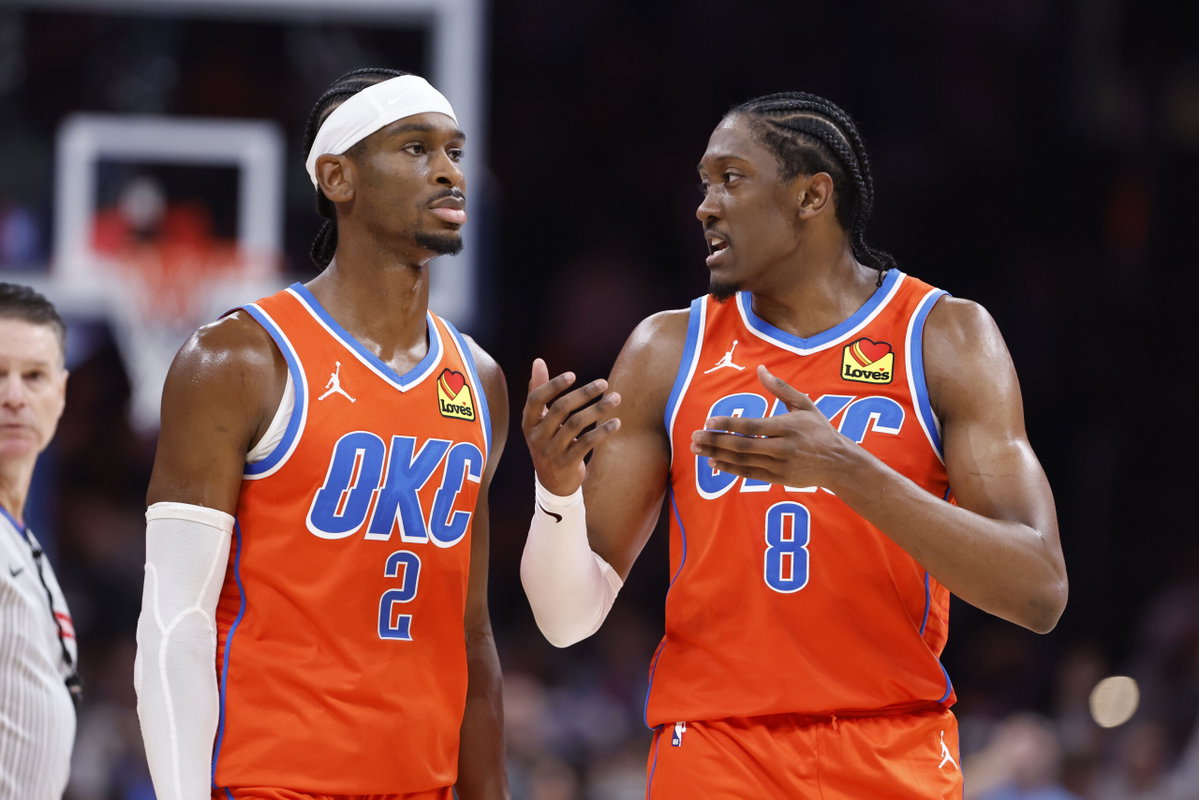
Furthermore, the blockbuster scenario centers on Oklahoma City trading Jalen Williams rather than paying all three stars maximum-level money for years to come. The idea is that Williams, despite being an All-Star, All-NBA player, and a critical piece of the Thunder’s 2025 championship run, might become the franchise’s most valuable trade chip because of his age, contract situation, and league-wide appeal.

USA Today via Reuters
Apr 24, 2024; Oklahoma City, Oklahoma, USA; Oklahoma City Thunder forward Jalen Williams (8) celebrates after scoring a basket against the New Orleans Pelicans during the second quarter of game two of the first round for the 2024 NBA playoffs at Paycom Center. Mandatory Credit: Alonzo Adams-USA TODAY Sports
That reasoning is exactly why many around the league would question whether Oklahoma City should even entertain the idea. Williams isn’t simply another young contributor. The 25-year-old has already developed into an All-Star and All-NBA caliber wing capable of defending multiple positions, creating offense and playing alongside either Gilgeous-Alexander or Holmgren. More importantly, the Thunder spent years stockpiling draft assets in hopes of finding players exactly like Williams. Trading him immediately after he became one of the league’s most valuable young stars would represent a dramatic shift from the philosophy that built the roster.
The Thunder felt Williams’ absence during their Western Conference Finals loss to the Spurs. Speaking after the series, Williams told USA Today, “I think we could’ve won if I played.” He added, “Went to seven with them without me playing. I don’t think I make us worse.”
The comments sparked debate across NBA circles, but they also served as a reminder of how important Williams remains to Oklahoma City’s championship aspirations.
What’s Next for OKC Thunder and Jalen Williams?
While the trade idea comes off as a shock, the bigger theme is the Thunder’s financial standing. Over the next several years, Gilgeous-Alexander is expected to command one of the richest contracts in NBA history. The reigning MVP signed a four-year, $285 million supermax extension with OKC in July 2025. Williams is entering the first season of his massive five-year extension, and OKC still views him as one of the pillars of the franchise alongside Shai Gilgeous-Alexander and Chet Holmgren.
Gilgeous-Alexander himself recently pushed back against concerns surrounding the Thunder’s young core. Discussing Williams and Holmgren after the season, the reigning MVP said, “When he’s the best version of himself, we’re the best version of ourself.” He later added, “They’re a big part of the success we’ve built.”
Those comments make it difficult to imagine Oklahoma City actively shopping Williams unless the franchise becomes convinced the long-term financial math simply no longer works.
Thunder general manager Sam Presti has also acknowledged the challenges created by the NBA’s new financial landscape. Speaking after the season, Presti said teams operating near the apron face restrictions that make roster-building “very hard to transact things,” highlighting just how difficult it has become to maintain expensive championship cores under the current CBA.
This offseason, the Thunder’s priority should be trying to extend their championship window, not break it apart. They still have one of the deepest collections of draft assets in the NBA and a roster capable of contending for years. The more realistic questions this summer involve role players like Isaiah Hartenstein’s expensive option, Lu Dort’s future contract, and whether they consolidate draft picks into another win-now move.
The comparison that immediately comes to mind is the James Harden trade. In 2012, Oklahoma City chose future flexibility over keeping together a young Finals core, only to watch Harden develop into one of the league’s biggest stars. More than a decade later, that decision still serves as a cautionary tale whenever payroll concerns enter the conversation. Whether Buckley’s proposal is realistic or not, it raises the same uncomfortable question Thunder executives once faced: is financial flexibility worth the risk of moving a player who could be central to the franchise’s future?