
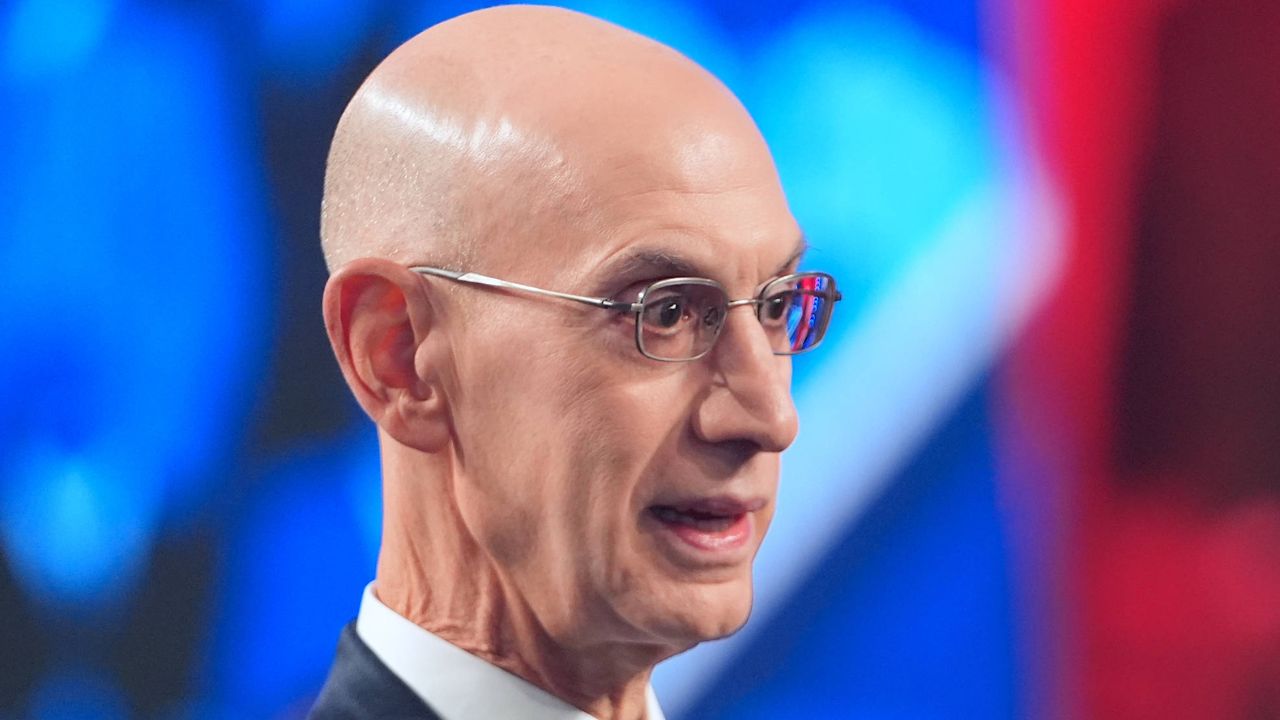
The NBA’s biggest dynasty killer isn’t a rival franchise anymore. It’s the league’s own mission. As championship cores continue to break apart under the weight of the new CBA, commissioner Adam Silver made one thing clear in Las Vegas: the league’s push toward competitive parity is a by-product of a well-oiled system.
Watch What’s Trending Now!
“It’s certainly not an unintended consequence,” Silver told the reporters, defending the NBA’s current financial model and its impact on roster building. In short, he batted for the lethal second apron tax.
“In the case of a league, it’s in essence zero-sum. So, to the extent that one player doesn’t sign up, doesn’t re-sign a player, or chooses to trade a player, of course, that player goes to another team. And so, the purpose of the system is ultimately to create competition throughout the league. And from that standpoint, I think the system’s working incredibly well.”
As shared by the X NBA Fan Page, ‘Oh No He Didn’t’.
That philosophy sits at the heart of the NBA’s 2023 CBA. Previous luxury-tax rules mostly punished owners financially. Wealthy franchises could absorb massive tax bills and continue to stack talent.
The teams used Bird rights to retain their homegrown talent and completed complicated sign-and-trade deals. Most importantly, they relied on the taxpayer mid-level exception to acquire role players.
Paying hefty taxes did hurt the owner’s wallet, but it rarely affected the roster.
The second apron changed that equation.
Instead of increasing the financial burden, the NBA introduced structural penalties. The teams that breach the second-apron threshold have a list of restrictions imposed on them. From frozen future first-round picks to no taxpayer mid-level exception.
Those restrictions reach far beyond payroll. They directly limit how contenders can further improve their rosters. Front offices are now operating under a system designed to make talent distribution inevitable.
Adam Silver argued that the results already speak for themselves.
“The goal isn’t necessarily to have a different champion every year, but we’ve had eight different champions over the last eight years.”
That level of competition would have seemed unlikely during the late 2010s. The Golden State Warriors and Cleveland Cavaliers met in four straight NBA Finals. It turned out to be one of the league’s longest modern rivalries. Today’s CBA was significantly designed to prevent that domination.
The Warriors became the perfect example. In 2016, a new national television deal caused the salary cap to jump roughly 34%. It immediately raised the cap space from $70 million to $94 million in a single season.
In return, it enabled the 73-win team to sign Kevin Durant straight from free agency.
Under the current CBA rule, that scenario is impossible. A cap-smoothing mechanism that limits annual salary-cap growth by 10%. Similarly, Bird rights still allow teams to re-sign their own players; the second apron makes it far more challenging to do so.
To give a straightforward example, take a look at the latest Jaylen Brown trade. A team can’t really carry two super-max players on the same roster and also have depth.
Now, the fan-related understanding here varies, and some of the community might not like the new direction Silver’s rules are pushing the league towards. For example, Boston fans are left wondering who will carry their attack forward alongside Jayson Tatum. Tactically, there wasn’t an issue with the Jays. Still, a change needed to be made. Is this CBA system really going to sustain the fanbase for decades? Especially the younger fans… when players are suddenly moved.
This almost deviates any team from building the league’s next dynasty. Adam Silver’s message was straightforward. The NBA is not trying to guarantee a new champion every season. It ensures every team has a realistic pathway to contention.