
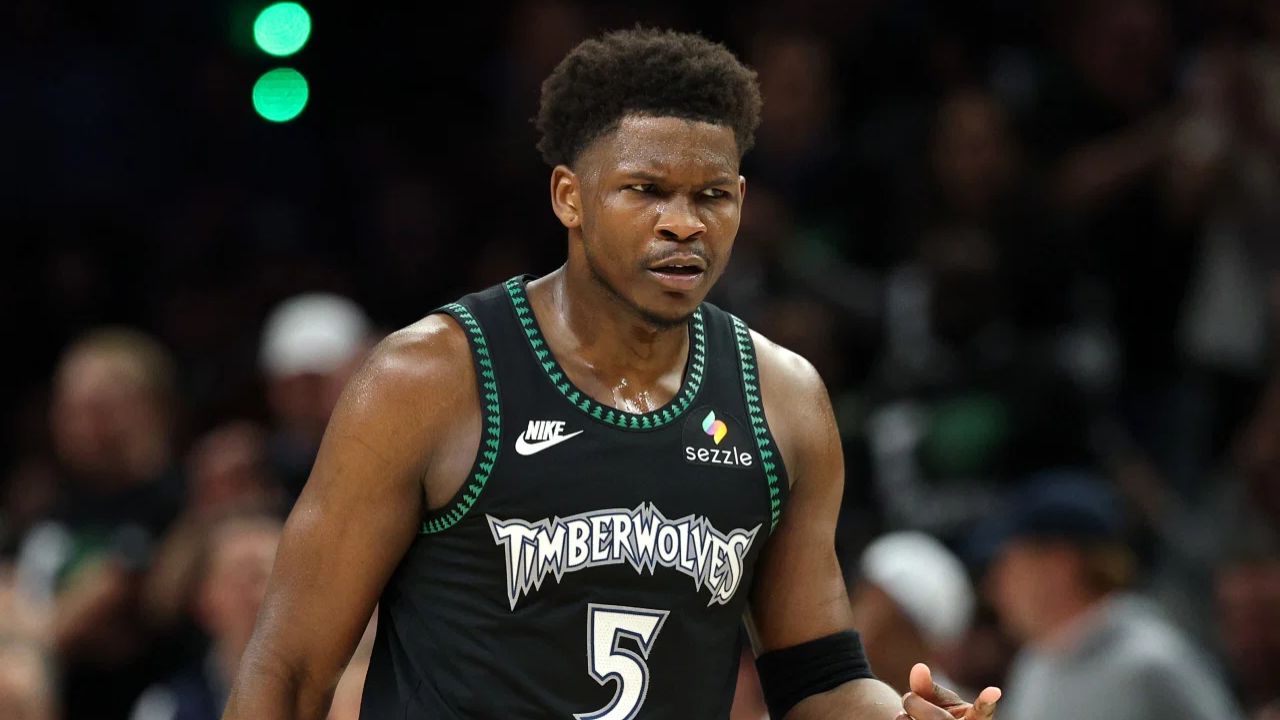
The Minnesota Timberwolves face a pivotal juncture in their season as franchise cornerstone Anthony Edwards prepares to undergo arthroscopic knee surgery. While Minnesota prioritizes its superstar’s long-term health, the timing of the procedure introduces significant financial and structural stakes for both the player and the franchise.
Watch What’s Trending Now!
Under the NBA’s collective bargaining agreement, players must appear for 20 minutes in at least 65 regular-season games to qualify for postseason awards, including All-NBA honors. For Edwards, his All-NBA selection is a requirement to unlock a potential supermax contract extension next summer, a deal projected at roughly $300 million over four years.
If Edwards’ recovery timeline extends and causes him to miss the 65-game threshold, he would be limited to a standard two-year extension worth approximately $122 million, a potential difference of over $175 million in future earnings. The financial impact depends entirely on whether Edwards can return and play 65-plus games this season; the surgery itself does not automatically forfeit his earnings.
The Timberwolves, however, have emphasized that their priority is Edwards’ long-term health. President of basketball operations Tim Connelly addressed the situation after updated imaging revealed an issue the organization wanted to address quickly.
When asked whether the problem could have been addressed during the summer, Connelly said, “No, the imaging has changed. The most recent imaging, we’ve had a bunch of imaging since the summer, and it changed as it was.”
Connelly also acknowledged that Edwards wanted to continue playing despite the issue. “I mean, there’s always the ability, like he wants to play tonight. He looked pretty good the other night, having the 47, but we’re just concerned about his long-term health. We want to make sure we put him in his best position to be the best version he can be by one time.”
Connelly also clarified the nature of the procedure, saying, “It’s not a meniscus. I don’t want to speak out of school. My liberal arts degree will screw me up. It’s just an arthroscopic cleanup of his knee.”
Reacting to Connelly’s clarification, Sutterer wrote on X, “I like it even less. I’d rather it was a clear new injury rather than a nonspecific joint ‘clean up’.”
Dr. Brian Sutterer Explains Why Knee Scopes Raise Long-Term Concerns
Dr. Brian Sutterer explained that arthroscopic knee procedures can provide short-term relief while potentially creating longer-term concerns.
“That in and of itself is not like a big major structural injury to the knee. But what often can happen whenever a surgeon has to go in and trim out some of that torn tissue, debris away, clean up this little area over here, is you are getting some short-term improvement for potentially more longer-term issues. It’s a trade-off.”
Sutterer specifically addressed Edwards’ situation, explaining why the procedure makes him cautious about the young guard’s future.
“And oftentimes, like I said, the surgery can be a short-term solution to what can develop into being a long-term problem. And so when a young player like Edwards, when we start hearing about these knee surgeries, it makes me cautious about things in the future. It makes me cautious about what’s gonna happen in the next five years. Is this gonna lead to more knee surgeries? Is this gonna lead to more issues?”
His comments highlight potential risks associated with knee procedures, not a prediction that Edwards will suffer further complications.
The procedure is intended to address the knee issue and protect his long-term health, but his absence could also affect his eligibility for All-NBA honors and a potential supermax contract. How he responds to the procedure will be important for both his return to the court and his future contract prospects.