
Essentials Inside The Story
- Austin Reaves has gone from an undrafted Lakers guard to one of the NBA’s most talked-about rising names, but that attention has also brought fresh criticism.
- Questions around his growing reputation, bigger contract and place among the league’s top guards have now put his true value under the microscope.
- A closer look at his recent rise and impact, however, paints a far more interesting picture than the “overrated” label suggests.
There was a time when Austin Reaves had to prove he belonged in the NBA. Now, apparently, he has to prove he is not getting too much credit for it.
Watch What’s Trending Now!
Bleacher Report’s Zach Buckley placed the Los Angeles Lakers guard at No. 10 on a list of the NBA’s most overrated players. And on the surface, you can at least understand where the conversation comes from. Reaves plays for the Lakers, one of the biggest brands in sports. His rise from an undrafted free agent to a household name has been covered at every turn. Then there is the four-year, $185 million extension, which naturally brings another level of scrutiny.
But there is one problem with calling Reaves overrated. The numbers keep making the argument harder to defend.
This is no longer the same player who averaged 7.3 points as a rookie. Reaves averaged 20.2 points, 5.8 assists and 4.5 rebounds in 2024-25. He followed that by climbing to 23.3 points, 5.5 assists and 4.7 rebounds across 51 games in 2025-26. His field-goal percentage jumped from 46.0% to 49.0%.
And the biggest part is that his efficiency did not disappear when his role grew.
Imago
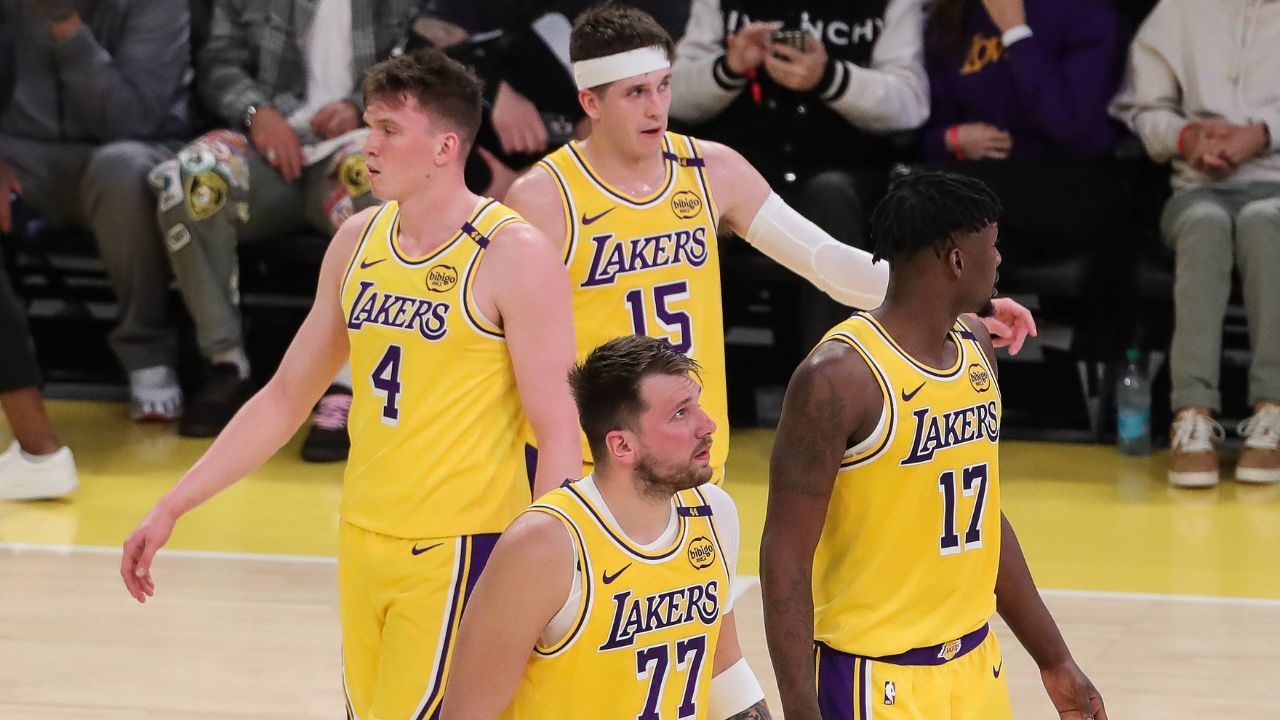
LOS ANGELES, CA – FEBRUARY 19: Los Angeles Lakers young core of guard Dalton Knecht 4, guard Austin Reaves 15, forward Dorian Finney-Smith 17 and guard Luka Doncic 77 during the NBA, Basketball Herren, USA game between the Charlotte Hornets and the Los Angeles Lakers on February 19, 2025, at Crypto.com Arena in Los Angeles, CA. Photo by Jevone Moore/Icon Sportswire NBA: FEB 19 Hornets at Lakers EDITORIAL USE ONLY Icon20250219076
Reaves posted a 64.1% true shooting percentage this past season while carrying a 26.8% usage rate. The research puts the average true shooting mark for NBA guards playing more than 30 minutes at 57.7%. Reaves was 6.4 percentage points above that mark.
His 56.7% effective field-goal percentage also cleared the 52.2% guard average. He shot 87.1% from the free-throw line and took 7.3 free-throw attempts per game. His foul drawing ranked in the 99th percentile for his position.
That is an important distinction.
An overrated scorer can pile up points because somebody has to take the shots. Reaves increased his workload and somehow became more efficient in the process. His usage rose from 24.0% as a complementary option to 26.8%, while his true shooting went from 61.6% to 64.1%, and his turnover rate actually fell from 12.9% to 11.0%.
That does not look like a player being exposed by a bigger role.
The Lakers Have Already Seen What Happens When Reaves Gets the Keys
The easiest criticism to throw at Reaves is that life becomes much easier when you share a floor with stars. For years, he had been attracting attention with LeBron James. Luka Doncic gave defenses another nightmare to worry about. Naturally, Reaves benefits from that.
So what happens when that protection disappears?
This might be the strongest answer to the entire overrated debate.
Across 25 games without LeBron over the last two seasons, Reaves averaged 28.2 points, 8.0 assists and 5.4 rebounds while shooting 49.0% from the field and 38.2% from three. His true shooting percentage was 64.6%, and the Lakers went 16-9.
His usage climbed again, this time to 28.5%. Yet his turnover rate remained at just 11.8%, while he maintained a 2.58 assist-to-turnover ratio.
In other words, giving Reaves more responsibility did not make his production fall apart. It did the opposite.
The individual games make that even harder to ignore.
With Los Angeles needing him to take over against Sacramento in October, Reaves exploded for 51 points, 11 rebounds and nine assists while posting an absurd 80.5% true shooting mark. Against Indiana in February 2025, he put up 45 points, seven rebounds and seven assists. A month later in Denver, he finished with 37 points and 13 assists.
And in the three-game sample without both LeBron and Luka, the numbers became almost silly: 40.0 points and 10.0 assists per game on 68.3% true shooting. Los Angeles went 2-1.
Nobody should take three games and declare Reaves a superstar. But that is not the point. The point is that one of the main cases against him is supposed to be that his production comes from playing beside bigger stars. When those stars disappeared, Reaves did not.
The Lakers’ team numbers tell a similar story.
In 2025-26, Los Angeles went 36-15 when Reaves played and 17-14 without him. Cleaning The Glass data also had the Lakers scoring 122.6 points per 100 possessions with Reaves on the floor compared with 114.3 when he sat. His on/off differential ranked in the 84th percentile.
This was not a one-season advanced-stat fluke either. In 2024-25, Reaves posted a +2.7 Estimated Plus-Minus, placing him in the 92nd percentile. His 7.6 Win Shares tied LeBron for the team lead. His Player Efficiency Rating then rose to a career-high 20.2 this past season.
There is real team impact behind the box-score numbers.
And that brings us to the All-Star conversation.
Reaves did not make the 2026 All-Star team, and pretending otherwise would weaken the case. The West is loaded with guards. But his production was hardly out of place in that conversation.
Compare him with three notable Western Conference guards from the same season. Reaves averaged 23.3 points on 64.1% true shooting. Devin Booker was at 24.1 points on 58.5%. De’Aaron Fox averaged 22.2 on 55.5%, while Ja Morant averaged 21.5 on 54.0%.
Reaves also led that group in true shooting percentage, effective field-goal percentage and PER.
So was he an obvious All-Star snub? That is harder to argue. Was his play at least good enough to belong around that conversation? The numbers give a much stronger case.
There is still a fair argument buried somewhere inside the criticism.
Reaves is not a perfect player. Defense has long been one of the easier areas to question. He now carries a $46.25 million average annual salary on his extension.
And because he plays in Los Angeles, a good Reaves game will always receive more attention than the same performance might elsewhere.
But even the defensive numbers in the research complicate that criticism. The Lakers allowed 112.3 points per 100 possessions with Reaves on the floor this past season and 113.0 with him off it.
That does not turn him into an elite defender, but it also makes it difficult to argue that his defense wipes away everything he provides offensively.
The contract argument needs the same context.
Trae Young, another player on Bleacher Report’s overrated list, averaged 21.0 points on 55.5% true shooting with a negative on/off net rating.
Fox averaged 22.2 points on the same 55.5% true shooting mark. Reaves was at 23.3 points, 64.1% true shooting and had a far stronger positive impact on the Lakers’ on/off numbers.
That does not automatically make Reaves better than either player. Basketball is not that simple. It does show why singling out his price tag without considering his production misses part of the picture.
The Lakers spotlight may have changed the way people talk about Austin Reaves. That part is probably unavoidable. He went from undrafted to 7.3 points per game, then 13.0, 15.9, 20.2 and finally 23.3. More attention followed every step.
But attention is not the same thing as overrating someone.
If Reaves were putting up empty numbers, the efficiency could expose him. It doesn’t. If he were feeding off superstars, the games without LeBron could expose him. They don’t. If his production did not translate to the team, the on/off numbers could expose him. Again, they don’t.
There are flaws in Reaves’ game. There are reasons to debate whether $185 million will prove worthwhile. And there is certainly room to argue about where exactly he belongs among the NBA’s best guards.
But calling him one of the league’s most overrated players requires ignoring a growing pile of evidence.
Austin Reaves might get more attention because he wears purple and gold. At this point, though, he has done more than enough to earn plenty of it.