
USA Today via Reuters
Dec 14, 2014; Minneapolis, MN, USA; Los Angeles Lakers guard Kobe Bryant (24) against the Minnesota Timberwolves at Target Center. The Lakers defeated the Timberwolves 100-94. Mandatory Credit: Brace Hemmelgarn-USA TODAY Sports
USA Today via Reuters
Dec 14, 2014; Minneapolis, MN, USA; Los Angeles Lakers guard Kobe Bryant (24) against the Minnesota Timberwolves at Target Center. The Lakers defeated the Timberwolves 100-94. Mandatory Credit: Brace Hemmelgarn-USA TODAY Sports
In the NBA, firings are usually clean, rehearsed, and corporate. This one was not. Nearly a decade later, the anger behind it still spills out raw, personal, and unresolved. That emotion resurfaced when former Los Angeles Lakers head coach Byron Scott revisited the night his job disappeared, and the people he believes lied to his face. The story is not just about a firing. It is about a broken promise at the end of Kobe Bryant’s career, and the moment the Lakers’ internal order began to fracture.


When the Lakers hired Scott in 2014, the mandate was clear. This would be a rebuild. According to Scott, Mitch Kupchak and Jim Buss explicitly framed the job as a multi-year project that would extend beyond Bryant’s final season. That assurance is why the call caught him off guard.
Watch What’s Trending Now!
Scott recalled Kupchak phoning him at 8:00 p.m. shortly after the season ended, despite recent public comments suggesting his job was safe. While driving to the facility, Scott admitted he suspected the outcome, but still refused to believe it. The same people who asked if he was comfortable with a two-to-four-year rebuild were now asking him to come in after hours.
That meeting ended quickly. The Lakers were moving on. Scott kept his composure in the room. Internally, he was furious. “If this would have probably happened 10 years ago, I would have flipped that damn table upside his head. I swear to God, I would have beat his a**. I swear because I’m looking at you like you just straight lied my face.”
The quote was not an exaggeration. It was betrayal. Scott believed the front office had changed course without ever honoring the plan they sold him. He was told patience would be required. Instead, he became expendable the moment Bryant’s farewell season ended.
Later that night, Scott went home rather than packing his office. When his wife asked if he was okay, he said yes. He was not.
Getty
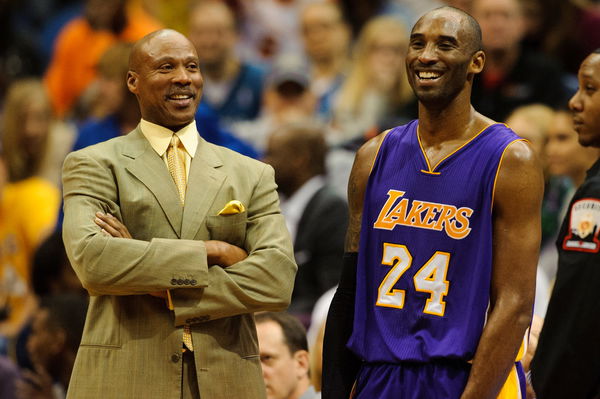
MINNEAPOLIS, MN – DECEMBER 14: Byron Scott of the Los Angeles Lakers speaks with Kobe Bryant #24 during a timeout in the fourth quarter of the game against the Minnesota Timberwolves on December 14, 2014 at Target Center in Minneapolis, Minnesota. The Lakers defeated the Timberwolves 100-94. NOTE TO USER: User expressly acknowledges and agrees that, by downloading and or using this Photograph, user is consenting to the terms and conditions of the Getty Images License Agreement. (Photo by Hannah Foslien/Getty Images)
On paper, Scott’s tenure looked ugly. The Lakers won just 38 games across two seasons. In context, that outcome was expected. The roster was thin, assets were limited, and the franchise had openly accepted short-term pain.
Scott has said he felt his real job was to manage Bryant’s final chapter, not to oversee the rebuild that was supposed to follow it. Their relationship dated back to Bryant’s early years in the league, and Scott took repeated criticism while shielding a front office that had already pivoted away from him.
When he was fired, Scott felt Kupchak and Jim Buss positioned him as the problem rather than acknowledging the broader organizational failure.
One firing sparked the Buss sibling rivalry
Scott’s dismissal did not immediately explode the Lakers. However, it cracked the foundation. The team struggled again under Luke Walton, and patience inside the Buss family evaporated. In February 2017, Jeanie Buss removed both Kupchak and her brother Jim Buss from power. Magic Johnson and Rob Pelinka stepped in soon after.
Kupchak’s 36 years with the franchise did not save him. The more explosive fallout came next. Jim and Johnny Buss attempted to challenge Jeanie’s authority, triggering a public family power struggle. Jeanie responded by filing a temporary restraining order to block a board meeting that threatened her position as governor.
Johnny eventually exited the organization. Jim’s firing stood. Every Buss sibling except Jeanie disappeared from Lakers operations. Scott’s firing did not single-handedly cause the Buss family civil war. Still, it marked the moment when trust inside the organization fully eroded. Promises stopped meaning much. Decisions became reactionary. Stability vanished.
Eventually, Johnson helped recruit LeBron James, and the Lakers climbed back to a championship in 2020. Success returned. Order followed. Yet Scott’s story remains a reminder of how quickly the Lakers once unraveled, and how one late-night phone call exposed the gap between what the franchise said publicly and what it was already planning privately.
In Scott’s words, the anger never came from losing the job. It came from being told he was safe, then learning he never was.
Written by

Edited by

Ved Vaze