
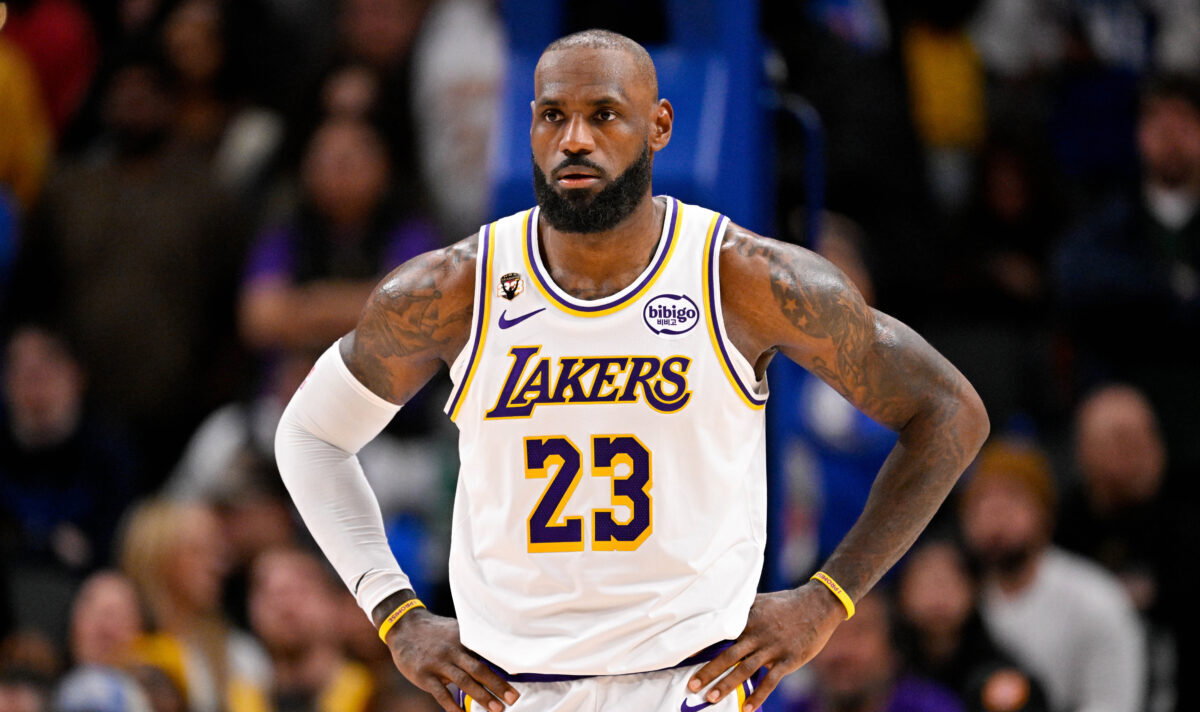
The NBA world gasped. The most durable superstar in the game, a man who appeared unaffected by time and had missed only one game all season, had crumpled to the Staples Centre floor, clutching his right ankle and screaming in pain. The date was March 20, 2021. Solomon Hill collided with LeBron James’ planted right leg while attempting to steal the ball, and the MRI confirmed what the trainers feared: a high ankle sprain that would sideline the defending champion indefinitely. Five years later, speaking with ESPN’s Dave McMenamin, the 41-year-old admits plainly what he has never said before: it never fully healed.
Watch What’s Trending Now!
“My foot and my ankle ain’t been the same since,” James told McMenamin when asked to reflect on the Hill collision. “Ever since that injury, I’ve been fighting uphill to get it back to normal. But it’s been a little blah ever since.” The admission is striking in its directness, not a carefully managed injury update, not a deflection into talk of managing load and minutes, but a flat acknowledgment that one of the most consequential moments of his later career left a mark that five years of training, therapy, and recovery could not fully undo.
Coming into the night he was injured, he was averaging 25.8 points, 8.1 rebounds, and 8.0 assists, and had kept his name firmly atop the MVP conversation. He had missed just one game all season and was riding a then-NBA-record streak of 1,036 consecutive games scoring at least 10 points. McMenamin asked him directly: when it happened, did he know he had only scored seven points? “Yeah, I’m not going to sit here and lie and say I didn’t know where I was,” James said. “But I’ve hurt my ankle and my foot a couple times, and I’ve laced my shoes up and just went back and played. And that was kind of my mindset. It wasn’t like, ‘Continue the streak.’ It was more like, ‘Well, let me see. Let me see.’ Or more like, ‘F****. Please no. Please no. Please, not right now.’ Because I’m playing too f***ing [well]. I have a chance to have a historical season.”
After the foul was called, James limped back to the bench, retied his sneakers during the timeout, and returned to the floor, hitting a corner three-pointer before signaling to the bench that he could no longer continue. He knocked over a chair on his way to the locker room. “Nothing angers and saddens me more than not being available to and for my teammates,” he wrote on social media that night. “I’m hurt inside and out right now.” What no one understood at the time was that the pain would not be a chapter; it would become a permanent condition.
The Injury That Quietly Reshaped LeBron James’ Final Years
The long shadow of that night in March 2021 has rarely been discussed this openly. LeBron James appeared to aggravate the same ankle in a game against the Dallas Mavericks in February 2023, remaining in the game through the third and fourth quarters before heading for further evaluation, another instance of the same “let me see” mentality he described to McMenamin.
High ankle sprains are particularly difficult injuries because the stabilizing ligaments above the ankle joint take significantly longer to fully heal than standard ankle sprains, and returning too quickly puts the athlete at heightened risk of re-injury. For a player who prides himself on availability above almost everything else, five years of describing his own ankle and foot as “blah” represents a quiet, ongoing cost that the public box scores never fully captured.
Appearing on The Dan Patrick Show, Windhorst revealed that when LeBron James returned from the sciatica injury that sidelined him for the first 14 games of his 23rd season, the sight was alarming. “When he first came back, he looked terrible, to be fair. For the first time, he looked old,” Windhorst said. “I remember watching when he first came back and saying, ‘Oh, this might be it.’” The numbers backed that up early, as James averaged roughly 14 points across his first six games back, far below his usual scoring output, with noticeably fewer drives and less burst.
The concern was serious enough that Windhorst took it upstairs. “I had a meeting with my bosses, and I go, ‘You know, we may need to start our content planning for him retiring, because he looks for the first time like an old man who can’t compete.’” The honest assessment was grounded in context rather than alarm. James sustained the sciatica injury during an on-court workout in late July or early August, which wiped out his entire offseason and training camp. Without that buildup, the version of him that returned in late November looked visibly diminished. Windhorst made that clear: “He couldn’t really work out all summer. He had no training camp.” For the first time, the body that had defied every precedent in sport looked like it had limits, and ESPN bosses quietly began preparing their coverage teams for a possible end.
King James’ comment to McMenamin, “What could have been, for sure,” is the most candid version of a thought he has circled around for years. He was 35 years old when it happened, in the middle of what he believed was a run at something historical, leading a franchise that had just won a championship in the bubble. The ankle that Solomon Hill rolled into didn’t just cost him weeks; by his own account, it cost him something that never came all the way back.