
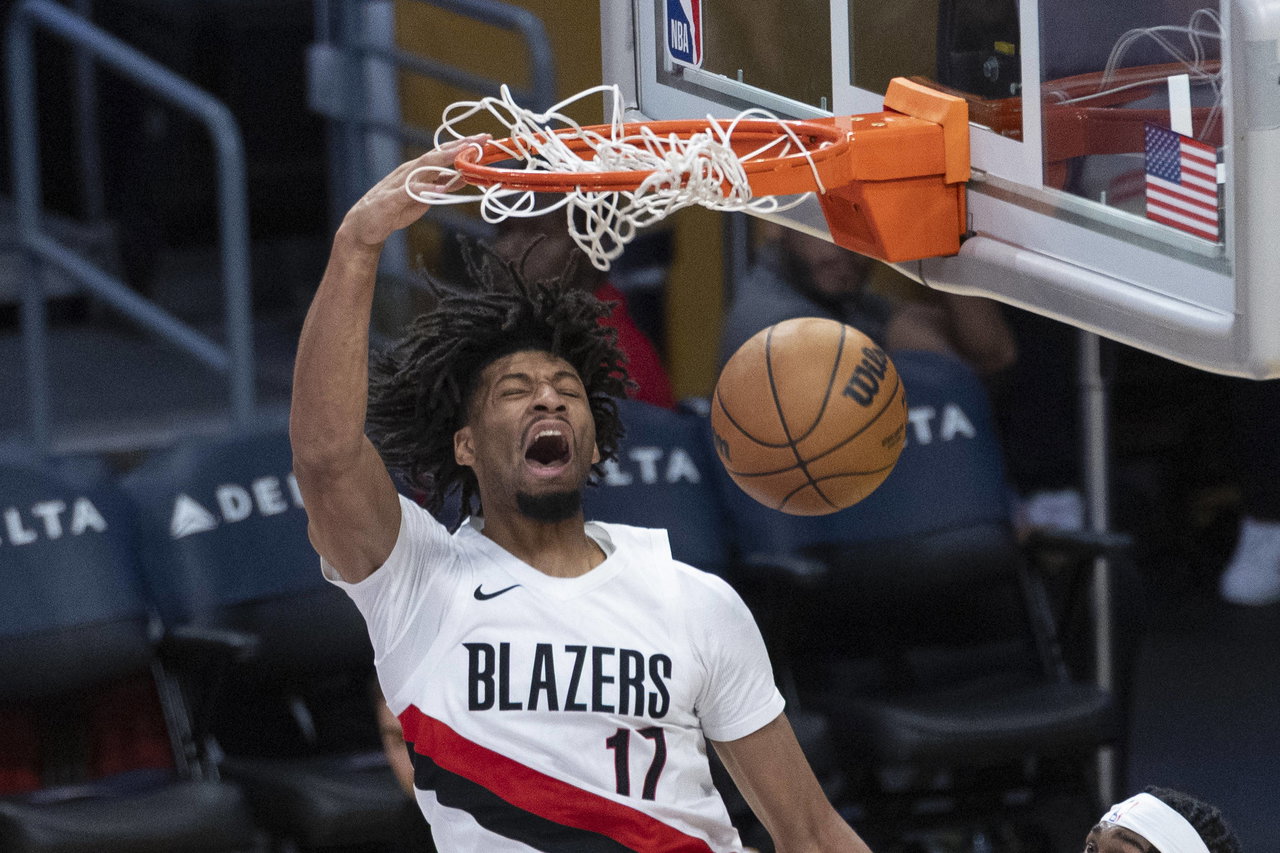
Shaedon Sharpe was supposed to enter the season building on the best stretch of his young career. Instead, a torn meniscus in his right knee has put the next six months on hold.
Watch What’s Trending Now!
Sharpe suffered the injury during an individual offseason workout in Portland, according to ESPN’s Shams Charania, and multiple reports have since corroborated the news. He is expected to undergo surgery this week and miss six months, which would put his return around late February if that timeline holds.
That makes the timing especially tough. Sharpe is coming off a career-high 20.8 points per game and entering the first season of a four-year, $90 million extension, but Portland’s crowded backcourt had already created questions about his role. The Blazers had added Ja Morant and were expecting Damian Lillard back, leaving Sharpe likely to remain an important scorer and creator without necessarily having the starting role he had held before. When Portland gave him the extension, general manager Joe Cronin said, “Shaedon Sharpe is one of the most exciting young players in the NBA. With his ability to score the basketball, play make and be a great teammate, we are ecstatic that Shaedon will be an electric part of the Trail Blazers for years to come.” The Athletic also reported that Sharpe was “expected to be a key rotation piece this coming season” and called him “one of the Blazers’ best shot creators and one of the NBA’s best leapers.”
There was another unusual development after the injury became public. Sharpe’s Instagram account, @shaedonsharpe, became unavailable on Aug. 24, shortly after reports of the injury began circulating. There has been no verified explanation from Sharpe, his representatives or the Trail Blazers, so the reason for the account’s disappearance remains unclear.
The six-month absence is a major interruption because Sharpe had only just begun to show what Portland believed it was paying for. He played 50 games last season, starting 42, and averaged 20.8 points, 4.3 rebounds and 2.6 assists in 29.4 minutes. His 20.8 points were a career high, and he emerged as one of Portland’s better shot creators while providing the athleticism that has always made his ceiling so intriguing.
But even that breakout season was interrupted. A left fibula stress reaction diagnosed in February forced Sharpe to miss a large portion of the schedule after the issue was initially treated as a calf strain. He returned for the final two regular-season games and played in all five playoff games, but only averaged about 13.4 minutes and 7.2 points in the first-round series against San Antonio.
In other words, Sharpe never got to finish the season he had started. He reached a career-high scoring level, then lost a large part of the season to the fibula injury. Now, before he can build on that progress, another lower-body injury has taken him out for another six months.
That matters at 23. Sharpe has now had multiple interruptions during the part of his career when Portland is trying to turn his raw talent into a consistent NBA game. His career has included a major abdominal injury that limited him to 32 games in 2023-24, another shoulder injury before the 2024-25 season and the fibula issue last season. He has played 234 games through his first four seasons, but the interruptions have repeatedly broken up his momentum.
The strange part is that Portland may be better equipped to survive Sharpe’s absence than it would have been a year ago. The Blazers acquired Ja Morant in June, while Damian Lillard is preparing to return after missing last season with an Achilles injury. Jrue Holiday gives the team another veteran option, and Scoot Henderson remains part of the team’s young backcourt.
That depth was already creating a problem for Portland before Sharpe got hurt. Preseason projections had Morant and Lillard as likely starters, with Sharpe expected to remain an important scorer and creator but potentially move into more of a sixth-man or secondary role. He was not being pushed out of the rotation; the role was simply becoming less straightforward.
Now the logjam is gone, but not in the way Portland wanted.
Sharpe’s absence makes the rotation easier to sort out because there are simply fewer players competing for those minutes. Morant, Lillard, Holiday and Henderson can take on more of the backcourt workload, while Deni Avdija and Portland’s other wings can help cover the minutes around them.
But replacing Sharpe’s minutes is not the same as replacing Sharpe. Portland can replace his scoring volume. It cannot easily recreate his combination of vertical athleticism, transition finishing, rim pressure and one-on-one shot creation.
That distinction could become important over the course of the season. Morant can carry more of the creation burden. Lillard can provide shooting and another experienced ball-handler. Holiday can defend and stabilize the second unit. Henderson can continue developing with the ball in his hands.
None of them, however, gives Portland exactly what Sharpe does as an explosive scoring wing. His 20.8 points per game last season came in only 50 games, and his ability to attack the rim and finish above the defense gives the Blazers a different look from their other guards.
That is also why the timing of the injury feels bigger than a normal six-month absence.
Portland did not give Sharpe four years and $90 million simply to become another player in a crowded rotation. The franchise made the commitment because it believed his scoring, playmaking and athletic ability could become a major part of what came next.
When the extension was finalized, Cronin and Chauncey Billups told Sharpe, “The job’s not done. We’ve still got work to do. Let’s get this thing rolling.”
The next step was supposed to be finding out how far Sharpe could take the progress he had made. Instead, Portland will spend the next six months waiting for him to get back on the court.
Sharpe’s biggest challenge now is not simply getting healthy. It is recovering the time he was supposed to spend developing.
Last season showed real progress, but it also showed that there was still plenty left to clean up. His 45.2% shooting from the field was strong, while his 33.7% from three left room for improvement. His defense and consistency were also still areas where Portland needed more from him.
A six-month absence means all of that work pauses again. By the time Sharpe is ready to return, the season could already be entering its final stretch, leaving him with limited time to find his rhythm before the playoffs.
And that is where this injury becomes more complicated than the six months on the calendar.
Portland can survive without Sharpe. The Blazers have enough creators and enough depth to get through the season without asking one player to replace everything he does. But surviving the season is not the same as finding out what Sharpe could have become in it.
When he finally returns, Portland’s backcourt may look different again. Morant, Lillard, Holiday and Henderson will have had months to establish their own roles, while Sharpe will be coming back from another long layoff with the same $90 million commitment attached to him.
The question will not simply be whether Sharpe can get back on the floor. It will be whether he can pick up where his breakout season stopped — and whether Portland can still give him the role it believed he was going to grow into when it made that $90 million bet.