
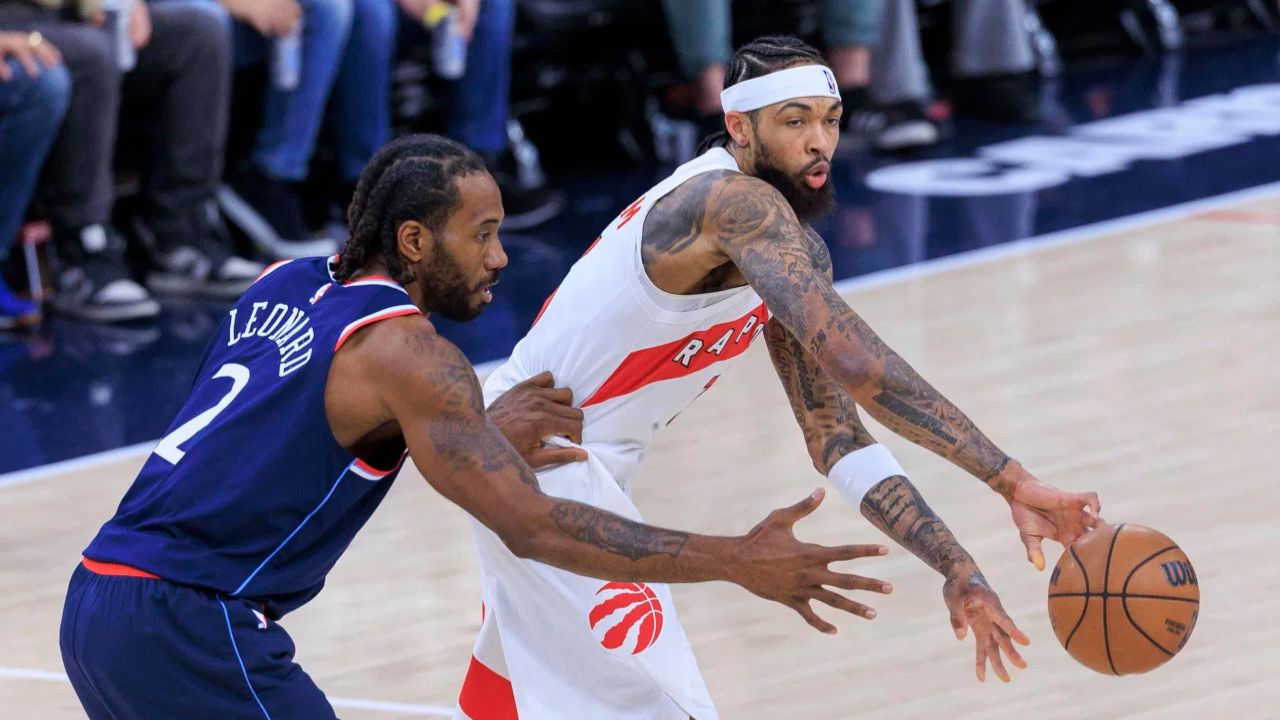
Kawhi Leonard’s $115 million extension has raised questions about whether Toronto took too much risk on a star with a long injury history. But there is another side to the equation that can easily get lost when the focus stays on Leonard’s knees. ESPN’s Brian Windhorst brought Brandon Ingram’s situation into the conversation, pointing to the former Raptors forward’s own health uncertainty.
Watch What’s Trending Now!
His argument forces a closer look at what the Raptors actually gave up. Speaking after Tim MacMahon called Leonard’s extension a “massive risk,” Windhorst offered a different way to evaluate the move.
“I know this isn’t talked about, Brandon Ingram had surgery in the offseason on his foot, on his heel,” Windy said, speaking on the NBA Today panel. “We don’t have an update on how he’s going to be. We’re going to hear at media day where he’s at with his heel.”
He pointed out Ingram’s status for the upcoming season is still unclear.
“Think of the upgrade for Brandon Ingram, who kind of wasn’t able to deliver in the playoffs for them last year.”
The insider’s larger point was that the Raptors cannot judge Kawhi Leonard’s durability in isolation. He has obvious injury concerns, but when healthy, the story is different.
“Kawhi, when he’s been healthy, has delivered in the playoffs. There’s no doubt about it, including for that franchise. So, of course, there’s the injury question, absolutely. But their franchise player next to Barnes that they had last year wasn’t able to be healthy in the playoffs. So to me, look, if this was a four-year deal, that would be a massive risk. This is a two-year extension, and we’ve just seen he’s got value in the trade market. Believe it or not, he’s got value in the trade market,” Windy concluded.
The contrast becomes clearer when looking at how Ingram’s season ended. He appeared in 77 regular-season games and averaged 21.5 ppg.
It gave Toronto a reliable offensive option alongside Scottie Barnes. But his right heel became a major problem late in the season after he dealt with a structural heel spur.
Without a doubt, it was the worst time to get injured.
By the playoffs, the issue had significantly affected his performance. Ingram averaged only 12 points per game while shooting 32.8% from the field across 5 games against the Cavs.
Then, in Game 5, he aggravated the heel after just 11 minutes and left in a walking boot. He missed the final two games of the series.
That injury eventually led to surgery in May, when Ingram underwent a procedure to remove the bone spur. The Raptors then included him in the deal that brought Kawhi Leonard back to the franchise. It left the team with a very different question to answer:
Was Kawhi Leonard’s injury history actually a greater risk than continuing with an uncertain Ingram?
Windhorst didn’t dismiss Kawhi Leonard’s health concerns. Instead, he argued that the contract’s structure changes the calculation. The team didn’t take a massive risk by signing a four-year contract. They committed to only two seasons.
That distinction gives the Raptors a defined window around Scottie Barnes without locking themselves into a long-term commitment to an aging star.
Kawhi Leonard’s previous success in Toronto also provides a clear blueprint for what the organization hopes to recreate. His postseason resume gives the franchise a known championship-level ceiling.
It’s something Ingram couldn’t provide when his health deteriorated against the Cavs. There is another part of Windy’s argument that could matter just as much.
Kawhi Leonard’s contract may be expensive, but the short duration could preserve flexibility if circumstances change. He noted that Leonard “has value in the trade market.”
Meaning, Toronto would not necessarily remain locked into the contract if the partnership eventually stops making sense.