
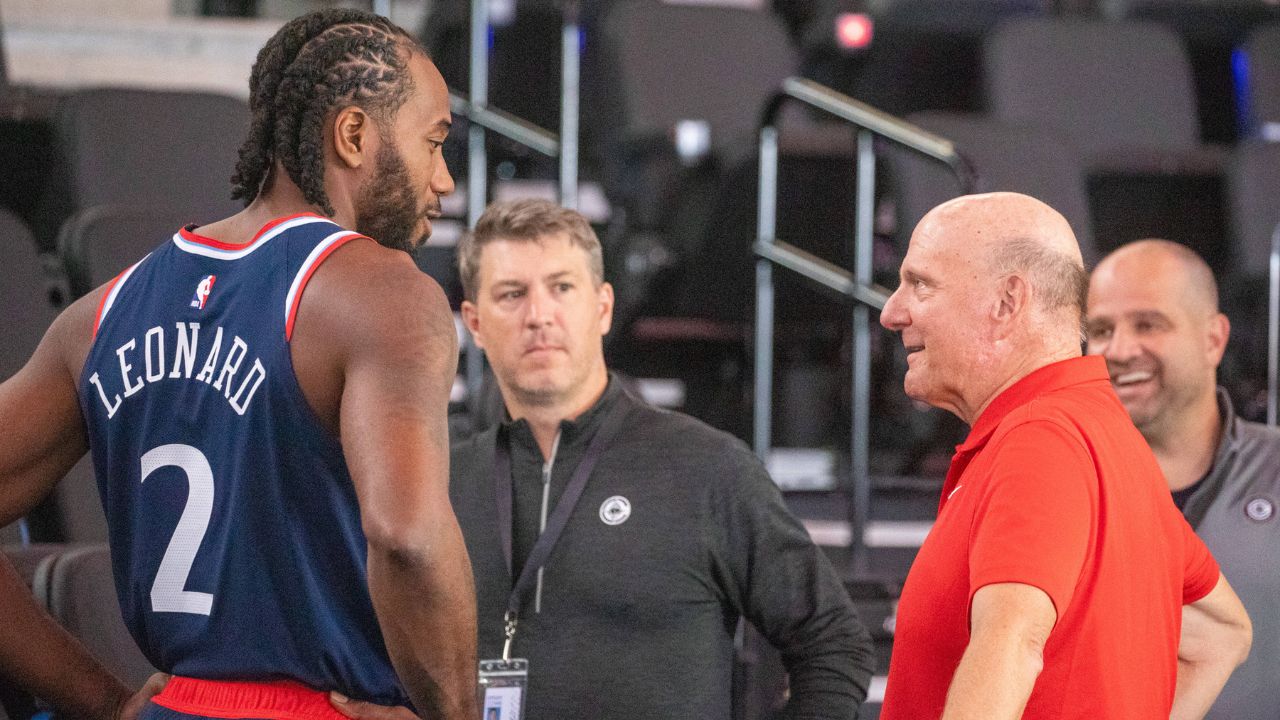
After a yearlong investigation, the Los Angeles Clippers face the largest fine in NBA history. It all started when investigative journalist Pable Torre reported a $28 million endorsement between Kawhi Leonard and Aspiration. It only got worse from there, with other financial engagements. Although the Clippers maintained that they were always the middleman, the Wachtell Lipton report deems that Steve Ballmer’s team did not abide by the circumvention rules.
Watch What’s Trending Now!
The NBA has stripped five future first-round draft picks, fined the Clippers $30 million, and banned owner Steve Ballmer, President of Business Operations Gillian Zucker, and President of Basketball Operations Lawrence Frank in different capacities. Crucially, the report mentions no evidence that would appear to implicate Ballmer directly in the mess, but he still bore the brunt of it.
League insider Brian Windhorst says Commissioner Adam Silver imposed the “maximum allowed fine” for cap circumvention. In response to these allegations, though, the Clippers have vehemently rejected the findings. Ballmer’s legal team has also accused the league of conducting a “biased investigation” to fulfill “a predetermined narrative.”
As Silver emphasized the need to protect competitive integrity and player compensation structures, the Clippers have vowed to vigorously challenge the findings and penalties “through every avenue available to us.” Now, before we fully dive into how the Clippers reacted, let’s first understand what they’ve been accused of.
NBA’s Statement: Key Findings and Summary of Penalties
The NBA’s official ruling details a “pattern of misconduct” in how the Clippers illegally introduced, facilitated, and induced endorsement deals between Kawhi Leonard and four of the team’s corporate vendors: Aspiration Partners, Boingo Wireless, Daktronics, and Lockton Insurance, in exchange for team business, while also covering unspecified personal expenses.
The report says the Clippers paid millions in “consulting” fees to these businesses to allegedly settle the terms after they paid Leonard from the outside.
Additionally, the league noted that Leonard’s then-business manager, Dennis Robertson, aka “Uncle Dennis,” aggressively pressured the Clippers into aiding these transactions. Based on these findings, Commissioner Adam Silver and the league office issued the following finalized penalties:
- Draft Pick Forfeitures: The Clippers forfeit five first-round draft picks, losing one selection in each of the 2029, 2030, 2031, 2032, and 2033 NBA Drafts.
- Financial Fines: The Clippers franchise is fined $30 million, while Kawhi Leonard must personally pay $700,000 to the league for violating the circumvention rules.
- Executive Suspensions: Clippers owner Steve Ballmer is suspended from all league and team activities for one year. President of Business Operations Gillian Zucker is suspended without pay for one year for direct involvement and providing misleading statements. President of Basketball Operations Lawrence Frank is suspended without pay for six months. The Clippers and its employees will also be subject to a five-year league compliance monitoring program.
- Representative Bans & Compliance: Dennis Robertson is banned for five years from conducting business or even engaging with NBA personnel, teams, and affiliates.
In an official statement, Adam Silver said he is “deeply disappointed” by the LA franchise’s “institutional and leadership failures” and that the severity of the penalties only reflects the “seriousness of the violations.”
Now, here’s the other side of the coin.
The Clippers’ Letter to Adam Silver
The Clippers organization refused to accept the verdict, issuing an official media statement immediately pushing back:
Furthermore, a lengthy letter addressed to Commissioner Silver from the Clippers’ legal counsel, David N. Kelley of O’Melveny & Myers LLP, sharply criticized the league’s process.
Kelley also highlighted that this leaves his client Ballmer’s reputation in the dumps and “irreparably damaged” because of multiple civil litigations and investigations that will take years to move away from his name.
Kelley further argued that the NBA retroactively created rules to punish routine corporate introductions:
The remainder of the letter to Silver is summarized in the following points:
- Broken Due Process Commitments: The firm accused Silver of failing to uphold promised standards of due process and basic fairness, improperly shifting the burden onto the franchise rather than requiring concrete proof.
- Resource Strain and Cost: Kelley said Ballmer spent nearly $50 million funding the Wachtell Lipton probe, producing 30,000+ documents, facilitating 30 interviews, and reimbursing six law firms.
- Harm to Third Parties: Corporate sponsors like Boingo, Daktronics, and Lockton were allegedly pressured and threatened during the probe, with their confidential business terms improperly disclosed in the public report.
- Vow of Legal Warfare: Finally, labeling the entire probe an inexcusable “witch hunt,” the firm confirmed that the Clippers will explore all available judicial and legal remedies to challenge the sanctions.
Fallout of the Punishment; Who will handle the Clippers?
The immediate fallout of these sanctions leaves the Clippers’ long-term future in jeopardy. Stripped of five consecutive first-round draft picks from 2029 through 2033, the franchise’s draft capital is almost empty. Because LA already traded significant future capital to build around Leonard, Paul George, and James Harden, losing five more picks deprives them of draft flexibility for nearly a decade.
On the court, the ruling presumably clears the path for the previously agreed-upon trade of Leonard to the Toronto Raptors. While receiving assets like Brandon Ingram, Gradey Dick, and two future picks (unprotected 2031 and 2033) provides short-term retooling alongside Darius Garland and rookie Keaton Wagler, the Clippers face a murky rebuilding road.
However, league insider Bobby Marks revealed the Clippers won’t be able to trade those picks because of the NBA’s Stepien rule, which states that no team may trade a future first-round pick if the result would leave the team without first-round picks in any two consecutive future years.
With key decision-makers Lawrence Frank and Gillian Zucker suspended, Steve Ballmer banned from team facilities for a year, and heavy financial fines imposed, the Clippers haven’t clarified how it’s going to proceed leadership-wise.
According to ESPN, current Clippers general manager Trent Redden, a respected veteran executive, will possibly lead basketball operations. Meanwhile, alternate governor Dennis Wong was also named an Aspiration investor, so it is unclear if the Clippers will have an ownership presence in Ballmer’s absence. This, however, doesn’t mandate that Ballmer sell the team.
When former owner Donald Sterling was banned by Adam Silver in 2014, even he wasn’t required to sell the Clippers. In fact, it was his wife, Shelly, who decided to sell before the NBA’s board of governors could vote to remove him.
The Minnesota Timberwolves were without an owner when Glen Taylor was suspended for a year (Joe Smith case, 2000). Mark Stevens (Golden State Warriors) and Robert Sarver (Phoenix Suns) have also been reprimanded for a year or more.
For now, though, the Clippers are exploring all available avenues to legally challenge the investigation, suggesting this matter doesn’t end with sanctions alone. What was once envisioned as a championship era under Ballmer’s deep-pocketed leadership has descended into franchise instability, and the fallout from this salary cap scandal will be felt for years to come.