
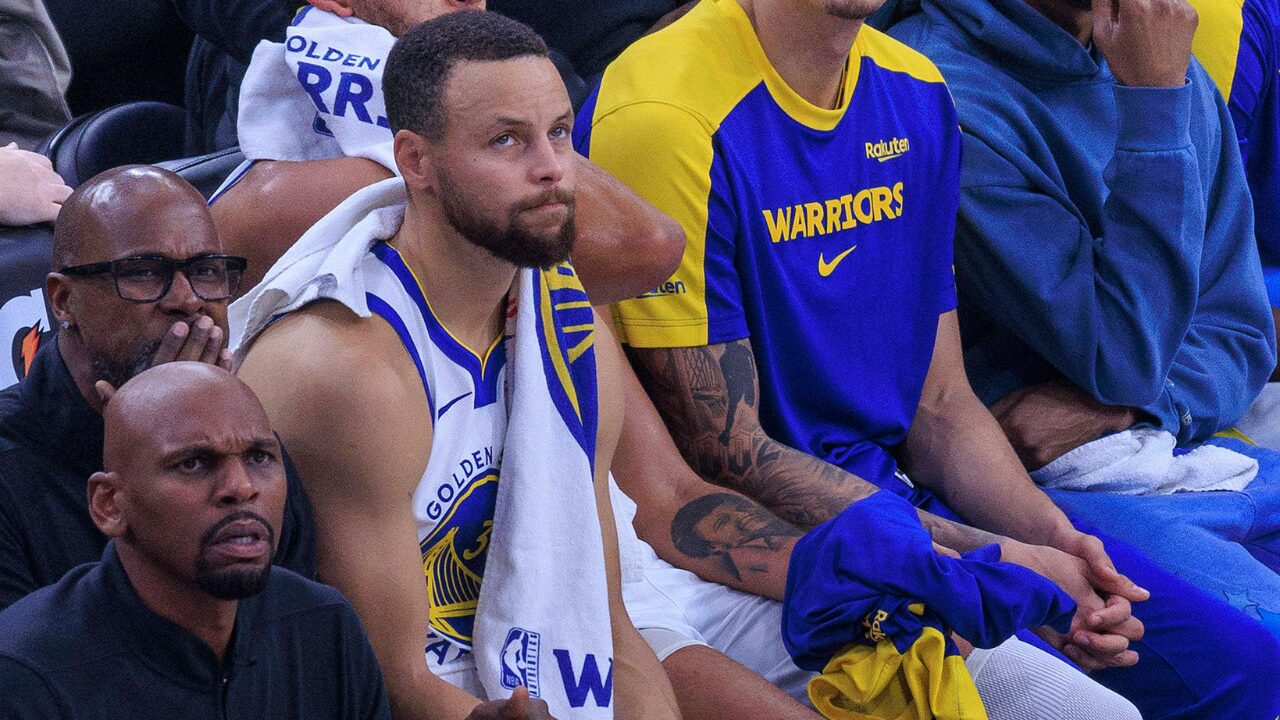
Last season, Stephen Curry expected his right-knee problem to keep him out for about a week. Instead, the injury turned into a 27-game absence, a missed All-Star Game, and one of the most difficult stretches of the Warriors’ season.
Watch What’s Trending Now!
“I thought I was going to be out a week,” Curry said during his recovery. But each time he tried to return to the court, the knee reacted, forcing him to wait longer.
By the time he finally returned on April 5, the issue had become more than a short-term interruption. Curry had played through discomfort before, but this time, his body had made the decision for him. Now, footage from his September China tour has brought that same right knee back into the spotlight—and raised a question Golden State would rather not be facing before training camp.
The 38-year-old appeared to be limping or moving cautiously in clips from the Li-Ning “Wide Open Tour,” prompting concern among Warriors fans. The footage does not confirm a new injury or prove that the movement is connected to his previous condition. But it arrives at an important time, especially after reporting suggested that Curry’s knee may require more ongoing attention than it did earlier in his career.
“There’s at least some lingering concern about the knee,” Warriors insider Monte Poole said.
That concern is not necessarily about whether Curry can play basketball again. He already returned last season and finished the campaign. The bigger question is whether his knee can be managed well enough for him to remain available and effective across an entire season.
And for the Warriors, that question has become harder to ignore.
Curry’s knee problem was more than a brief absence
Curry’s right-knee trouble began around late January 2026. He experienced discomfort and swelling during an individual workout in Minneapolis before the Warriors’ game against the Timberwolves.
He initially tried to play through the issue. But on January 30, against Detroit, he left the game late in the third quarter and did not return. An MRI revealed patellofemoral pain syndrome, commonly known as runner’s knee. The condition was described as inflammation around the kneecap rather than a major structural injury, and a second MRI also reportedly came back clean.
That did not make the recovery simple.
Curry missed 27 consecutive games, roughly two months of the season, before returning in early April. He also missed the 2026 All-Star Game because of the knee. During that 27-game stretch, Golden State went 9–18—a record that showed how difficult it was for the team to replace its offensive centerpiece.
The absence also changed the way Curry approached his return. He later explained that the recovery was not progressing as quickly as expected.
“I thought I was going to be out a week… every time I got on the court… there was always a reaction.”
That sentence helps explain why the current footage has attracted so much attention. The concern is not based on a single missed game or a routine night of rest. It is connected to an injury that already kept Curry away from the court for an extended period and proved difficult to settle.
Still, the fact that the condition was persistent does not mean every cautious step is evidence of a setback. Patellofemoral pain syndrome can be managed, and an athlete’s movement in a short video cannot establish the severity—or even the cause—of what viewers are seeing.
The more important information comes from what was reported about Curry’s plans for the season.
Monte Poole’s report adds a bigger question
In early September, Monte Poole provided context that makes the China footage more significant. His reporting suggested that the knee is no longer something Curry can simply ignore.
“From what I’ve been told, it can be managed, but it has to be managed and that’s a new thing for Steph. People always say he is the most conditioned guy in the league, and now he has to manage a knee.”
That is a notable change for a player whose conditioning and ability to stay ready have long been part of his identity. The issue is not that Curry suddenly cannot compete. It is that managing his body may now be a necessary part of competing at the level Golden State needs.
Poole also explained that Curry and his trainers have been working on ways to support the situation.
“From what I understand, he and his trainers have devised ways to kind of work around that and sort of support that whole possibility of the knee not being as great as he wants it to be.”
The wording matters. This is reporting about an ongoing management concern, not confirmation that Curry has suffered another injury. There has been no official announcement from Curry, the Warriors, or Li-Ning confirming a new setback connected to the China footage.
There is also a reason not to assume the worst. Poole reported that Curry remains confident in his ability to play a substantial number of games.
“Steph seems pretty confident that he’ll be able to go out there and put out 70-plus games.”
That creates the central tension heading into the season. Curry believes he can be available for a significant portion of the schedule, while the reporting suggests that doing so may require more careful management than before.
The China videos do not resolve that tension. They simply bring it back into public view.
The China footage is concerning—but it is not a diagnosis
The first clip circulated from Curry’s Beijing tour showed him arriving for a morning workout. His gait appeared cautious, and many viewers interpreted it as a limp or as him favoring a leg. He was also seen wearing a knee sleeve.
That was enough to send fans into discussion, particularly with training camp approaching on September 29. But the context matters: the clip was short, filmed around a promotional event, and did not establish whether the movement was caused by his right knee.
Other footage from the trip offered a less clear-cut picture. Curry was seen participating in activities, interacting with fans, and taking part in basketball-related events. A separate clip showed him outside a Beijing venue after a workout, where he attempted to sign for fans before security intervened. Some later footage appeared to show him moving without the same obvious favoring of a leg.
That does not disprove the concern raised by the earlier clip. It does, however, show why the footage should be treated carefully. A few seconds of movement cannot tell us whether Curry is experiencing a flare-up, dealing with stiffness, recovering from travel, or simply moving cautiously in that particular moment.
The second widely shared video made the conversation even more complicated. Curry was initially sitting courtside while children showed off their basketball skills. Once the ball reached him, he was drawn into the action and appeared to move cautiously as he stepped onto the court. Then he knocked down a three-pointer.
For fans, the shot was familiar. The movement getting him there was what stood out.
One fan reacted with concern:
“Even if it’s for an event, isn’t it totally messed up to forcibly drag Steph’s body around like that? There’s less than a month until preseason, you know? Seriously, it’s unacceptable… And yet, it’s frustrating that star players who wouldn’t come to Japan otherwise are showing up in droves just for business.”
Another wrote:
“Da*n Steph looks hurt. That runner’s knee at 38 is no joke😭.”
And another fan questioned whether Curry was trying to hide something:
“Feels like curry is trying to either mask a limp or he’s just doing a hoopers walk idk looks weird.”
The reactions reflect how quickly a visual moment can become a larger conversation when a star already has a known injury history. But they remain reactions—not medical assessments.
One fan went further, writing:
“If this is the same “runner’s knee”, and if it lingers into the coming season, this is the thing that’s going to end up cutting Steph Curry’s career short. Pray it’s something else because if it isn’t and this is what it looks like after the offseason, it’s a wrap.”
That is a fear, not a conclusion supported by the footage. There is no credible confirmation that Curry’s career is approaching an end, or that the China clips show a worsening condition.
The real concern is more practical: what does it take to keep Curry healthy enough to play the season the Warriors need him to play?
Golden State has less room for error this time
Curry’s health would be a major storyline for Golden State under almost any circumstances. He remains the team’s primary offensive engine, responsible not only for scoring but also for the spacing, movement, and defensive attention that shape the entire offense.
When he is available, the Warriors can build around his shooting and creation. When he is not, the team loses more than a scorer. It loses the player who forces defenses to change how they guard almost every possession.
That was clear during last season’s 27-game absence. Golden State went 9–18 during that stretch, and the team struggled to replace the offensive pressure Curry creates simply by being on the floor.
The roster entering 2026–27 also offers little reason to dismiss the importance of his availability. Jimmy Butler is recovering from a torn right ACL suffered against Miami on January 19, with an optimistic return target of January or February 2027. Moses Moody is recovering from a torn left patellar tendon suffered against Dallas in March and is expected to miss the early part of the season after a lengthy rehabilitation.
Those are not minor absences. Butler provides secondary creation, defense, and two-way wing play. Moody had been developing into an important rotation piece, offering shooting, defense, and improved scoring before his injury.
Without them, Golden State has less depth and fewer proven options to absorb the impact of missed games or reduced production from Curry. The team can still compete, but its margin for error is smaller.
That makes the knee-management question more important than the footage itself. If Curry needs additional recovery time, a carefully managed workload, or simply more attention to how he prepares for games, the Warriors will need to account for that while building their rotation.
The issue is not whether Curry can still hit a three-pointer while appearing uncomfortable. He clearly can. The issue is whether he can do that consistently enough, over enough games, to give Golden State the season it expects.
The question before training camp
Curry’s China tour has created a fresh wave of concern, but the underlying issue was already present before the videos appeared. Last season’s 27-game absence showed how difficult the knee problem could be, while Poole’s reporting suggested that ongoing management may now be part of Curry’s routine.
At the same time, Curry reportedly believes he can play 70-plus games. That is an encouraging sign, but it is not a guarantee. Neither is a short clip showing him moving cautiously—or another showing him making a three-pointer.
For now, there is no official confirmation of a new injury, setback, or deterioration tied to the China footage. The clips are worth watching because of Curry’s history, not because they prove something has gone wrong.
But they do bring the Warriors’ biggest question into focus again: Can Golden State keep Stephen Curry healthy, effective, and available while managing a knee that may no longer be something he can simply play through without adjustment?
That answer will matter far more than any single viral video.