
If you were waiting for Patrick Dumont to say the words “Luka Doncic,” keep waiting. The Mavericks’ governor finally addressed the Nico Harrison firing with an open letter to fans… and then sidestepped the very thing fans believe started the avalanche. Cue the collective eye-roll across Mavs Nation.
Watch What’s Trending Now!
Here’s the clean, sharp breakdown of what Dumont said, what he didn’t, and why the backlash now has a brand-new battery.
In his note to “Mavs Family,” Dumont thanked fans, acknowledged the ugly start (3–8), and framed Harrison’s ouster as a necessary step to restore a “winning culture.” He promised transparency, investment, and patience. He even tossed in the rally cry: Go Mavs!
Top Stories





What never appears? Luka Doncic. Not a word about the February blockbuster that shipped a franchise icon to the Lakers for Anthony Davis (plus spare parts), touched off months of “Fire Nico!” chants, and cratered organizational morale. If this was the mea culpa moment, it whiffed on the most obvious sentence: We messed up the Luka trade.
I understand Dumont approved the trade, but im encouraged by these words and the decision today pic.twitter.com/m38SlY02s6
— Isaac Harris (@IsaacLHarris) November 11, 2025
Because the timeline isn’t subtle. Dallas traded Luka; the season imploded; the fanbase revolted; the team fired the GM. Everyone sees that dotted line become a straight, neon arrow. When your corrective action is clearly tied to the Luka trade backlash, refusing to even name the catalyst reads as corporate choreography, not accountability.
Worse, the night before the firing, a courtside fan in a Lakers Luka jersey shared that Dumont privately admitted the mistake. Private contrition + public silence? That gap is exactly what’s fueling the “Luka-disrespect” label.
Dallas sent Doncic to Los Angeles; AD arrived banged up; Kyrie Irving later tore his ACL; the offense turned into a paint-drying tutorial; the 2025 playoffs came and went without the Mavs; and this fall opened with a 3–8 thud. Meanwhile, in L.A., Luka soared and inked a latest contract extension, a 3-year, $165 million maximum contract.
Dumont and former GM Nico Harrison were hesitant to offer Luka Doncic a full supermax contract, citing concerns about the financial risk it posed to the franchise. The deal, valued at roughly $345 million over five years- about $116 million more than competing offers- was seen as a major long-term gamble.
Inside the organization, frustration had been building over Luka’s lack of discipline with his diet and conditioning, which many believed contributed to his recurring injuries. These concerns, combined with the financial implications, led the Mavericks to pull back from fully committing to the supermax.
Dumont later described the decision to trade Doncic as a “risk-allocation decision,” rejecting the idea that ownership alone dictated the move. Instead, he characterized it as a collective, carefully considered choice made in what the organization believed was its best long-term interest.
Fans didn’t just dislike the return; they despised the vision. And they let the team hear it inside the arena, outside the arena, and pretty much anywhere a mic existed.
The Optics Gap: “Step 1 Is Done… But Where’s Step 2?”
Dumont’s letter completes Step 1 (firing Harrison) but dodges Step 2: owning the Luka decision in public. Even a single line, “We misjudged the trade and learned from it” would’ve poured a little water on the wildfires. Instead, fans got a vibes-forward note about results and culture.
Call it what it is: a nothing-burger to the very people begging for one explicit sentence.
The basketball ops handoff goes to Michael Finley and Matt Riccardi on an interim basis. That’s a solid stabilizer. Finley brings credibility, history, and calm —the kind of voice that resonates in the locker room and in the lower bowl. Riccardi is the communicator Harrison never was, clear, candid, and already the public-facing explainer of Dallas’ plan.
If the Mavericks want fans to feel heard again, letting this duo run clean, public processes is Step 1A. Teams often tiptoe around other teams’ stars to avoid tampering optics, but there’s no law against acknowledging the franchise’s own trade history. This omission appears to be a deliberate choice, rather than a constraint, and fans are grading it accordingly.
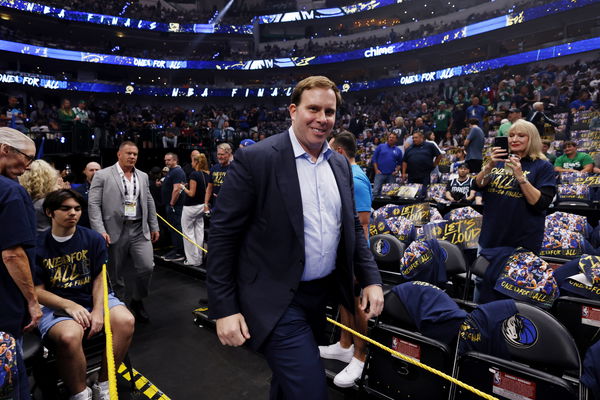
USA Today via Reuters
Jun 14, 2024; Dallas, Texas, USA; Dallas Mavericks owner Patrick Dumont walks onto the court before game four of the 2024 NBA Finals against the Boston Celtics at American Airlines Center. Mandatory Credit: Peter Casey-USA TODAY Sports
Dumont framed the decision around the team’s 3–8 start. Fans, however, see something different: an off-court choice that shattered trust. This goes beyond rotations and shot charts. It’s about acknowledging the misjudgment that replaced a generational cornerstone with an injury risk and a weaker foundation.
If you want support for the rebuild, you can’t act like the decline was due to a random cold streak. First, retire the “Kyrie/AD healthy fairytale.” The new GM can’t sell hope as a health plan.
Second, choose a clear path around Anthony Davis —whether as a pillar or a premium trade asset. Hesitation helps no one. Third, build a functional foundation for your current and future core (yes, that includes giving your young star a spacing-first environment and a veteran guard who can lead without hogging touches).
Fourth, be openly transparent. Hold press conferences with real answers. Explain your cap strategy in plain language. Offer fewer mystery boxes and clearer roadmaps.
And above all: say the quiet part out loud at least once. It’s not weakness; it’s a reset.
On the other hand, Doncic’s public response has been a masterclass in emotional restraint —a Slovenian stoicism that contrasts sharply with the Mavericks’ front-office spin. He never requested a trade, never badmouthed Dallas, and repeatedly emphasized his unbreakable bond with the city and its supporters.
Yet, beneath the high-road platitudes lies a palpable ache: the betrayal of loyalty from an organization he viewed as family. “I thought I’d spend my career here and I wanted so badly to bring you a championship.” His emotional open letter to Dallas fans, posted hours after the trade. He thanked the city for adopting him since his 2018 draft-night arrival, calling it “home” and vowing to cherish the memories.
Patrick Dumont removed Nico Harrison. Good. But the letter that followed ducked the noun everyone had been waiting for: Luka. If the organization wants to truly turn the page, it needs one public sentence of accountability, a GM who sells a real plan (not a rehab brochure), and an interim period that treats transparency as a daily habit, not a headline.
Dallas can fix this. But you can’t rebuild trust with euphemisms. Say the thing. Then do the work.
Written by

Edited by

Tanay Sahai