
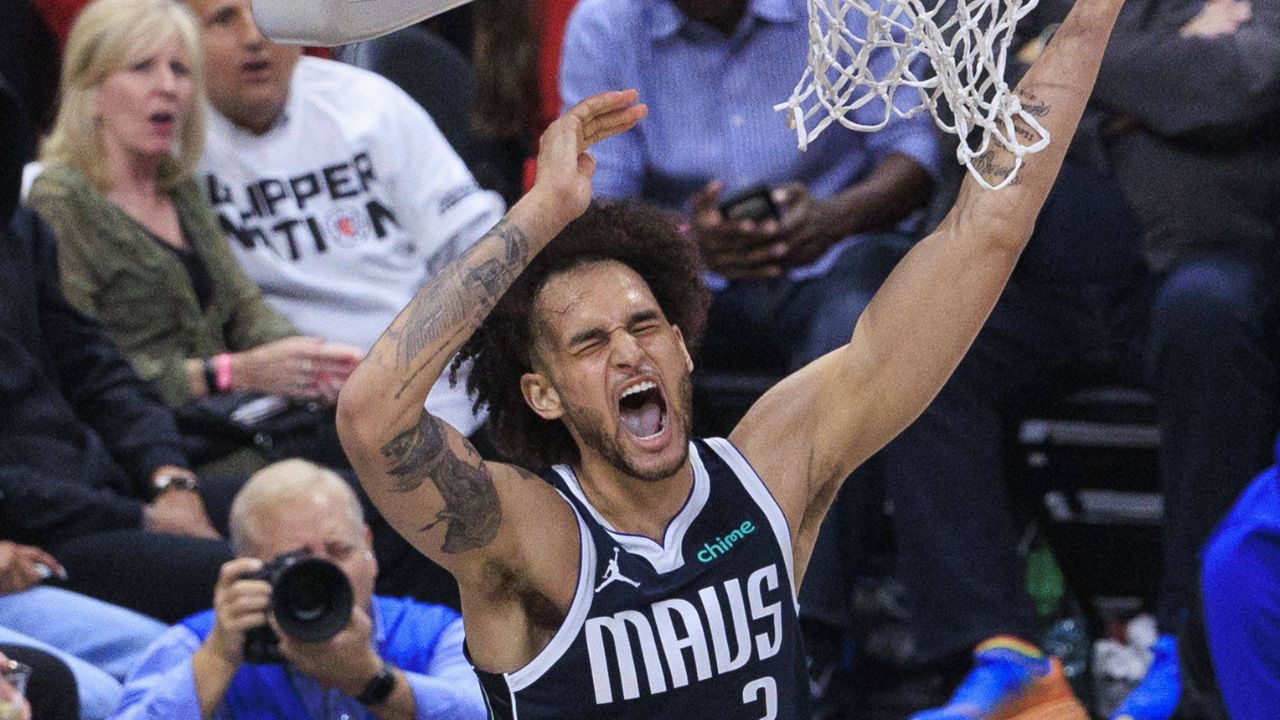
Nico Harrison once saw Dereck Lively II as a cornerstone of the Mavericks’ future. He traded down in the 2023 NBA Draft to get him, and Lively quickly proved his value during the Mavs’ run to the 2024 NBA Finals. Two years later, though, recurring right ankle and foot problems, along with turmoil within the team’s health and performance department, have complicated the 22-year-old’s time in Dallas.
Watch What’s Trending Now!
When Nico Harrison hired Keith Belton, the Mavericks brought in a strength coach who did not hold either of the NSCA certifications required under Article XXII of the NBA’s collective bargaining agreement. The NBA was aware of the issue and temporarily accepted Belton’s College Strength and Conditioning Coaches Association credentials, with the expectation that he would obtain the required NSCA certification after the season, as ESPN reported.
That situation drew more attention after Dereck Lively II suffered an ankle injury. He was initially listed with a right ankle sprain and later went through an intense return-to-play workout under Belton’s supervision. But Johann Bilsborough, Dallas’ director of player health and performance, remained concerned and pushed for a CT scan. The additional testing uncovered a stress fracture in Lively’s right ankle, keeping him out for roughly 2½ months.
The episode has now also prompted calls for legal action online, including a social-media post from Showtime Luka urging Lively to “sue” Harrison and Belton. “Dereck Lively should sue Nico Harrison and Keith Belton for playing with his potential earnings,” the post read.
Whether Lively wishes to sue remains unknown. But if he does, Lively would hardly be the first NBA player to take his team’s medical care to court. In the late 1970s, Bill Walton sued the Portland Trail Blazers, seeking $632,000 for lost wages and medical expenses and $5 million in general damages, claiming that an injury to his left foot was negligently treated in March and April of 1978. Walton’s case was ultimately settled out of court.
Also, in 2021, former Seton Hall star Myles Powell sued the university and members of its athletic and medical staff, alleging that his knee injury had initially been treated as an ankle injury. The case eventually went against Powell at summary judgment.
As for Harrison, any potential claim against him would raise a separate question from a medical-malpractice claim against a health professional, because Harrison was a basketball executive rather than the person who diagnosed or treated Lively.
That said, the diagnosis also sparked a heated confrontation between Belton and Bilsborough. ESPN reported that the argument began in the trainer’s room and continued into the weight room. The incident added to questions about the Mavs’ medical and performance staff, although there is no reporting that shows Belton’s workout caused Lively’s stress fracture.
The 22-year-old’s injury problems did not end there. He underwent right-foot surgery in July 2025 and then a second surgery on Dec. 21, which ended his 2025-26 season. His recovery then remained slow, with subsequent updates offering little clarity on when he would return to basketball activity. And the prolonged absence was not what Dallas expected when Lively underwent the first surgery, as he was initially expected to be healthy for training camp in September.
But by late June this year, Lively had still not progressed to running, according to The Athletic’s Christian Clark. Then, earlier this week, ESPN reported that Lively still had not been cleared for Mavs training camp, which opened Saturday. With more than nine months now gone since his surgery, the update raised fresh questions about his return. However, Ujiri said Friday that the center had progressed from shooting to running on the court and was where Dallas had hoped he would be entering camp.
Still, those setbacks matter because Lively has been an important part of the Mavs when healthy. The No. 12 pick in the 2023 NBA Draft quickly made an impact as a rookie and helped Dallas reach the 2024 NBA Finals. Yet he has appeared in only 98 of a possible 246 regular-season games since entering the league. Lively played 55 games as a rookie, 36 in his second season, and just seven last season.
Neither Belton nor Bilsborough remains in Dallas. The Mavericks fired Belton in May 2025, ending his run as the team’s athletic performance director. Bilsborough stayed through the 2025-26 season before Dallas parted ways with him in April 2026 after two seasons. The departures continued a period of repeated turnover in Dallas’ health and performance department, which has undergone multiple major changes in recent years.
The overhaul is especially notable because Dallas’ health operation once had an award-winning figure at its center. Casey Smith, who spent two decades with the Mavericks, was fired in 2023 and later joined the Knicks. In his first season in New York, the Knicks’ training staff won the NBA Trainers Association’s Training Staff of the Year award.
“One of the things I think we have to get better here is how we figure out medically what we do,” Masai Ujiri said this during his introductory press conference in May. Four months later, Dallas made another major change to its health and performance staff.
On Sept. 24, Dallas named Nico Berg its executive director of health and performance. Berg has NBA ties dating to the Minnesota Timberwolves, where he taught his “Hard Core Strength” program and consulted on core strengthening, athletic performance, and injury prevention from 2010 to 2014. His connection to Ujiri is indirect but runs through Toronto and Alex McKechnie.
Berg trained with Alex McKechnie, the longtime Lakers and Raptors performance specialist, who spent 13 years with the Lakers and then signed with the Raptors in 2011. It was during Ujiri’s tenure with Toronto that McKechnie was promoted to vice president of player health and performance in 2019.
“We had to find the right guy, and we had to go to the right places, and Nico Berg is the right guy,” Ujiri said in a recent press conference.
That said, the timing is particularly significant because Lively is entering the final season of his rookie contract, making the next stage of his recovery important not only for his role in Dallas but for his position entering his next contract.
There is, however, one reason for Lively to remain hopeful. The Mavericks have long compared Lively to Tyson Chandler, another athletic 7-footer whose early career was interrupted by injuries before he eventually became an NBA champion and Defensive Player of the Year. Dallas itself invoked Chandler’s career path when Lively underwent his second foot surgery last December.