
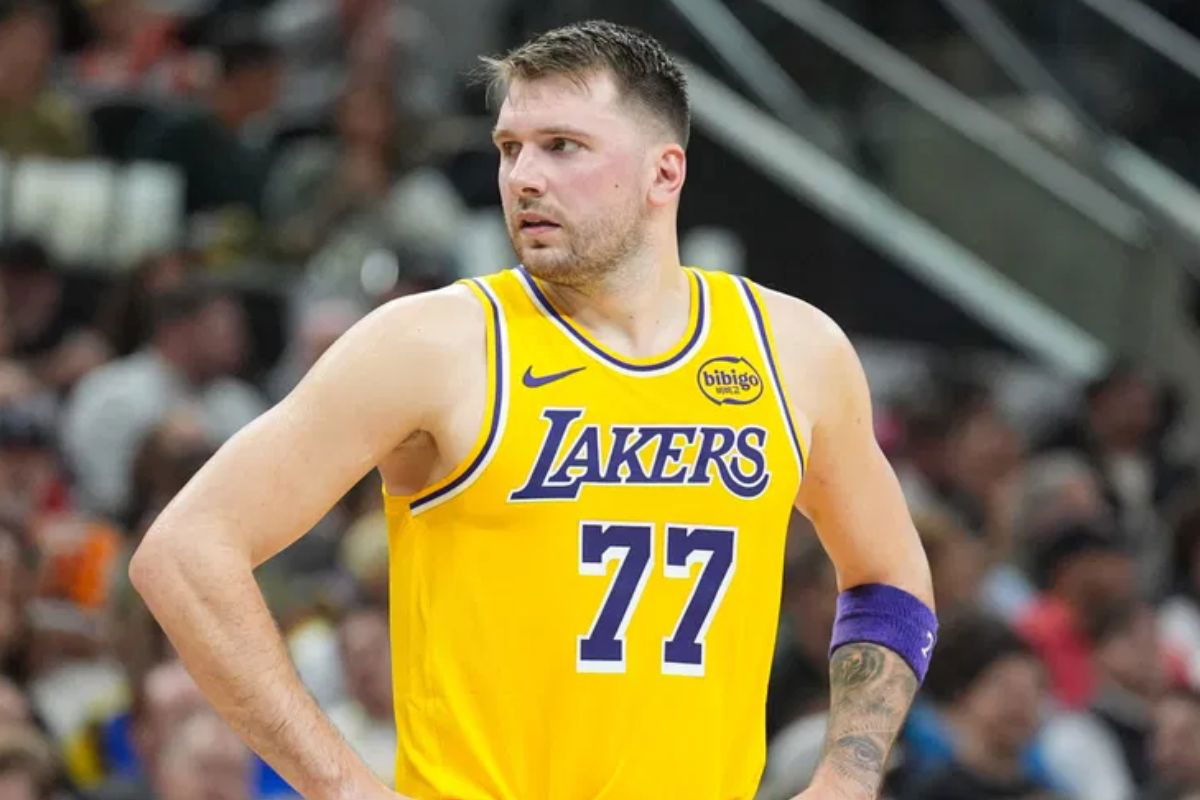
Luka Doncic averaged 33.5 points per game in 64 games last season – the highest in the entire NBA, clinching his second career scoring title after a hamstring injury cut short his season. It was one of the most dominant individual scoring seasons in modern basketball. So when a fan asked him to settle the debate between leagues, the answer that came back was a bit surprising.
Watch What’s Trending Now!
Speaking with fan account ls_hoops, Doncic was asked how much harder it is to score in the NBA or the EuroLeague. “EuroLeague,” he said, “because of the rules.” He didn’t share further, but the comparison isn’t new, especially with the long-standing reality of European basketball – zone principles, more physical handchecking, a narrower three-point arc, and far less spacing than the switch-heavy, perimeter-oriented schemes that dominate the modern NBA.
View this post on Instagram
Coming from a player who just led the world’s “best” league in scoring, the answer carried as much weight just because of who it came from.
Luka Doncic finished the season as scoring champion, beating out Shai Gilgeous-Alexander’s 31.1 points per game and Anthony Edwards’ 28.8. It made him the first Laker to win a scoring title since Kobe Bryant in 2006-07, and just the fifth player in franchise history to do it. He’s now one of three point guards in NBA history with multiple scoring titles, joining Stephen Curry and Russell Westbrook.
Luka’s Euroleague status in the past gave his answer real authority – he won the EuroLeague title with Real Madrid in 2018, winning both EuroLeague MVP and Final Four MVP in the same tournament, and was named ACB Most Valuable Player that same year.
He debuted in EuroLeague at 16, becoming the 21st player ever to do so before turning 17, and was twice named MVP of the Round before he’d even left his teenage years. He has lived in both basketball worlds at the highest level, which is exactly why his comment, “because of the rules,” looks less like a lose comment and more like a verdict from someone who has scored at an elite level in both systems.
Doncic will not be representing Slovenia this summer, confirming on Instagram that an ongoing custody situation involving his two daughters is the reason. Slovenia’s 17-player preliminary roster for the upcoming FIBA World Cup Qualifiers was announced without either him or teammate Jaxson Hayes on it.
Why the Rules Make a Real Difference
Doncic’s “because of the rules” answer pointed to a set of structural differences that change how scoring works between the two leagues. The most cited is the lane and the post game: FIBA rules use a trapezoid-shaped key in some older formats and, more relevantly today, allow defenses to play more physical, body-to-body post and perimeter defense than NBA officiating typically tolerates.
Hand-checking, bumping cutters, and contesting at the point of the catch are all permitted to a greater degree in EuroLeague, which means a player has to fight through more contact just to get into a scoring position, let alone finish.
Floor spacing is another major factor. The NBA’s three-point line sits at 23 feet 9 inches at the top of the arc, while the FIBA/EuroLeague line is shorter, at roughly 22 feet 1.75 inches. A shorter arc, combined with generally more compact spacing schemes, leaves attacking players with less room to operate one-on-one. Where NBA stars routinely create space through ball-handling and spacing built around shooters stationed beyond the arc, EuroLeague defenses are designed specifically to take that space away.
The result is a league where Doncic, even at his current level of NBA dominance, faces tighter spacing, more physical resistance, and less officiating protection than he does running pick-and-rolls in the NBA, the gap his answer pointed to.