
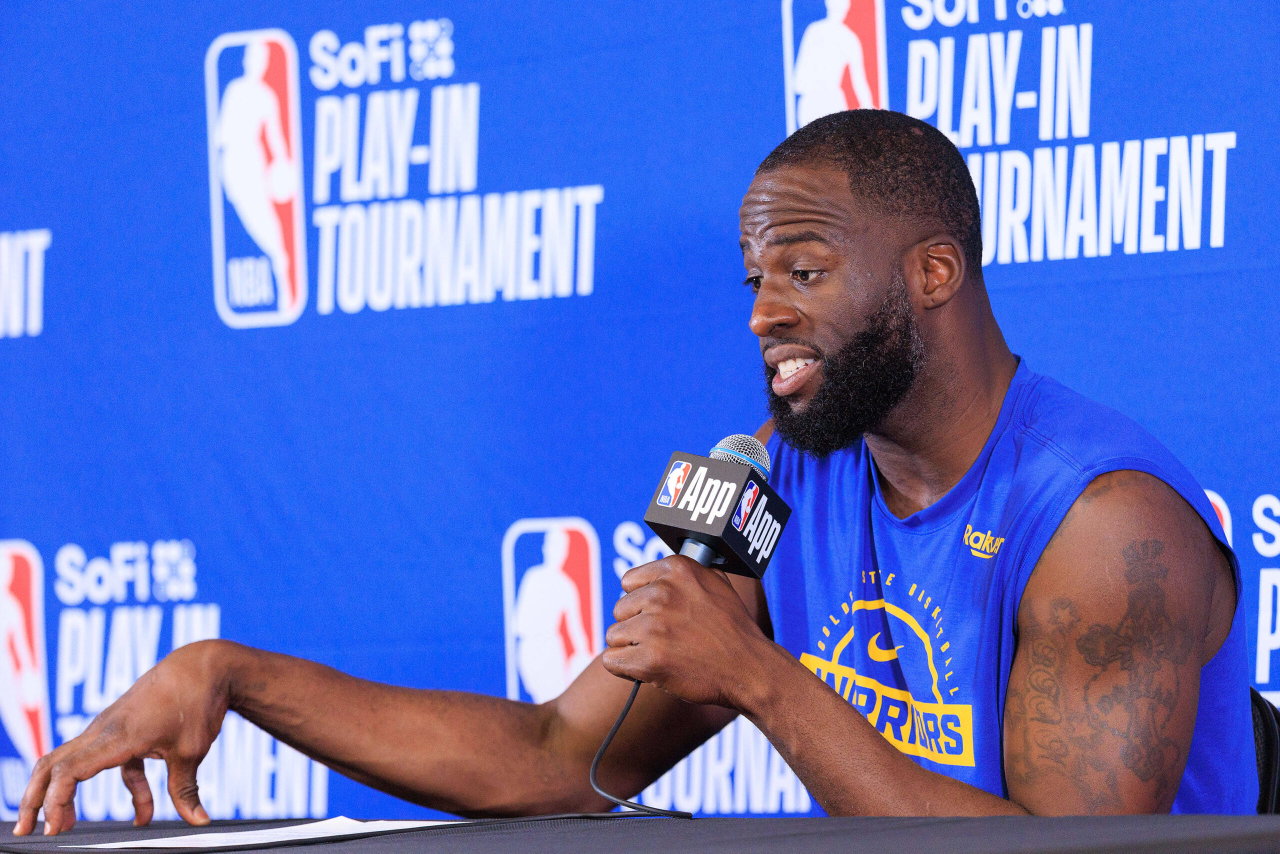
Draymond Green says his work through therapy should not be judged by every reaction he has on the basketball court. The Golden State Warriors forward recently faced criticism after his ejection against the Phoenix Suns, with Stephen A. Smith questioning his behavior given what Green has said about his therapy.
Watch What’s Trending Now!
Green addressed the criticism on the November 5 episode of The Draymond Green Show, telling Smith not to tie his on-court reactions to the progress he has made through therapy.
‘I just want to let Stephen A know, I thank you for speaking on Open Season. Because I’m going to tell you, Stephen A, so the next time you want to go speak on it, I’m going to get into something on the basketball court again. At some point throughout the season, that is not an admission of, ‘Oh, the therapy didn’t work. It’s always ongoing work, by the way, Stephen A,'” Green asserted. “Don’t do that. Maybe I go a little too far sometimes, but don’t intertwine the two.”
He said occasional emotional reactions during games should not be read as proof that the process has failed. He acknowledged that he can sometimes go too far, but he said his therapy is separate from how he responds to situations on the court.
“I play a sport that get a little dicey sometimes, and I respond to things sometimes on the court, maybe differently than you would have or could have,” Green said.
The comments came after Green’s ejection during Golden State’s 116-113 win over Phoenix. The incident began with a hard foul on Suns center Khaman Maluach before Dillon Brooks confronted Green, leading to a heated exchange and Green’s ejection. The sequence renewed discussion about the veteran forward’s on-court behavior, particularly given his previous disciplinary history.
On the same episode, Green responded to former NBA center Kendrick Perkins, who had questioned his contribution to the Warriors during an appearance on the Road Trippin’ podcast. Perkins argued that talk about Green was increasingly focused on his confrontations rather than his basketball, and he asked whether Green was delivering enough on the court.
Green defended his value despite the physical decline that comes with age.
“The difference between myself and big dummies like you is I can think about to be 37 years old and cannot jump as high as I used to jump or body don’t move the same as it used to move, all those things, but I got a brain,” he said.
Green also noted that Perkins had praised his defensive performance against Kawhi Leonard only five or six games earlier.
Perkins’ criticism also comes amid a modest offensive start for Green. Through six appearances, he was averaging 3.2 points, 5.0 rebounds and 6.3 assists. Though his scoring is low, his role with Golden State includes defensive organization and playmaking, which points do not capture.
Green accepts that he sometimes goes too far on the court, but he made clear that he does not want those moments to define his progress in therapy, which he called “always ongoing work.”