
USA Today via Reuters
Image Credits: USA Today Network Via Imagn Images
USA Today via Reuters
Image Credits: USA Today Network Via Imagn Images
Trust and selective honesty are two currencies that NBA locker rooms survive on. Lose one, and the season does not collapse in April; it shatters in February. That is precisely the pressure that now lingers over the Houston Rockets following the so-called Kevin Durant burner debacle that unfolded during the All-Star weekend.
Watch What’s Trending Now!
The story itself isn’t new. The reaction is. When Draymond Green is discussing a locker room issue, the league listens. Not politely. Not academically. Players will listen as the colleagues do when the HR sends a calendar invite without a subject line.
On the Feb. 19 episode of The Draymond Green Show, he didn’t accuse Durant directly. He did something worse: he explained the consequences. “I personally would address it publicly if it’s a public thing… you leave it up for people to decide what they want to decide.”
The one line redefines the whole situation. This no longer concerns tweets. It is concerning power within a competitor. And Houston is no slouch.
Houston is a definite competitor, with a 33-20 record and a balance-based profile, as they have the top- 6 offense, top-5 defense, and a net rating of +5.06. In the past, teams with such a shape do not make it to the playoffs undetected. They push deep into May.
The crime runs through the late-game scoring by Durant when Sengun is acting as the play-making center, with Durant scoring 25.8 points a night and Sengun nearly producing triple-threats of 20.7 points, 9.4 rebounds, and 6.3 assists. At the paper level, this is the most balanced list Durant has had since Golden State.
Yet Houston is 13-15 in clutch games and 1-5 in overtime. That is not a skill issue. That is a communication issue. Which brings us back to Green’s point. “When stuff happen in the public eye, it’s hard to just address it behind closed doors… everybody still have their opinion.”
Green isn’t speculating about feelings. He’s describing how trust erodes in real time. Players don’t debate if the account exists. They debate if the words feel true.
Draymond stressed trust and honesty as key to teams surviving mid-season (not just crumbling in playoffs), and implied the situation feels dangerous for Houston’s chemistry right now. He ended with a classic line like “maybe one day we’ll know the truth… maybe we already know the truth,” subtly shading without flat-out accusing.
What was allegedly said by Kevin Durant, and why it’s explosive?
The alleged @GetHigher77 posts didn’t just criticize performance. They questioned competence and respect hierarchy:
- Sengun: franchise player “can’t shoot or defend”
- Jabari Smith Jr.: unreliable
- Rockets teammates: “crayon eaters”
- Steve Kerr: never drew plays
The alleged KD files highlights 📲💀
🔸On Jabari Smith Jr.: “He’s lowkey ret*rded”
🔸”I swear I miss Ben Simmons. Least that Ni**a would give me the ball”
🔸On “Booker and Frank Vogel: Two dictators / Stalin and Hitler / Mussolini and Kim Jong Un”
🔸On James Harden: “I miss… pic.twitter.com/Epw1JpIonY
— Basketball Forever (@bballforever_) February 18, 2026
Former teammates across the league mocked or insulted. In a vacuum, that’s just internet nonsense. Inside a playoff push, it becomes leadership sabotage. A superstar can call out teammates privately. Championship teams actually require it.
But public ridicule changes hierarchy. Suddenly, players are not responding to a leader. They’re responding to a coworker who might be subtweeting them after practice.
Draymond didn’t accuse Durant of posting. He warned about what would happen if teammates believed he did. “I don’t know how you walk back into practice… it probably feel like a Key & Peele sketch.” That line sounds like a joke. It’s actually a psychological diagnosis.
The leadership paradox of Durant teams
Every Durant contender eventually faces the same structural question: Who emotionally owns the team?
- Oklahoma City → Westbrook did
- Golden State → Draymond and Curry did
- Brooklyn → nobody did
- Phoenix → Booker did
Houston is the first team built where Durant is clearly the senior basketball authority but not the emotional authority. Ime Udoka controls discipline. Sengun controls playmaking flow. Young core controls energy.
Durant controls winning possessions. That works until friction appears. Because closing games requires emotional buy-in, not just shotmaking. Houston’s clutch record already reflects this contradiction. They dominate for 46 minutes, then default into isolation hierarchy confusion. This controversy amplifies that exact weakness.
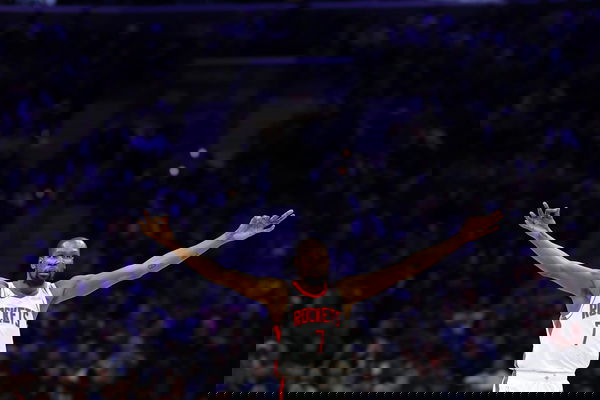
Imago
Jan 22, 2026; Philadelphia, Pennsylvania, USA; Houston Rockets forward Kevin Durant (7) reacts to a three pointer against the Philadelphia 76ers during the fourth quarter at Xfinity Mobile Arena. Mandatory Credit: Bill Streicher-Imagn Images
Golden State Warriors stand at 29-26 and are holding on to the play-in. They are still in the top-10 defensively despite being injured and having a high roster turnover. The reason is not talent. It is an intra-organizational structure. Green is the emotional interpreter of stars and role players. Everyone is aware of their positions prior to tip-off.
Houston currently does not. Green has effectively described this distinction without saying it: Public controversy + silence = Private interpretation. Personal interpretation = locker-room opinions. Factions = blown clutch games. Such sequence is already comparable with the record profile of Houston.
The stark truth is that now the ceiling in Houston is dependent on trust rather than talent. In case the situation is clarified, then they immediately become a conference-final threat. When it continues to linger, then they are a first-round upset candidate no matter the seed group.
Durant ensures high floor. The main point that Draymond was attempting to reveal is this: competitors fail when players cease to understand their position. Games get lost in the NBA because of missed shots. Questions that go unanswered end up losing playoffs.
Written by

Edited by

Tanay Sahai