
Essentials Inside The Story
- A 53-year wait ended, but thousands never made it past the barricades.
- The celebration drew more fans than Lower Manhattan could realistically hold.
- Why arriving before sunrise still wasn't enough for many Knicks supporters.
On May 15, 1973, more than 2,000 Knicks fans packed the steps of City Hall to celebrate an NBA championship. Police struggled to keep the speakers’ stand clear, Red Holzman addressed the crowd, and New York basked in another basketball title. Yet one thing was missing. There was no ticker-tape parade through the Canyon of Heroes.
Watch What’s Trending Now!
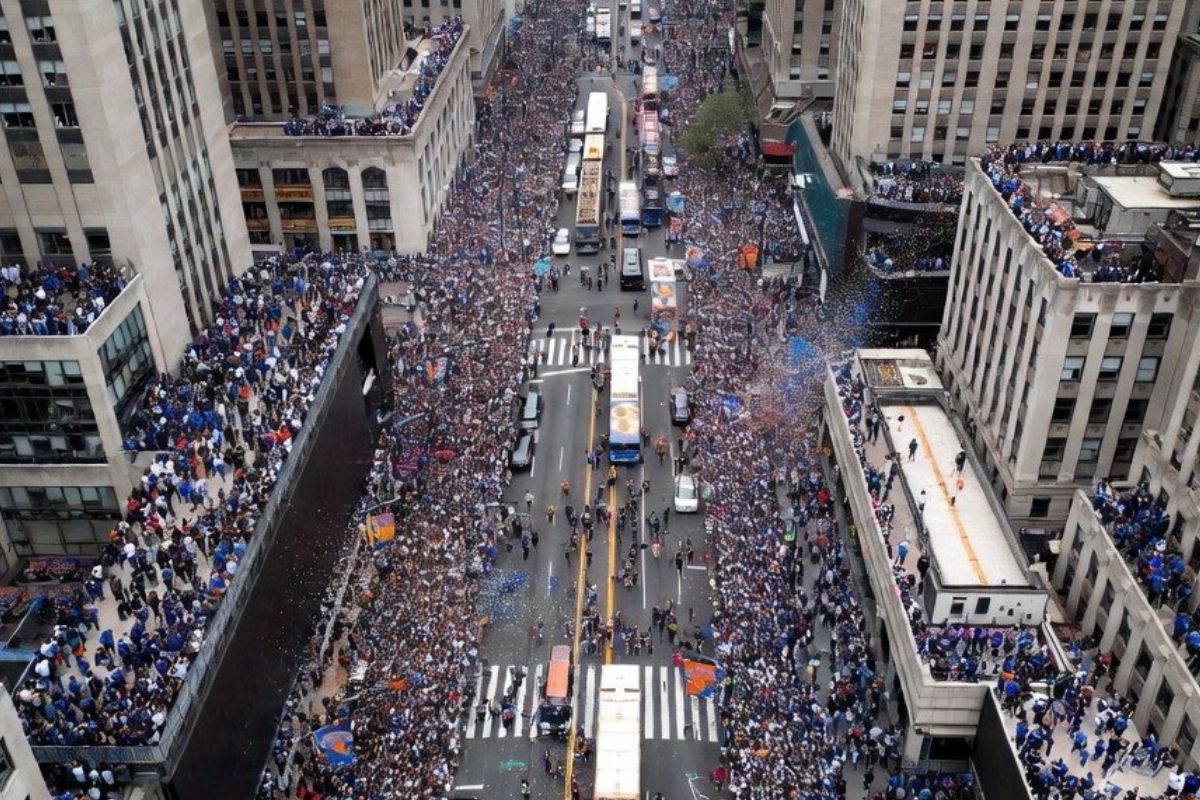
For more than five decades, Knicks fans waited for the franchise’s first championship parade. When that moment finally arrived on Thursday, the demand proved almost impossible to contain. Long before Jalen Brunson and the Larry O’Brien Trophy reached Lower Manhattan, thousands of fans had already flooded the city hoping to secure a spot along Broadway. By roughly 7:30 a.m., nearly two and a half hours before the scheduled start, the NYPD announced that all 23 viewing pens along the parade route had reached capacity and no additional spectators would be allowed inside. The decision left thousands of fans outside the secured viewing areas despite arriving hours before the parade began.
The announcement came despite repeated warnings from city officials that attendance would exceed the available space in Lower Manhattan. Ahead of the celebration, Police Commissioner Jessica Tisch said, “We expect viewing areas to fill quickly. Attendance is projected to exceed the available space in Lower Manhattan and once designated viewing areas reach capacity, people will be redirected or turned away.”
Many fans followed exactly that advice and still found themselves locked out. Marino and Anna Zambuto arrived at a Church Street checkpoint at 5:45 a.m. and waited for nearly two hours before learning the viewing areas had closed. “We knew we weren’t going to get in,” Marino said as the crowd continued to swell around the perimeter. Meanwhile, Shareefa Wallace woke up at 3 a.m. to make the trip from Long Island, only to discover the viewing pens had already been sealed by the time she arrived.

JUST IN: The New York Police Department declaring there’s no more room for spectators at the Knicks championship parade hours before the event is set to kick off. All viewing pens for the Knicks championship parade are full, and officials say no one else will be allowed into the Show more
As checkpoints closed across Lower Manhattan, frustration quickly became visible. Crowds gathered outside barricades chanting “Let us in!” while police maintained the lockouts. Some fans climbed scaffolding, traffic structures and construction corridors in search of alternative views after realizing they would never make it into the secured zones.
The challenges were not limited to fans. Newsday reporter Steve Popper, who has covered the Knicks for nearly three decades, hinted at the conditions before the parade even began. Sharing a photo of the media setup, Popper wrote, “MSG will broadcast the parade tomorrow for those of you who don’t want to spend hours in a pen.”
The crowd surge created problems beyond simple sightlines. At intersections near Nassau, Pine and John streets, overloaded cellular networks made it difficult for journalists to upload photos, transmit video or even access the city’s official livestreams, creating what some reporters described as a temporary “media blackout.”
Videos circulating online showed spectators lifting barricades and attempting to breach security lines near the Financial District. However, despite the crowd pressure and isolated perimeter incidents, officials reported no major violence during the parade itself and only three people required transportation for non-life-threatening medical issues.
Mayor Zohran Mamdani addresses unprecedented turnout
Mayor Zohran Mamdani acknowledged the historic significance of the day before the festivities began, saying, “For more than 50 years, New Yorkers have waited for this moment. This Thursday, our city will rise to the occasion.” As the crowds surged into Lower Manhattan, city officials issued transit alerts and advised residents to expect major disruptions across the Financial District.
The scale of the operation reflected just how seriously officials viewed the event. Under Commissioner Jessica Tisch, the NYPD deployed more than 10,000 officers, the largest security deployment for a planned event in department history. The force was larger than the one typically assigned to New Year’s Eve celebrations in Times Square, as officials anticipated attendance topping one million people.
The celebration concluded at City Hall, where players received the Keys to the City. But the crowds also forced significant transportation changes, with Wall Street and City Hall stations bypassed throughout the morning and commuters redirected toward Bowling Green, Fulton, Brooklyn Bridge-City Hall and Chambers Street.
Ultimately, the parade delivered a long-awaited celebration for a fan base that had waited 53 years to see the Knicks roll through the Canyon of Heroes. Yet it also exposed the challenge of fitting more than a million people into less than a mile of Lower Manhattan. For many fans, the biggest memory of the day was finally seeing the Knicks celebrate a championship. For others, it was arriving before sunrise and still finding the gates closed.