

The story of where LeBron James plays basketball in 2026-27 began when his agent, Rich Paul, told ESPN’s Shams Charania that James would exercise his player option for 2025-26 with the Lakers: “LeBron wants to compete for a championship.” The championship didn’t come. The Lakers were eliminated in four games by the Oklahoma City Thunder in the second round, with James playing 40 minutes and posting 24 points and 12 rebounds in the closing loss, a performance that encapsulated the entire season in miniature: elite, and not quite enough. Now, with unrestricted free agency arriving, two franchises with genuine emotional pull are circling. But both of them have the same problem.
Watch What’s Trending Now!
According to league insider Marc Stein, the Golden State Warriors have maintained a ‘longstanding interest’ in bringing James to Northern California, a pursuit that ESPN’s Ramona Shelburne and Anthony Slater confirmed is expected to resurface this offseason, with Golden State set to “test the waters again on soon-to-be free agent LeBron James.” But Stein’s reporting made the obstacle equally plain: the Warriors will be severely limited in what they can offer. Golden State’s most realistic path involves creating a full mid-level exception, potentially around $15 million, by having Draymond Green take a pay cut on his player option and shedding Al Horford’s $6 million deal, but the framework remains contingent on multiple moving pieces falling into place before a formal offer can be made.
The Cleveland Cavaliers present the same financial ceiling, and arguably more. Stein noted that Cleveland has even less flexibility than Golden State and is “so far away from all the Tinseltown ties that LeBron and his family have established during this run as a Laker.” Yet Stein was careful not to close the door entirely, pointing to two factors that keep the Cavaliers relevant: the storybook ending narrative and a franchise whose resistance to another reunion has apparently softened.
“The Cavs were once resistant to the idea of another reunion,” Stein wrote, “but they might be more open to a third marriage given that they’re facing the prospect of a third successive humbling postseason after failing to close out Detroit at home on Friday night and now need to win a Game 7 on the road Sunday to keep their season alive.” Cleveland’s cap situation would likely require a sign-and-trade, potentially sending Jarrett Allen to the Lakers in exchange, or James accepting a minimum deal, with James Harden’s $42 million player option the one lever the Cavaliers could pull to create meaningful space.
LeBron James himself has not committed to anything publicly. “I think for me it’s about the process,” he said. “If I can commit to still being in love with the process of showing up to the arena five and a half hours before a game to start preparing, showing up to 11 o’clock practice at 8 o’clock, preparing my body, preparing my mind. I think that would be a big factor.” The retirement conversation is real, and it is running parallel to the recruitment conversation in real time.
Reporters pick one destination that fits James the best
Betting markets reflect the uncertainty: Kalshi has a 58% chance that James either remains in Los Angeles or retires, with Cleveland at 26% and Golden State well behind. The Lakers remain the most likely outcome by almost every measurement, geography, family ties, organizational familiarity, and a front office that has already signaled mutual interest in continuing the partnership, per The Athletic’s Dan Woike and Sam Amick.
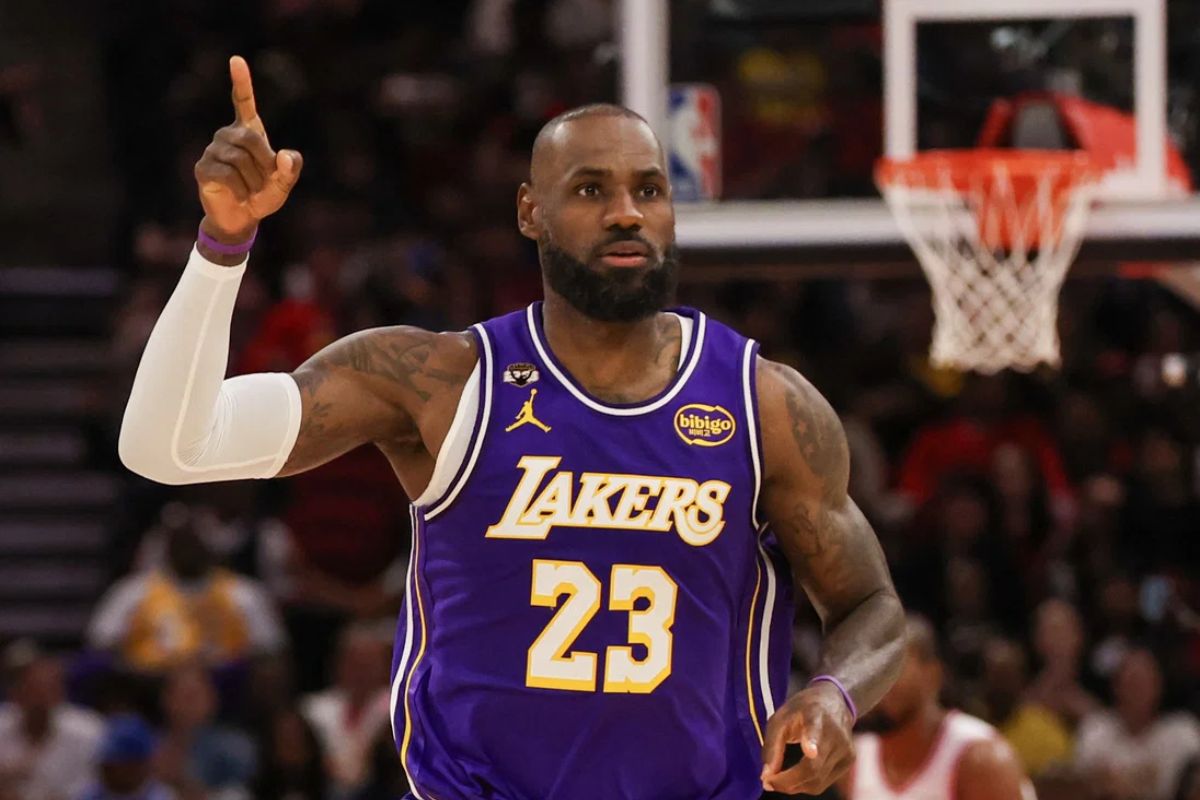
Imago
Mar 18, 2026; Houston, Texas, USA; Los Angeles Lakers forward LeBron James (23) reacts to his basket against the Houston Rockets in the second quarter at Toyota Center. Mandatory Credit: Thomas Shea-Imagn Images
What Stein’s framing captures is the specific weight both the Warriors and Cavaliers are carrying into this summer. Golden State has Stephen Curry’s endorsement, Draymond Green’s recruitment instincts, and a front office that has promised its franchise player a blockbuster move, but the cap math requires a near-perfect offseason to make even a mid-level offer viable.
Cleveland has the emotional architecture of the greatest comeback in Finals history, a young core, and a hometown connection that no other franchise can replicate, but its financial constraints are even tighter than Golden State’s, making a meaningful contract offer structurally difficult without significant roster surgery.
Both teams want him. Neither can pay him what he is worth. The Lakers, according to ESPN’s Brian Windhorst, cannot simply offer a number either; they need to offer a plan, a coherent “why” behind whatever discount they ask him to take. Everybody is selling. James is still deciding what he is buying.