
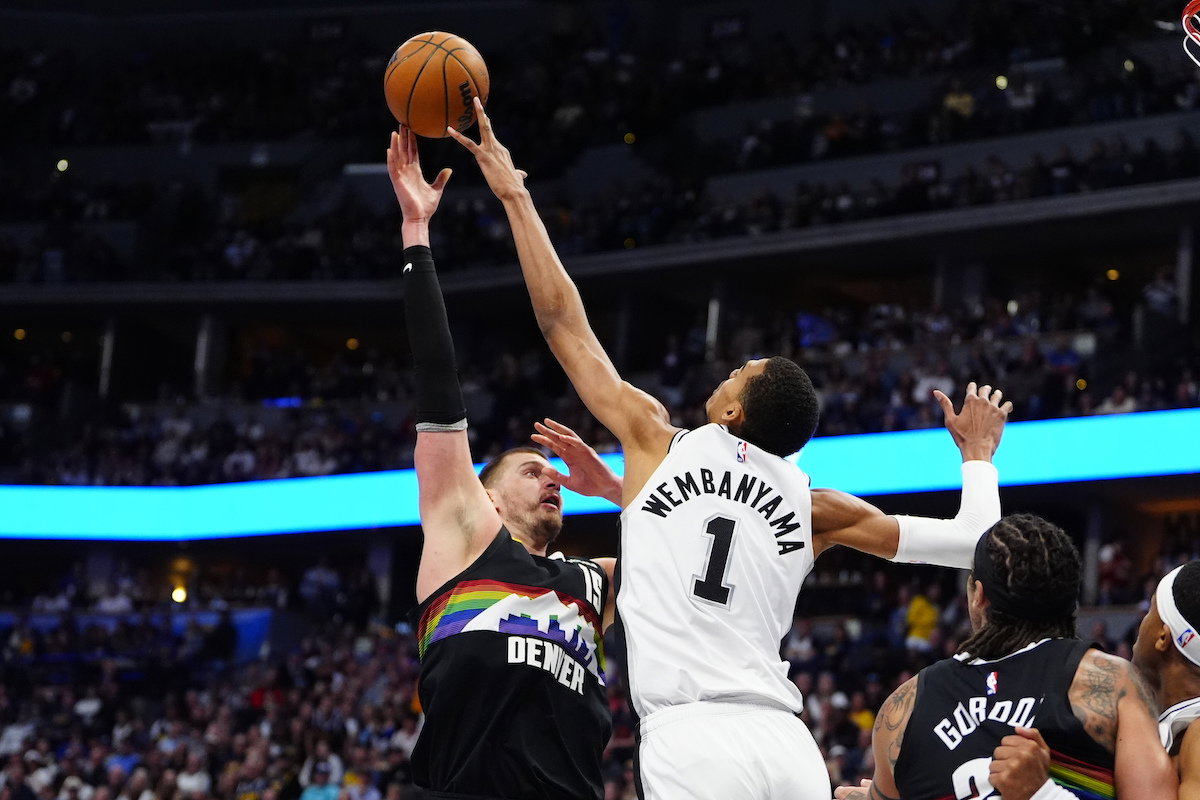
Victor Wembanyama’s 2026 playoff run has turned a long-term debate into an immediate one. After years of Nikola Jokic sitting comfortably atop the NBA’s center hierarchy, Wembanyama has finally produced the combination of winning, impact metrics, and postseason dominance needed to seriously challenge him for the throne.
Watch What’s Trending Now!
The numbers are becoming difficult to ignore. During these playoffs, the San Antonio Spurs have outscored opponents by 11.8 points per 100 possessions with Wembanyama on the floor. Denver, meanwhile, was only +3.2 with Jokic on the court before its postseason ended. Pair that with San Antonio’s 62-win season and Wembanyama’s Defensive Player of the Year campaign, and suddenly this conversation no longer feels premature.
The NBA has historically belonged to dominant big men. Hakeem Olajuwon, Shaquille O’Neal, Tim Duncan, Kevin Garnett, and now Jokic all spent years controlling the league in different eras. But for the first time since Jokic took over the sport earlier this decade, there is a legitimate argument that another center has surpassed him.
Why Victor Wembanyama Has Surpassed Nikola Jokic
This season marked the first time Wembanyama was both healthy and playing meaningful basketball deep into the year. He appeared in 64 games, anchored a 62-win Spurs team, won Defensive Player of the Year, and entered the playoffs looking far more physically prepared for postseason basketball than he did as a rookie.
Meanwhile, Jokic’s season came with more physical limitations than usual. He played the fewest games of his career and looked noticeably less explosive after returning from a knee injury in January. For the first time in years, Jokic also lost his grip on Estimated Plus-Minus, one of the league’s most respected all-in-one impact metrics. Wembanyama finished ahead of him.
Jokic has long been the master of plus-minus data. This year, his on/off rating was 1.1 points per 100 possessions better than Wembanyama’s output (per Cleaning the Glass). However, that could just be because Wembanyama’s backup center (Luke Kornet) was better at holding down the fort than Jokic’s understudy (Jonas Valanciunas). Besides, the heights that Wembanyama was able to carry his San Antonio Spurs to (they were outscoring opponents by 16.7 points per 100 when he was out there) were far greater than what Jokic did with the Denver Nuggets this season (+11.5 per 100). As a result, San Antonio won eight more regular season games (62) than Denver (54) and drew a more favorable postseason matchup.
Speaking of the playoffs, the Spurs have been alive for eleven more days (and counting) than the Nuggets, and two of their three losses came in games where Wembanyama was not able to play in the second half, for one reason or another. From an individual impact perspective, this postseason, the Spurs are 11.8 points per 100 better with Wembanyama on the floor than him on the bench. On the flip side, the Nuggets are just 3.2 points per 100 better when Jokic is on the floor. Of course, Jokic has a long history of being a huge difference maker in the postseason, but we aren’t talking about playoff peaks, we are analyzing who these two players are right now.
Why Nikola Jokic Is Still Better Than Victor Wembanyama
Jokic-stans may be reading this and saying to themselves that the previous section is missing one key thing: context. Jokic missed more time than we are used to this year, and even when he did come back, he didn’t look like the savant we’ve come to know and love.
Prior to December 29 (when Jokic went down with the knee injury that sidelined him for a month), The Joker was averaging 29.9 PPG and 11.1 APG on a God-like true shooting efficiency of 71.4%. After he returned, those numbers dwindled down to a less omnipotent 25.8 PPG and 10.5 APG on 62.7% TS. Obviously, most dudes don’t magically become healthier once the postseason begins, so it’s safe to presume that the version of Jokic was not the All-World force we’ve grown accustomed to seeing.
Matchups are everything in the playoffs, and, in the first round, the Nuggets were pitted against their ultimate foil in the Minnesota Timberwolves (a team that is also giving the Spurs a run for their money). Historically, no one clips the wings of Jokic and his partner-in-crime (Jamal Murray) quite like Jaden McDaniels and Rudy Gobert. Meanwhile, San Antonio got to warm up against the Portland Trail Blazers – one of the few teams with just as much inexperience as the Spurs and one that needed the help of the play-in tournament to punch in their postseason ticket.
This is all without mentioning that Wembanyama is surrounded by a better team than Jokic. Today’s game is faster and more physically demanding than ever before. Wembanyama’s primary supporting cast features six guys 26 years old or younger, and De’Aaron Fox, who is still only 28 years of age. On the flip side, Jokic’s two most athletic teammates (Aaron Gordon and Peyton Watson) were either not present (Watson) or a shell of themselves from a physical standpoint (Gordon) during the first round.
The Bottom Line
My wonderful editors at Essentially Sports (shoutout, Ved!) are always challenging me to be a stronger writer. And one thing I’ve often been thinking about is how I would explain my takes to someone at a bar. In that setting, I probably wouldn’t pull out a bunch of advanced data. What I would respond to a question about Wembanyama surpassing Jokic would sound something like this:
Yes, Wembanyama has surpassed Jokic. No player in the NBA is able to change the way offenses operate with their presence in the paint the way Wembanyama can with his once-in-a-lifetime rim protection. Jokic is still the superior offensive player, but Wembanyama’s ability to catch lobs from outerspace and the improvements he’s made to his body and his ability to absorb contact have closed the gap between them in a way where his defense can propel him past The Joker. And while he hasn’t won a championship yet, he has shown he can overcome enhanced playoff game plans and still give his team a massive edge when he is on the floor.
So yes, there is finally a legitimate case that Wembanyama has surpassed Jokic as the best center in basketball. Jokic still remains the more polished offensive engine, and his résumé is significantly stronger. But when elite rim protection, postseason impact, advanced metrics, athletic dominance, and team success all start pointing in the same direction, the conversation changes quickly.
Right now, both the eye test and the numbers suggest Wembanyama may already be the most impactful big man in the NBA.