
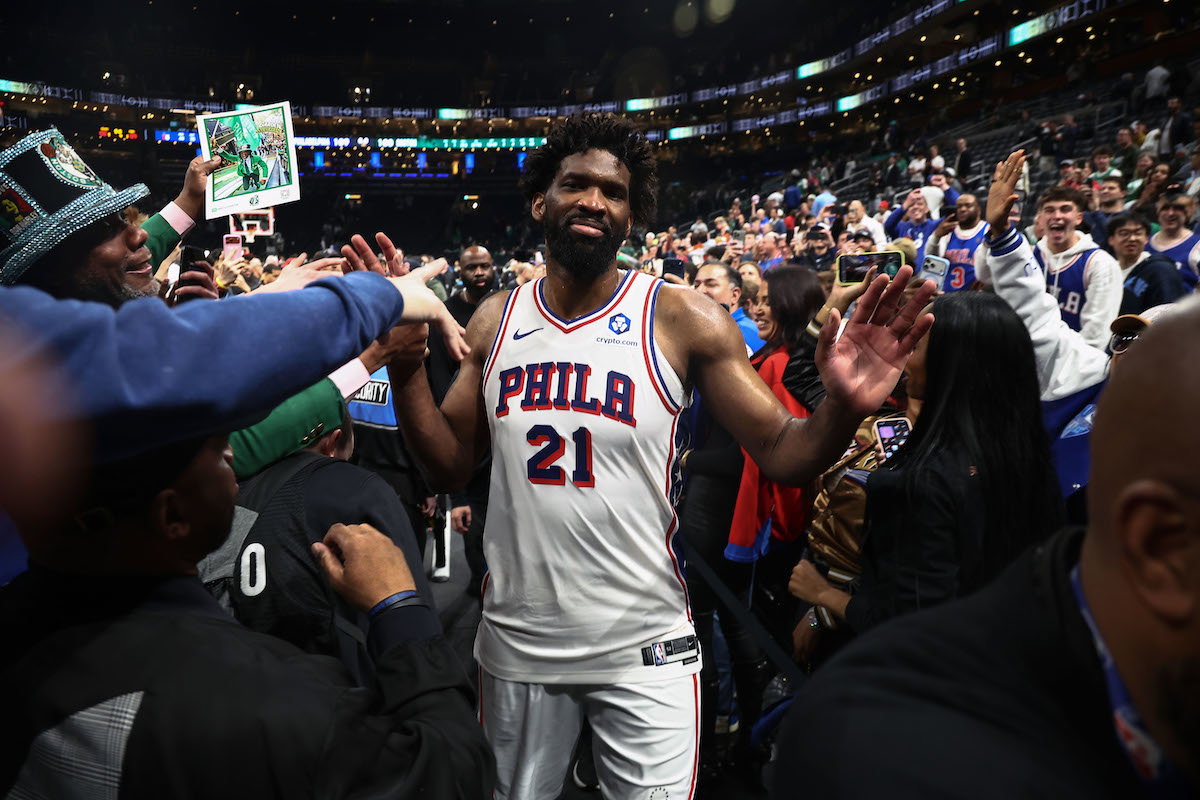
Two Sundays ago, Joel Embiid returned from appendicitis and walked straight into a 3-1 deficit. The Philadelphia 76ers were 0-18 all-time in that situation. The Boston Celtics were 32-0 when leading a series 3-1. It looked finished. Instead, it became the 14th comeback from that deficit in NBA history and the first in franchise history.
Watch What’s Trending Now!

The 76ers' incredible comeback against the Celtics has lodged several new stats and facts in the NBA book. After winning the series, Philadelphia are 1-18 when trailing a playoff series 3-1. Meanwhile, Boston are now 32-1 when leading a playoff series 3-1.

It briefly felt like Embiid’s physical decline had closed Philadelphia’s window. Even in his return, he produced 26 points, 10 rebounds, and 6 assists, but the explosion, rim pressure, and defensive dominance that once defined him appeared diminished. The assumption was simple. The ceiling had already been reached.
Over a week later, man, do I and the rest of the basketball world look like fools. We eulogized Embiid and his 76ers prematurely, and the former MVP decided that he was done letting tragic circumstances tell his tale. Embiid is the sole author of the story, and, in this chapter, he flipped the script on the powerhouse Celtics to pull off one of the greatest upsets we’ve ever seen.
The Celtics Had No Answer For Embiid
A major reason Embiid had struggled against Boston in prior series was their ability to throw multiple physical, switchable defenders at him. That layer no longer existed. Boston no longer had the same combination of strength, discipline, and interior resistance that historically disrupted his rhythm, and that shift turned a difficult matchup into a manageable one.
Neemias Queta, Luka Garza, and Nikola Vucevic filled minutes at center during the season, but none of these options could handle Embiid in isolation or contain the chain reaction his presence created. When guarded one-on-one, he scored efficiently. When doubled, he dissected the defense through quick reads from the elbow and high post.

Despite only playing 4 games, Joel Embiid leads the playoffs with 32 post-ups thus far. He's scored 1.13 points per possession on those plays, exhibiting poise and dominance no matter the coverage.
Philadelphia built its offense around Embiid’s decision-making. Elbow touches, short-roll reads, and high-post facilitation became the foundation. With Tyrese Maxey’s downhill pressure pulling defenders outward, Embiid punished rotations by finding cutters and shooters. His 7 assists per game were not incidental. They were the mechanism that stabilized the offense.
The results were measurable. Philadelphia’s field goal percentage at the rim improved by 4.7 percent with Embiid on the floor, and their free throw rate jumped to 27 percent over the final four games, up 8.3 percent from the opening stretch of the series. Those numbers reflect a shift in shot quality, not just volume.
That shift mattered because of Boston’s identity. The Celtics rely heavily on three-point volume, ranking near the top of the league in attempt rate, but that approach carries variance. In Games 5 through 7, they shot 27.9 percent from deep. Philadelphia, anchored by Embiid, generated offense built on rim pressure and free throws, a far more stable model late in a series.
A Force On The Inside
Even in a diminished state, Embiid still tilted the floor defensively. With him on the court, Philadelphia’s defense improved by roughly 13 points per 100 possessions. His presence allowed the 76ers to simplify their scheme and control the most important area of the floor.
Embiid isn’t back to being the elite paint protector he was in his early years, but he’s still a relatively nimble giant, and the Celtics don’t have any supreme paint scorers who can challenge him the way the Minnesota Timberwolves did with Nikola Jokic. During the regular season, the Celtics were dead-last in rim frequency (per Cleaning the Glass); and in Embiid’s minutes, the already-disadvantaged Celtics were 2.7% less efficient on those shots while seeing their frequency dip by 2%.
That allowed Philadelphia to lean into a clean defensive structure. Embiid anchored drop coverage, turning possessions into controlled two-on-two actions while the remaining defenders stayed home on perimeter threats. This reduced Boston’s clean looks and contributed directly to their late-series shooting struggles.

the fundamental issue with Jaylen Brown's scoring process is that it's purely contingent on whether the ball goes in and it really does nothing to bend defenses in any meaningful way; the ball did go in a few times in the 4th to make it look like JB was dragging the Celtics back Show more

Sports are a business so the importance of optics & the fanbase can never be undermined, but it’s hard to think of any basketball reasons for the Celtics keeping Jaylen Brown His ballstopping midrange heavy diet is the opposite of what the roster is built for, let alone the $
Funny enough, Embiid’s impact on the defensive side of the ball made more of a difference than his smooth 28 PPG. According to PBP Stats, Philadelphia was actually 1.9 points per 100 better on offense when Embiid was not on the floor (some noise in this sample), but their defense improved by an astonishing 13 points per 100 when he stepped on the floor.
A common football idea is that games are won at the line of scrimmage. In basketball, that space is the paint. Philadelphia controlled it. Boston could not. That imbalance decided the series.
The next challenge is fundamentally different. Unlike Boston, the New York Knicks have both the personnel and the versatility to challenge Embiid. Mitchell Robinson is one of the league’s most effective interior defenders against him, while Karl-Anthony Towns offers a different kind of matchup problem with his mobility and skill. This will not be the same equation.
Philadelphia still enters the series as an underdog, and Embiid’s health remains a variable after logging heavy minutes and dealing with a hip issue. But the comeback against Boston changed the framing entirely. This is no longer a team hoping to compete. It is a team that has already proven it can control a series when Embiid controls the paint.