
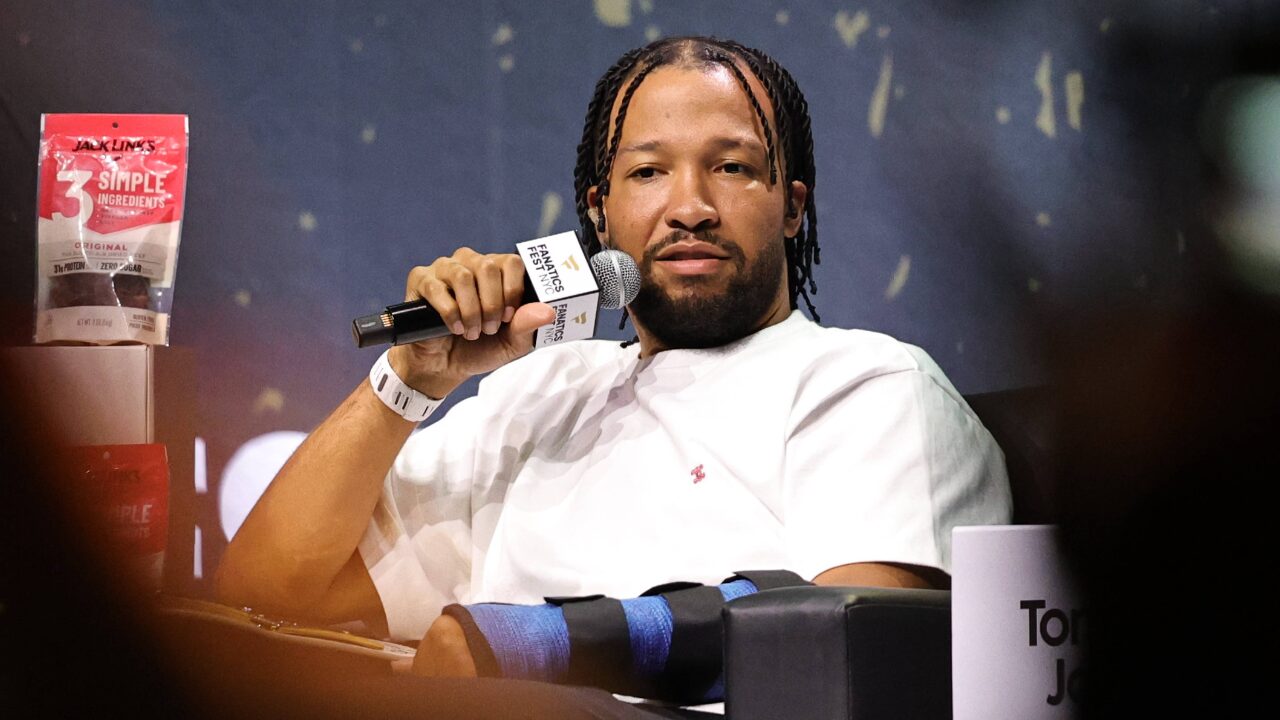
We knew that contract extensions would eventually dominate conversations around the New York Knicks when James Dolan made a critical statement in June. The franchise owner revealed he considers it “suicidal” to go into the second apron because of the penalties. Mitchell Robinson was one to pay the price earlier this offseason because of that. Now, there are four more players who’ll likely need to make a compromise, except for Jalen Brunson.
Watch What’s Trending Now!
Since ending the Knicks’ 53-season championship drought, Brunson has become a local hero. Mayor Zohran Mamdani even deemed him the king of New York. Also, the fact that Brunson sacrificed about $113 million by signing a team-friendly deal two years ago adds pressure on the Knicks to pay him his dues.
“In 2028-29, Jalen Brunson’s new contract will begin,” Fred Katz of The Athletic reported. “All signs point to the NBA Finals MVP earning a significant raise — a projected $290 million over four years.”
You may wonder: what’s the problem with Brunson getting a big payday? It’ll be the biggest contract in league history for a point guard. There’s no problem with him specifically. The thing is, Brunson’s salary could increase from $40.5 million in 2027-28 to $64.7 million in 2028-29. So, the Knicks need to find a way to account for and make up that money. That brings Karl-Anthony Towns into the picture first.
Towns is eligible for a maximum four-year extension worth up to $276 million. But while the Knicks desperately want to retain their star center, who carried the team alone at times in the postseason, they don’t want to pay the amount he is eligible for. Reports from The Athletic’s James Edwards indicate the two sides remain “far enough apart,” with talks expected to linger into the regular season.
Towns has so far balked at at least two offers while being aware of the disadvantage of waiting beyond a certain October deadline. The Knicks star addressed the uncertainty directly, noting his desire to remain in New York while acknowledging the awkward nature of public contract disputes.
“I’ve made it known I wanna play here,” KAT said. “I’ve been a fan since I was young. So, I would like to get [a deal] done, of course. That’s obvious. I would like to get it done so I can step on the court and feel comfortable as possible. I think in this situation, there is no comfortability to be had.”
The urgency to finalize an agreement before the October 19 regular-season mark is tied to an NBA rule. The CBA states that players with multiple years left on their contracts who are extension-eligible can put pen to paper only in the offseason. Once the respective season begins, these players cannot sign a deal until the next summer. Towns will make $57 million this season. But if he doesn’t sign a new contract, he can very well decline his player option worth $61 million for 2027-28 and leave. He could also decline it and sign a deal next season.
Whatever the permutation and combination, it boils down to one thing. The Knicks and Towns need to agree on a figure. Brunson’s imminent extension doesn’t just complicate the Towns deal, but also three more extension-eligible core contributors: Josh Hart, Miles “Deuce” McBride, and Tyler Kolek.
Earlier this week, Hart said he doesn’t expect an agreement before opening night. On paper, he is eligible to sign a four-year extension worth up to $132 million. Hart currently has one more guaranteed season, followed by a $22.4 million team option for 2027-28.
On the other hand, McBride is nowhere near receiving an offer. In fact, the Knicks are reportedly looking to use his contract in a trade to bolster their bench. He is entering the final season of his $13 million deal and recently expressed disappointment about not being able to make progress on this matter.
Lastly, Kolek, entering the final guaranteed year of his $9 million deal, remains the lowest priority on the front office’s list among this group.
These negotiations are moving more slowly than expected because Knicks owner James Dolan publicly said he has absolutely no intention of going over the luxury tax limit. This philosophy also led the franchise to let star center Mitchell Robinson walk to the Boston Celtics in free agency.
To maintain essential payroll flexibility once Brunson’s $290 million extension kicks in, the Knicks need a specific contract structure that is only possible before October 19. It hinges largely on what Towns agrees to. But as of now, Malika Andrews of ESPN reported that the center feels it is “unreasonable” to take the pay cut he is currently being asked to take.
Towns makes 35 percent of the cap, while Brunson is at 23 percent. Within two years’ time, this is bound to reverse itself and for good reason. But managing all these contracts alongside even other stars like Mikal Bridges and OG Anunoby is going to be New York’s primary hurdle to preserving its championship core.