
The Lakers are winning. However, the biggest question inside the locker room has nothing to do with wins. It is about whether their starting center is helping or quietly holding them back.


That tension has now reached a breaking point. JJ Redick is staring at a decision that could define the Lakers’ postseason.
Watch What’s Trending Now!
Because Deandre Ayton’s production has dipped at the worst possible time. Over recent games, he has posted four points against Golden State, two points and four rebounds against Phoenix, and four points against Boston, disappearing offensively despite starter-level minutes.
Imago
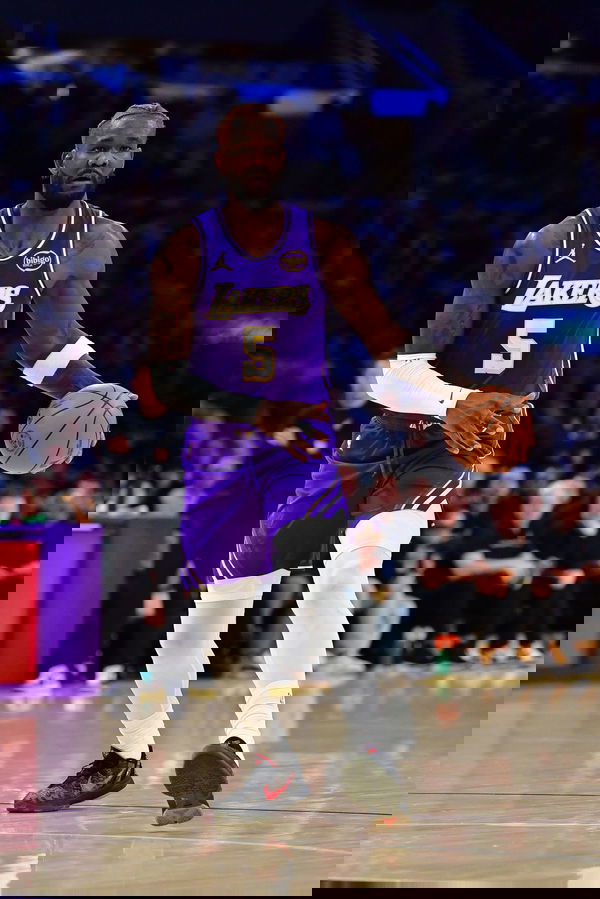
Nov 5, 2025; Los Angeles, California, USA; Los Angeles Lakers center Deandre Ayton (5) controls the ball against the San Antonio Spurs during the first half at Crypto.com Arena. Mandatory Credit: Gary A. Vasquez-Imagn Images
The real issue is what it reveals. Because this is no longer a slump. It is a structural problem.
On paper, Ayton still looks efficient. He is averaging 12.8 points and 8.4 rebounds on a career-high 66.2% shooting, numbers that suggest stability. However, those numbers do not tell the full story.
His performances have become unpredictable. A 21-point, 13-rebound outing against Orlando sits right next to multiple games where he barely impacts the floor. That inconsistency has become the defining theme of his season.
More importantly, the effort questions have not gone away. His -24 plus-minus against a short-handed Phoenix team raised alarms that cannot be ignored this late in the season.
Because of that, the frustration is no longer internal. It is visible. “They’re trying to make me Clint Capela.”
“I’m not no Clint Capela!” That quote changes the entire conversation.
Ayton’s frustration is not about touches. It is about identity. The Lakers need a rim-running, defensive anchor who sets screens, finishes lobs, and protects the paint. That role is built to complement elite playmakers like LeBron James and Luka Doncic.
Ayton does not see himself that way. Instead, he views himself as a versatile offensive big, capable of mid-range scoring and post play. That mismatch between expectation and execution is where the problem begins.
Because while Ayton resists the role, the system depends on it. That disconnect is now affecting performance. And it is forcing Redick into a decision he cannot delay much longer.
Meanwhile, Jaxson Hayes is doing the exact opposite. He is embracing the role Ayton is rejecting. Hayes is averaging 6.8 points and 3.9 rebounds in 17.3 minutes, but the efficiency stands out. He is shooting 76.8% from the field, thriving as a rim-runner and energy big.
His impact shows up beyond the box score. Against Golden State, Hayes posted a +18 plus-minus, outperforming Ayton in fewer minutes. That difference matters. Because Hayes fits the system naturally. He runs the floor, finishes lobs, and does not demand touches. That is exactly what this roster needs.
Why Benching Ayton Isn’t the Right Move
However, this is not a simple switch. Benching Ayton carries consequences. He is still the Lakers’ most physically imposing center and brings playoff experience, including a Finals run with Phoenix. That size matters against elite frontcourts.
At the same time, Hayes has not proven he can sustain starter minutes. In last year’s playoffs against Minnesota, he averaged 1.8 points and 2.0 rebounds in 7.8 minutes, struggling to stay on the floor due to fouls and defensive lapses.
That context cannot be ignored. Because the playoffs expose weaknesses immediately. If Hayes picks up early fouls, the Lakers’ rotation collapses. If Ayton disengages after a benching, the locker room risks instability.
That is why this decision is not just tactical. It is psychological. This is where Redick’s role becomes critical. He does not need to choose one over the other permanently.
He needs to control when each one matters. Ayton still serves a purpose. His size helps absorb physical matchups early in games and provides a baseline defensive presence.
However, that role comes with accountability. If effort drops or execution slips, the leash has to be short. Hayes, on the other hand, has earned situational trust. When the game speeds up or when energy is needed, he becomes the better option. His fit alongside the Lakers’ playmakers is already evident.
That creates a clear structure. Ayton starts. Hayes closes when necessary. Because at this stage of the season, performance has to outweigh reputation. This is not about choosing a better player. It is about choosing the right role.
Ayton gives the Lakers size and experience. Hayes gives them energy and fit. Neither is perfect. That is why Redick’s decision matters. If he leans too heavily on Ayton, the offense risks stagnation.
If he overcommits to Hayes, the defense risks collapse under playoff pressure. The solution is not drastic. It is controlled. Because the Lakers do not need a headline decision.
They need a consistent one. And if Redick gets that balance right, this debate disappears. If he does not, it will define how far this team actually goes.
Written by

Edited by

Ved Vaze