Imago
IMAGN
Imago
IMAGN
Will we witness one of the most remarkable comeback stories? Or are we seeing a wave of red flags that are too bright to ignore?
Watch What’s Trending Now!
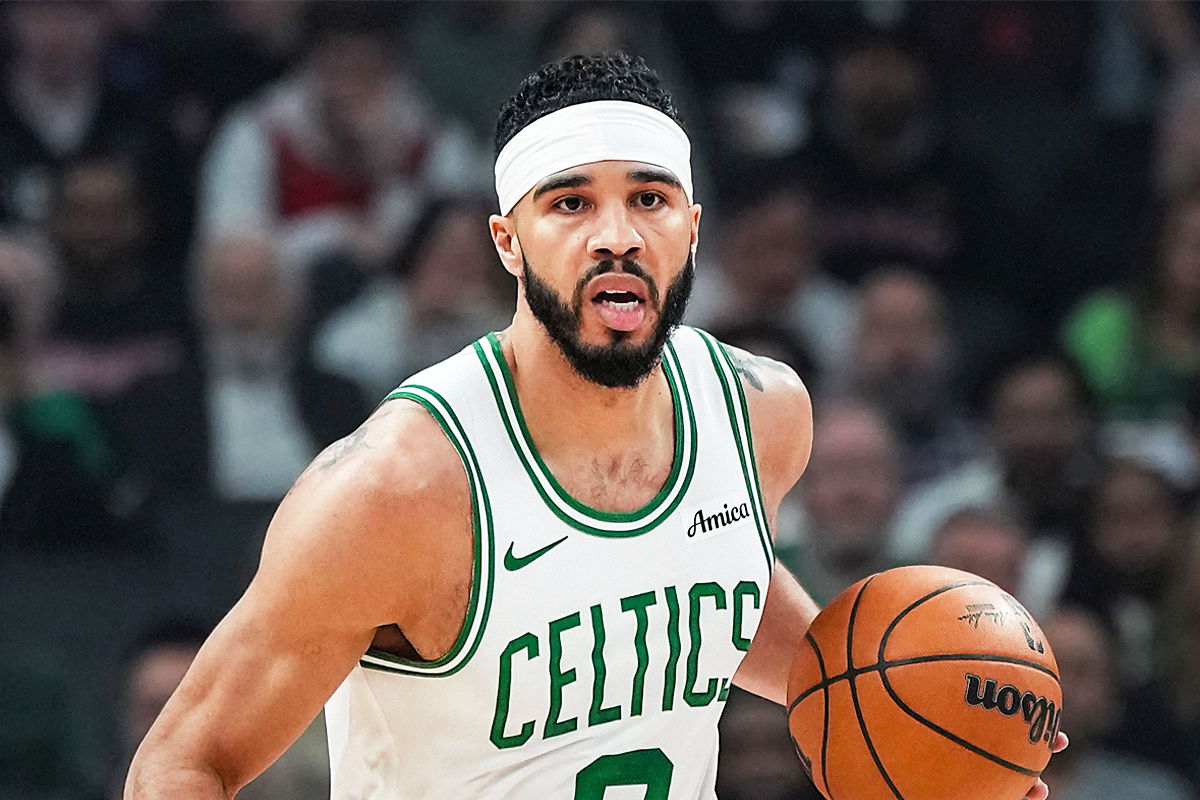
Even though they hold advanced medical degrees, doctors don’t fully know how Jayson Tatum’s return will fare after the Boston Celtics star spent the past 10 months rehabbing his right Achilles tendon. With Tatum making his debut as early as Friday’s game against the Dallas Mavericks, a handful of doctors sounded more intrigued than worried.
The panel included:
Dr. Douglas Cerynik, CEO of Stabiliz Orthopaedics.
Dr. David Gazzaniga, sports medicine at Hoag Orthopedic Institute.
Dr. Jonathan Kaplan, associate professor of orthopedic surgery at Duke University.
None of these doctors has worked directly with the Celtics or Tatum. But they all have treated patients with Achilles injuries. Cerynik was a co-author of a 2013 study that detailed how Achilles injuries affected NBA players. All three doctors shared their reaction to Tatum’s anticipated return and their expectations for his play and workload. They also shed light on how modern medicine and technology have enabled players to recover from Achilles injuries much more effectively than in previous decades.
Editor’s note: The following one-on-one interviews have been edited and condensed. Their interviews with EssentiallySports were conducted separately as well.
From your outside medical perspective, how does the news land with you that Jayson Tatum is set to return to play nearly 10 months after rupturing his right Achilles tendon?
Cerynik: “As a fan, it’s exciting. As a physician, I’m curious. Obviously, we don’t have insight into the type of repair and rehabilitation protocol. But it’s exciting to see how this goes. It’s definitely pushing the envelope, historically speaking.”
Gazzaniga: “I’ve done hundreds of Achilles repairs, and people respond differently in different ways. But I think the advantage that Jayson has is he had surgery pretty quickly after the injury occurred. That can help in the process. There is some concern about doing surgery immediately after that, with having swelling. But all of the signals for healing are ramping up. So to have the tendon in a good position early on is helpful.
Typically, professional athletes are different for a reason. They have an ability to heal like normal human beings cannot. I’ve seen that with taking care of professional athletes for 25 years. They’re much further along than you’d expect. For Tatum, he had the right surgery at the right time with the right kind of rehab. He has that ‘X’ factor that has gotten to him where he is anyway. So at 10 months, if he’s ready, he’s ready. It’s not like you have to wait for 12 months or need to force him back at nine. If he’s ready at 10, then he’s good to go.”
Kaplan: “In a sense, it’s a little surprising. But at the same time, it’s not super surprising. He tried to make it pretty clear when he first got injured that his goal was to get back as quickly as possible. So it’s not quite as surprising. With him being 10 months out from his surgery, the average return-to-play can be as early as 10 months and around a year. So I think it’s still within an acceptable timeframe.”
Imago
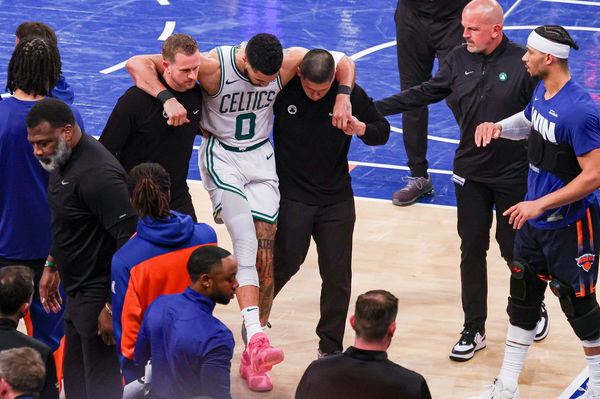
May 12, 2025; New York, New York, USA; Boston Celtics forward Jayson Tatum (0) is helped off the court by after an injury in the second half during game four of the second round for the 2025 NBA Playoffs against the New York Knicks at Madison Square Garden. Tatum would leave the game with an injury after this play. Mandatory Credit: Vincent Carchietta-Imagn Images
How would you characterize what your level of optimism or concern is for Tatum returning at this point?
Cerynik: “These are really high-performance athletes. They’re young. They’re healthy, generally speaking. They’re getting the best of care. So I don’t think someone will push a boundary that they shouldn’t push. But in light of the recent Lindsey Vonn accident, very different situation, but there is a measure of caution on how far you want to push boundaries with returning.”
Gazzaniga: “My optimism is pretty high. The thing about returning to any sport, whether it’s from a pulled hamstring or an ACL tear, you try to recreate game speed at a practice facility. But game speed doesn’t exist except in a game. That’s really where the rubber hits the road. For him, I’m sure he’s in high-intensity scrimmaging. Dr. [Martin] O’Malley, the doctor who did his surgery, doesn’t want his name attached to someone failing after surgery. So I’m sure he is scrutinized where he is. Tatum has all the best people looking at him. If I think anybody would be ready to come back at 10 months, it would be him.”
Kaplan: “Whether it’s nine months, a year, or after a year, historically they’re not as good when they first come back compared to when they get to year two. I’m optimistic that he’ll be able to come back and play at a high level because he’s super athletic. Do I think he’s going to come back and play to the capacity that he played before he had his injury? No. But that’s mainly because the majority of the data implies that is unlikely. There are always exceptions to the rule. But the majority of the data says they don’t play as well their first season back, especially in the first three to six months.
It’s going to be interesting what he does with the remainder of this season. With most Achilles ruptures, we see the second year back is better than the first year back. Even though he has the rest of this season before the playoffs, that can work in his favor a little bit, it’s still technically his first season back. So I’m going to be really intrigued to see how he does this year compared to next season when he has a full offseason to rehab.”
Given your expertise with Achilles injuries, Tatum’s age (28), and his role on the team, what are your expectations for what his return will look like?
Cerynik: “From a sports side, they are playing really well. So you wonder if that will disrupt things. But from a business side, they have a lot invested in him, and he is a star player on their team. You want to get him out there and get him up to speed and in the groove for the playoffs. It’ll be interesting to see if his game has evolved a little bit as well. Whether that’s more post-play or more set shooting, we don’t know. Only time will tell. So it’ll be really interesting to see what happens. I remember rumors about his return possibly happening a little while ago. At first, you’re thinking, ‘They’re doing really well. Why would you?’ But they are. So it’ll be interesting.”
Gazzaniga: “It’s going to be partly about his physical readiness to play. But the ‘X’ factor that determines what kind of player he is will be his apprehension and his internal caution. Think of Adrian Peterson after he came back from his ACL tear. He looked like he never missed a step. Other players take an entire season to get to the ability that they were before. Jayson is younger than Kevin Durant with his injury [in 2019]. Durant has made an effective comeback. But he’s 6’11” and can play from the outside. He can do a lot of different things to protect his Achilles and work his way back.
For Jayson Tatum, he might not be the player he was before. He might be more of a playmaker and setting other people up. But he’s been pretty good at that during his career, anyway. You’ll see that maybe he’s not the same dynamic player that he was. But maybe at 80%, he’s more effective than the next guy behind him.”
Imago
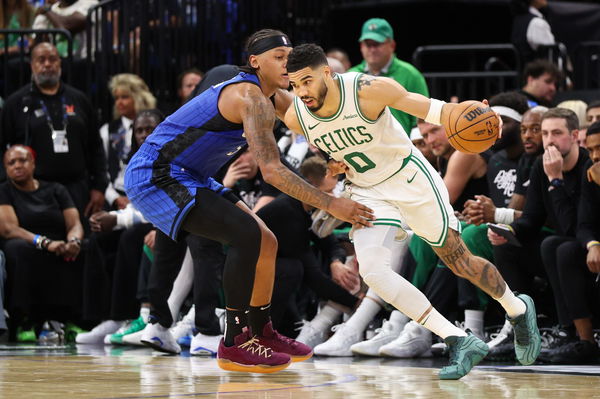
Apr 27, 2025; Orlando, Florida, USA; Boston Celtics forward Jayson Tatum (0) is guarded by Orlando Magic forward Paolo Banchero (5) in the second quarter during game four of first round for the 2025 NBA Playoffs at Kia Center. Mandatory Credit: Nathan Ray Seebeck-Imagn Images
Kaplan: “That’s where it maybe works in his favor a little bit. He can come back and doesn’t need me to be the alpha male. He doesn’t need to be the primary scorer and ball handler. That allows him to come back and get his feet wet. On top of that, Tatum coming back right now makes sense. He wants to come back quickly. But it also gives him time to get his bearings and catch up on his endurance before the playoffs. Sometimes you see guys come back right before the playoffs or even when it’s starting, and then they’re not game-ready. I think this works in his favor to be able to ramp up.
But when you look historically at all NBA players, most of them don’t come back and play as statistically well as before their injury. That’s not just in the first year or two. That’s the rest of their careers. There are exceptions to the rule. Dominique Wilkins is the classic example, and happened many years before these modern rehab techniques even existed (1992). But there was always concern with DeMarcus Cousins, Klay Thompson, and Kobe [Bryant].
Historically, players don’t come back and play as well statistically. You have to presume they aren’t as explosive. They can’t get as much separation. When they don’t get as much separation and explosion, they don’t have as good of a shooting percentage. They don’t score as well. There are always exceptions to that rule. But when you play the field, the data implies that players don’t come back as well as they did before their Achilles rupture.”
What are the important things for both the Celtics and Tatum to manage to ensure his return goes relatively smoothly?
Cerynik: “I would hope that he’s worked into the rotation very slowly with minutes restrictions and things like that. You would hate to see something that would lead to a re-rupture or another type of injury. There are examples of that, such as Klay Thompson. After working his way back from his ACL injury, he ruptured his Achilles [in 2020]. He was scrimmaging and was injured. But I’m trusting their staff has increased his workload behind-the-scenes very steadily to work him up to game speed and to be ready. But time will tell.”
Gazzaniga: “Load on the tendon is not just an immediate load. It’s also cumulative. For a player of that caliber, where you want him hitting his peak in the playoffs, his minutes should be limited. I wouldn’t put him on defense on a really dynamic player. I would put him on more of an outside set-shot player and someone that doesn’t drive to the hoop. I would try to protect him in that way to prevent him from having to make a lot of quick and dynamic movements. I’m just a doctor. I can’t control those things. But optimally, that’s what I’d want a player to do that’s coming back from an Achilles injury.
Even though he’s able to return, I think there’s still going to be some trepidation that other injuries might occur. For example, maybe he’s not moving off that leg at 100%. Maybe he is a split-second behind with doing something. Then he injures something else with his knee or foot or twists an ankle. There’s a focus of the Achilles tendon on whether that’s ready. But there also is a small percentage, but a risk that he might injure some other structure if he’s not firing at 100%.”
Kaplan: “The big things will be letting him ramp up his endurance and getting his bearings with being able to play minutes. They’ll need him to play when the playoffs start. I would imagine they’ll ease him into it and have him on a minutes count. They’re probably going to strategize their game plan for the next month or two with not needing to rely on him as much and just work him into the system. So by the time the playoffs roll around, they can really lean heavily on Tatum and Jaylen Brown. Right now, I think they’ll have him start out as a role player and build up from there.”
For a general interest audience, what have been the advances in modern medicine and technology that have helped players return from an Achilles injury much better than in previous eras?
Cerynik: “I don’t have data to back this up. But the historic narrative is starting to be rewritten a bit on how players previously performed worse after injury versus before injury. That historic convention is starting to be challenged in more modern times as the procedure itself evolves, and the recovery protocols evolve as well. There’s a study that we wrote years ago [in 2013]. Some others have had some follow-up studies. It showed that historically, from the time behind Kobe Bryant tearing his Achilles [in 2013] and before, almost everyone except Dominique Wilkins performed significantly worse after coming back from their injury. Many never returned to play. Many didn’t return for more than one season. Their minutes per game were less. All of the performance metrics were down.
USA Today via Reuters
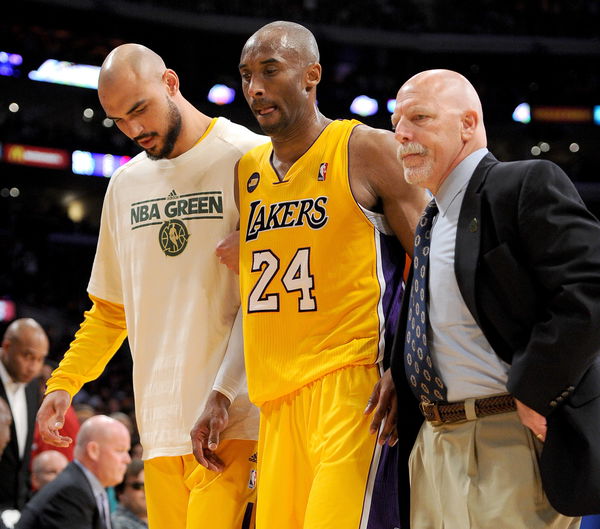
April 12, 2013; Los Angeles, CA, USA; Los Angeles Lakers trainer Gary Vitti and center Robert Sacre (50) help shooting guard Kobe Bryant (24) as leaves the game in the fourth quarter against the Golden State Warriors at the Staples Center. Bryant suffered a torn Achilles tendon. He under went surgery April 13 and is expected to miss six to nine months. Mandatory Credit: Jayne Kamin-Oncea-USA TODAY Sports
But broadly since Kevin Durant’s injury [in 2019], it seems that narrative is starting to change. People are coming back quicker and are performing at a really high level, too.
One of the advances would be surgical technique. More of them move toward minimally invasive procedures versus fully open repairs. There is better technique and technology available to repair a ruptured Achilles. That continues to evolve quite rapidly. Along with the technique evolving, you have the rehabilitation processes evolve, too.”
Gazzaniga: “The No. 1 thing that can help people coming back from an Achilles tear is how the surgery is performed. It can be done in a way that is as minimally invasive as possible by maintaining as much of the normal structures as possible. Before, you would have to make an incision and cut through all of the soft tissue to get to the tendon, repair it, and put all back together. There would be a lot of damage to the blood supply to the tendon. There would be damage to structures around the tendon. How the surgery is done is probably the most important thing in terms of how it recovers. The minimally invasive surgery technique is the most important.”
Kaplan: “The things that have helped players come back are a combination of surgical techniques. When you repair a tendon, you’re trying to take a tendon work like a rubber band so that it’s really explosive. Historically, we would stitch it together. Now, with our surgical techniques, we can repair it much stronger. That allows patients to rehab it much sooner. So when patients like Jayson Tatum can get into physical therapy, he can start working on rehab. That can work up their core strength and muscles a lot quicker. So when they come back to play, they’re stronger and more explosive off the bat.
I also think a bigger aspect that allows players to come back quicker and better is our rehabilitation technique. Things that our physical therapists do now is build up a person’s core strength, hip strength, and all of the muscles outside of the Achilles tendon. Normally, those would weaken when we don’t use them. So our physical therapists have been good with finding ways for patients to use all of their muscles without overloading the tendon that has been repaired.”
Mark Medina is an NBA insider for EssentiallySports. Follow him on X, Blue Sky, Instagram, Facebook, and Threads.