
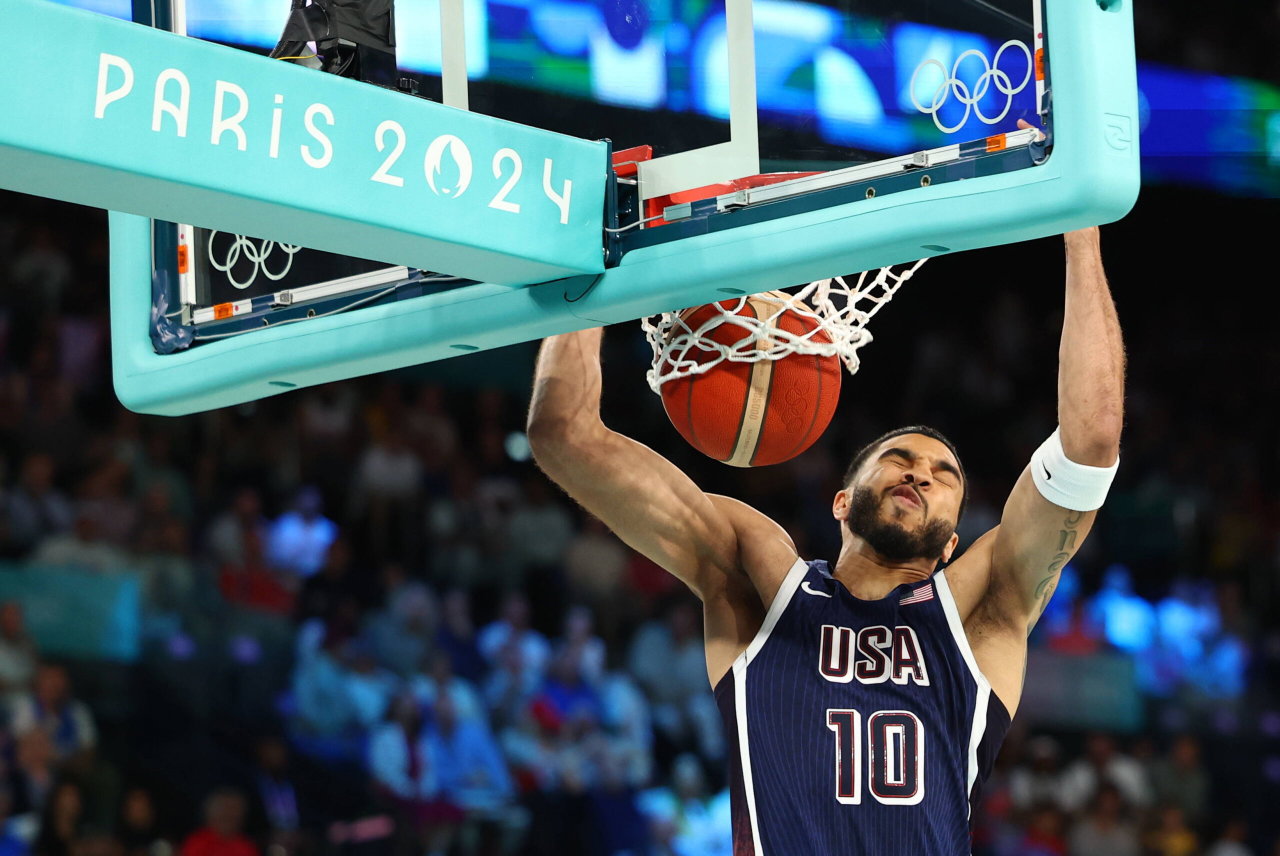
Shaquille O’Neal was already one of basketball’s biggest superstars when he represented the United States at the 1996 Atlanta Olympics. Yet, when Team USA faced Yugoslavia in the gold-medal game, the Lakers legend spent almost the entire night watching from the bench, playing only around five minutes.
Watch What’s Trending Now!
Before the game, head coach Lenny Wilkens approached O’Neal with an explanation that left him disappointed. David Robinson was playing in his final Olympics, and Wilkens wanted to give the veteran most of the minutes, leaving the younger superstar with a much smaller role.
Nearly three decades later, Jayson Tatum experienced a similar reality in Paris, despite entering the 2024 Olympics after winning an NBA championship and earning his third consecutive First Team All-NBA selection. Recalling the experience in his November 16, 2026 Boardroom interview with Speedy Morman, Tatum revealed what Steve Kerr told him before Team USA faced Serbia and how quickly he realized something was wrong.
“I’m like, what the fu** does that mean? Like, why are you telling me that? And then I remember sitting on the bench, and I think it was like, once I didn’t get in the first quarter, I was like, ‘Oh, some fishy sh** going on,'” Tatum said.
The Celtics star was not expecting to spend his summer watching from the sidelines. He had just helped Boston win its first NBA championship since 2008, finished the season as a First Team All-NBA selection for the third straight year, and even appeared on the cover of NBA 2K25.
Tatum described the contrast himself, making it clear why the Olympic experience caught him off guard. The excitement surrounding his career had barely settled when he found himself struggling to understand his place on a team filled with some of the biggest names in basketball.
“I just won the finals, I was All-NBA First Team, I was on the cover of 2K, like I was having a crazy, crazy summer, and then to get to the Olympics and then that happened.”
The decision came down to a major change in Team USA’s rotation. Kevin Durant had missed all five exhibition games because of a Grade 1 right calf strain, but his return ahead of the Olympic opener against Serbia meant Kerr suddenly had another superstar to fit into an already crowded lineup.
Durant came off the bench and made an immediate impact, scoring 23 points on 8-of-9 shooting in less than 17 minutes. His return changed the combinations Kerr wanted to use, and Tatum became the player who missed out when the Americans opened their campaign with a 110-84 victory.
Kerr had actually approached Tatum before the team boarded the bus for the game. According to the Celtics forward, the coach explained that Durant was back and that the team would need to work out its lineup, before asking him to remain patient.
“Steve, he came to me before we got on the bus to go to the game. He was like, you know, Kevin is back, so we’re going to have to try to figure something out with the lineup. He was like, just be patient.”
That message did little to prepare Tatum for what followed. He remained on the bench throughout the game, and only when the first quarter passed without him entering did he understand what Kerr had been trying to communicate.
Tatum admitted that he struggled to make sense of the decision. Even though he wanted to contribute to the national team’s campaign, he also knew that complaining about his minutes could take attention away from what the Americans were trying to accomplish.
“I mean, no, I didn’t understand it. I was confused. I was confused for sure. And, you know, it was frustrating, right?”
Kerr, meanwhile, knew exactly how unusual the decision looked. Leaving a player who had just won an NBA championship and earned another First Team All-NBA selection out of the rotation was never going to pass without questions, especially when the player had been part of the team’s exhibition plans.
After the Serbia victory, Kerr explained that the decision was about finding the right combinations rather than questioning Tatum’s ability. The coach also acknowledged how uncomfortable it was to leave the Celtics star out of the game.
“It’s really hard in a 40-minute game to play more than 10 guys. With Kevin coming back, I just went to the combinations that I felt made the most sense. It seems crazy. I thought I was crazy when I looked at everything and determined these are the lineups I wanted to get to.”
Speaking to ESPN’s Brian Windhorst, Kerr was even more direct about his feelings.
“I felt like an idiot not playing him, but every game’s going to be different based on matchups. Jayson’s gonna play… He’s a total pro.”
Tatum did get an opportunity to return against South Sudan, playing 17 minutes and 10 seconds in the Americans’ 103-86 victory. He followed that with a much stronger individual performance against Puerto Rico, recording 10 points, 10 rebounds and three assists in 22 minutes and 44 seconds.
However, his role became less certain again as the tournament moved into the knockout rounds. Against Brazil in the quarterfinals, Tatum came off the bench and was the 11th American player to enter the game, finishing with five points, three rebounds and one assist in just under 20 minutes.
Then came another meeting with Serbia, and another DNP for Tatum. The Americans had advanced to the semifinal, but Kerr once again decided that the Celtics forward would not be part of his rotation.
This time, the circumstances were considerably more difficult. Serbia pushed Team USA to the brink, building a 17-point lead before the Americans produced a remarkable comeback to secure a 95-91 victory and advance to the gold-medal game.
Stephen Curry led the response with 36 points, knocking down nine three-pointers. LeBron James added a triple-double with 16 points, 12 rebounds and 10 assists, while Joel Embiid contributed 19 points as Kerr leaned heavily on his most trusted players.
The rotation tightened as the game became more difficult, with Curry playing 33 minutes and James logging 32. Neither had played more than 27 minutes in any of Team USA’s earlier games, showing just how much Kerr relied on his leading players when the semifinal was on the line.
Kerr had already addressed Tatum’s reduced role before the semifinal, insisting that the situation had little to do with the forward’s individual performance. He instead pointed toward the difficulty of managing a roster with so many established stars and the combinations that had worked since Durant returned.
“It’s not what I’m not seeing from Jayson. It’s what I’ve seen from the other guys. Like I’ve said many times during this tournament and this last six weeks, it’s just hard to play 11 people, even in an NBA game.”
Kerr continued to explain that Tatum’s absence was not a punishment for something he had done on the court. The coach believed the existing combinations were working, making it difficult to find additional minutes without disrupting the rotation.
“It’s not about anything Jayson is doing or not doing. It’s just about combinations and the way that group has played together, the way Kevin has filled in since he came back from his injury. It’s just a math problem more than anything.”
The second benching also drew a reaction from Tatum’s family. His mother, Brandy Cole, publicly questioned the decision on X after the semifinal, making it clear that she was unhappy with how the situation had unfolded.
“No he not. But if you find out what’s going on please let me know — unacceptable and makes NO SENSE.”
Charles Barkley also questioned the decision, arguing that players should not be expected to represent their country at the Olympics without receiving an opportunity to play. The Hall of Famer compared Kerr’s approach with Chuck Daly’s management of the 1992 Dream Team, pointing out that even Christian Laettner received minutes during the gold-medal game.
But Tatum was determined not to let his individual situation become bigger than the team’s objective. Despite his frustration, he understood that Team USA had a gold medal to win, and he did not want the attention surrounding his playing time to become a distraction.
“I just tried my best to not make it about me, still be the best teammate that I could.”
His biggest concern was that the discussion surrounding his role could eventually overshadow the reason the team had travelled to Paris. For Tatum, winning gold had to remain the priority, regardless of how much time he spent on the court.
“What we’re not going to do is not win the gold medal, because then it’s like, none of this sh** was worth it.”
That mindset became especially important as Team USA prepared for its final game against France. Tatum returned to the rotation for the gold-medal contest, coming off the bench and recording two points, three rebounds and one steal in 11 minutes and three seconds.
The Americans eventually defeated France 98-87, securing their fifth consecutive Olympic men’s basketball gold medal. It was a successful ending for Team USA, even though Tatum’s individual contribution was considerably smaller than what he had been accustomed to providing in Boston.
Kerr later praised how Tatum and Tyrese Haliburton handled their reduced roles throughout the tournament. In September 2024, the coach made it clear that the two players had not allowed their individual situations to affect the team’s atmosphere or their commitment to winning.
“Those guys were all great. Jayson handled things so well. Then obviously it became a media subject, but he couldn’t have handled it better. Tyrese [Haliburton], same thing. Every game was different. And we talked about that from the first night — 12 superstars and probably only nine can play consistent minutes. They handled themselves really professionally and pulled for each other. I couldn’t be prouder of them all.”
Tatum’s experience also brought back memories of O’Neal’s disappointment in Atlanta. In his autobiography Shaq Uncut, the former Lakers center recalled how Wilkens explained that Robinson would receive most of the minutes because it was his final Olympics.
“Before the game Lenny Wilkens came up to me and said, ‘Shaq, you will go to many more Olympics, but this will be David Robinson’s last one, so I’m going to give him most of the minutes.’ Lenny is a very smooth talker, and before I could say anything he just walked off.”
O’Neal later admitted that the decision left him disappointed, particularly because he had barely featured in the final despite being one of the most dominant players in the NBA. He played around five minutes, scored two points and never represented Team USA at another Olympics.
“I barely played in the gold medal game. I played about five minutes total. Wilkens put me in for the final fifteen seconds. I think I had 2 points. It was David Robinson’s third Olympics and my first. So you can’t give me some time? I was really disappointed.”
For Tatum, the experience ended differently, with a gold medal and a tournament he could look back on as a difficult but valuable lesson. Still, his latest comments make clear that winning did not erase the confusion he felt when Kerr first told him to be patient, only for him to spend the opening game watching from the bench.