

In 2024, Jalen Brunson walked into Philadelphia’s Wells Fargo Center and received thunderous “MVP! MVP!” chants, not from 76ers fans, but from the waves of Knicks supporters who had flooded the building and effectively turned it into a road game for the home team. The 76ers organization is determined not to let it happen again, and yet, the numbers already suggest they may be fighting a losing battle.
Watch What’s Trending Now!
Despite the 76ers restricting direct ticket sales for their second-round home games to buyers in the Philadelphia market, TickPick data shows that 56.11% of purchases for Game 3 at Xfinity Mobile Arena have come from ZIP codes registered in New York or New Jersey. In other words, more than half the seats heading into Friday’s home game are already trending blue and orange, and the series hasn’t even started yet.

56.11% of purchases for Knicks–76ers Game 3 in Philadelphia have a ZIP code from New York or New Jersey, per @TickPick

The crowding-out scenario is one Joel Embiid addressed directly after the 76ers’ Game 7 win over the Celtics on Saturday night, delivering a pointed message to Philadelphia season-ticket holders.
“Last time we played the Knicks, it felt like Philadelphia was Madison Square Garden East. We’re going to need the support. Don’t sell your tickets. This is bigger than you. We need you guys,” he said.
The 76ers backed that plea with structural action, announcing restrictions on Ticketmaster that limited direct purchases to residents of the Greater Philadelphia area. Embiid even offered a financial safety net for fans tempted by the premium prices:
“There’s going to be people who will sell the tickets because they need the money. Don’t do it, we need you guys. If you need money, I’ve got you.”
The team’s website went further, warning that purchases would be canceled without notice and refunded if buyers did not live in the Greater Philadelphia area. But those restrictions, however firm on paper, apply only to the primary market.
The secondary market, where TickPick, StubHub, and similar platforms operate, is entirely beyond the team’s control, and that is precisely where Knicks fans are shopping.
TickPick’s data itself is legitimate; they’re simply reporting where purchases are coming from, but it isn’t a perfect proxy for actual attendance or a clean measure of fan split. The numbers lump together two regions with very different allegiances: North Jersey, which leans heavily toward the Knicks (and, more broadly, New York teams), and South Jersey, which is firmly part of Philadelphia’s sports footprint.
That nuance hasn’t stopped the discourse from taking shape. Philadelphia fans have pushed back on the idea that their home court is in danger again, pointing to those geographic realities, while Knicks fans have leaned into the figures, framing them as proof of their ability to travel and influence the environment.
The truth likely sits somewhere in between. Geography explains a portion of the New Jersey share, but the overall percentage, especially this early and despite restrictions, still signals a meaningful Knicks presence building ahead of Game 3.
When the two teams met two years ago, 76ers owners Josh Harris, David Blitzer, and David Adelman teamed up with Michael Rubin to buy over 2,000 tickets for Game 6 and distribute them to Philadelphians who serve the community, an emergency intervention that still wasn’t enough to stop Brunson from closing out the series in Philly to a thunderous ovation.
Embiid’s Plea Echoes 2024, When the Same Crowd Problem Helped Cost Philadelphia the Series
Two seasons ago, the 76ers lost that first-round series to the Knicks in six games, but what Joel Embiid and his teammates remembered more than the defeat was their home court becoming unfriendly territory. Many Knicks fans bought tickets for the three games in Philadelphia, making the then-Wells Fargo Center feel like another Madison Square Garden.
Embiid was openly dismayed at the time when Brunson received raucous “MVP!” chants while scoring 47 points as the Knicks won Game 4 in Philadelphia, saying afterward: “I don’t think that should happen. It’s not OK.”
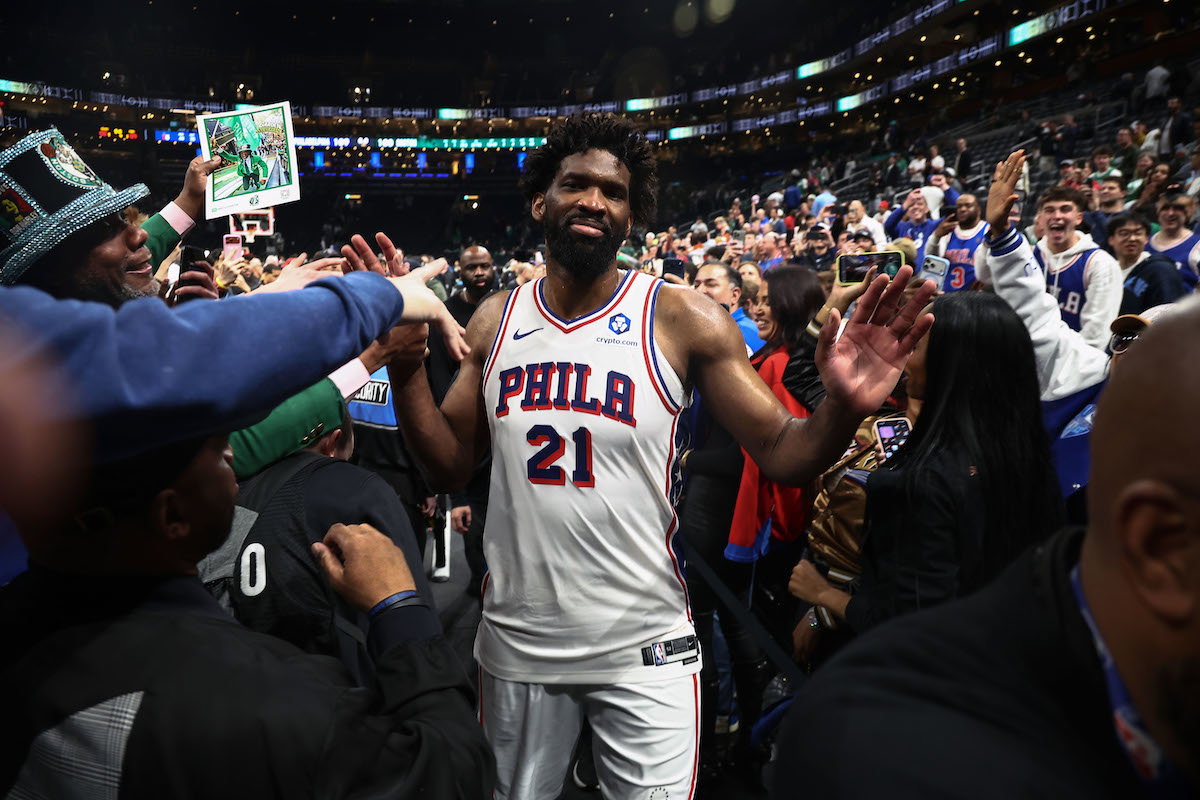
Imago
May 2, 2026; Boston, Massachusetts, USA; Philadelphia 76ers center Joel Embiid (21) gets congratulated as he leaves the court after their win over the Boston Celtics in game seven of the first round of the 2026 NBA Playoffs at TD Garden. Mandatory Credit: Winslow Townson-Imagn Images
This year, the Sixers enter the series as a No. 7 seed, having pulled off one of the more stunning upsets of the postseason, becoming the first No. 7 seed in the East to defeat a No. 2 seed since the first round expanded to best-of-seven in 2003.
The stakes are higher, the opponent is the same, and the crowd problem, according to the TickPick data, is already trending toward a repeat. With lower-level seats near the court going for $4,000 and more, and upper-level mezzanine seats fetching over $500 at center court, the financial incentive for Philadelphia ticketholders to cash out is significant, which is precisely why Embiid’s plea, however heartfelt, may struggle to override basic economics.
The 76ers have home-court advantage on paper for Games 3 and 4. Whether Xfinity Mobile Arena actually plays that way on Friday night is a different question entirely, one that the TickPick data is already beginning to answer.