
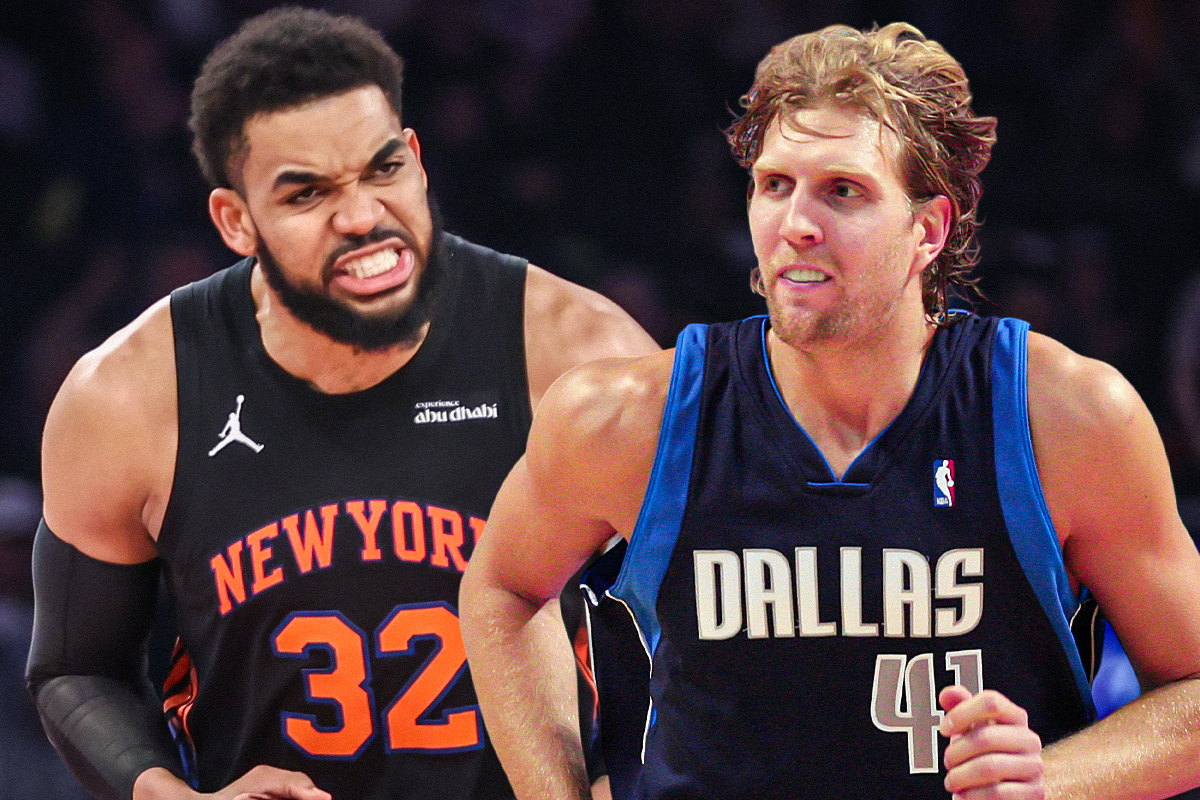
“I’m the greatest big man shooter of all time.”
Watch What’s Trending Now!
Since Karl-Anthony Towns uttered those words in an interview with The Athletic’s Jon Krawczynski, the three-time All-NBA big man has been compared to the progenitor of his archetype, Dirk Nowitzki.
It can be easy to group the two seven-footers into the same basket. Both of them are tall dudes, who can shoot, put the ball on the floor, and run into trouble on defense at times when they are required to slide their feet.
However, I’ve always thought classifying these two in the same player type was lazy. For his career, Towns takes a much greater portion (27%) of his shots from beyond the arc than Nowitzki did (22%). Meanwhile, Nowitzki operated in the midrange (55.7% of shots came from between ten feet and the 3-point line) far more than Towns does (14.9%). In his full form, Nowitzki was a jumbo Kobe Bryant, operating methodically out of the mid-post, while Towns has always been at his best when being used in quick-hitting actions.
How Karl-Anthony Towns Became Dirk Nowitzki
Where the similarities truly exist is in how Towns has been able to mature his game over time. Fourth-wall breaker alert, but during a recent conversation in preparation for our show, Bucket Talk, my co-host, Ben Pfeifer, commented on how amazed he is at Towns’ ability to go from someone who was long seen as a playoff faller into a player who has elevated his game this postseason.
Throughout his career, Towns had developed a reputation for posting gaudy regular-season numbers (typically beating up on weaker defenses), only to experience a drop-off in production when the lights got brighter and the opposition became fiercer. In this setting, teams would regularly stymie Towns by placing sturdy wings/forwards who could throw him off-balance while also matching his quickness. On the flip side, Towns’ limitations as a defender were magnified by prolific playoff offenses.
That was, until this postseason. Towns is scoring less, but that is more of a byproduct of a shift in his role. Even then, his efficiency is WAY up, and impact metrics that put him in rarified air.
This change – from faller to riser – immediately reminds me of what happened with Nowitzki. Maybe I’m being lazy like the individuals I was poking at earlier, but the resemblance is too hard to ignore.
After leading the Dallas Mavericks to the 2006 NBA Finals, only to have them flame out when they got there at the hands of the Miami Heat, Nowitzki received a lot of flak for faltering on the game’s biggest stage. That whole postseason was a difficult one for the former MVP, as his scoring volume, efficiency, and overall impact were all down compared to his regular season average. Falling to the eighth-seed Golden State Warriors after leading his team to 67 regular season wins only exacerbated that narrative.
Back then, European players weren’t viewed as basketball geniuses. Rather, the label “soft” was often attached to them. As is the case with all-star players, a lot of the criticism Nowitzki received was misguided. However, he wasn’t doing himself any favors with his playoff collapses.
Nowitzki responded by leveling up his game, dispelling any narratives that lingered around his legacy with a 2011 title run that featured one of the great title ascensions we’ve ever seen.
How Karl-Anthony Towns Evolved
I keep hinting at it with phrases like “full form” and “leveling up,” but few players experienced the career metamorphosis that Nowitzki was forced to endure. I often liken it to the life cycle of a tiny Charmander evolving into a ferocious Charizard, but like that iconic Pokémon genealogy chart, Nowitzki’s transformation includes three phases.
I’ve already catalogued this journey in pretty great detail, so I’ll keep this summary brief. Nowitzki started his career as a supercharged play finisher, profiting off the advantages that his running mate and beloved basketball buddy, Steve Nash, created for him. Once Nash left to go be an MVP in his own right, Nowitzki was forced to endure more self-creation than ever before. This was fine in the regular season because most teams didn’t have the personnel to match his blend of size, quickness, and skill. But against the very best teams (which is what you typically see in the later rounds of the playoffs), Nowitzki struggled with the increased focus that defenses allocated towards stopping him. After his early exit in 2007, Nowitzki refined his back-to-the-basket game to become the tactician that is now forever etched into our hearts.
Towns’ path isn’t nearly as linear. Throughout his career, there are moments when he was the lone big on the floor, and his offensive numbers were off the charts, only for his lack of traditional paint protection and lateral agility to be exploited on the defensive end of the ball. At other times, teams would pair him with a more defensive-oriented center (like Rudy Gobert); while this cured the defensive concerns, it created spacing problems on the other end that diminished Towns’ offensive effectiveness.
No matter how you slice it, all roads lead back to his current run with the New York Knicks. The Knicks have opted to (mostly) go with the Towns at the five approach. Part of his success is owed to his head coach, Mike Brown, who wisely made the adjustment to start using Towns as a playmaking hub after their Game 3 loss to the Atlanta Hawks.
However, a lot of what we’re seeing is Towns’ doing. Guarding Towns with wing/forward is no longer a viable option. His strength and balance have improved with age, and his decision-making process is sharper than ever before. He no longer plays with his food (taking the fewest dribbles per touch of his postseason career). Now, he swallows his prey whole, as if he were the hardwood equivalent of a Burmese Python. This means that you have to guard him with your center, which leads to the downstream effects that fuel the Knicks’ Towns-centric delay actions.
It works defensively because Towns is busting his butt out there. Since he’s taking 5.6 fewer shots and playing five fewer minutes per game, Towns has more energy to exert himself on that end of the floor. It will never be perfect with Towns, but the veteran has learned how to leverage his strength, IQ, and quick paws just enough to get the job done.
People will argue that the Knicks have benefited from a relatively lackluster array of opponents to get to this point. But what Towns did against Victor Wembanyama and the San Antonio Spurs in Game 1 of the NBA Finals is indisputable.
Towns and Nowitzki are not the same player, and it would probably take five more postseason runs like this one for Towns’ career to stack up to German Jesus. But their shared maturation from fallers to risers is too poetic not to wax. Now, all that remains is to see if Towns can complete his Nowitzki arc by bringing the Larry O’Brien Trophy back to New York.