
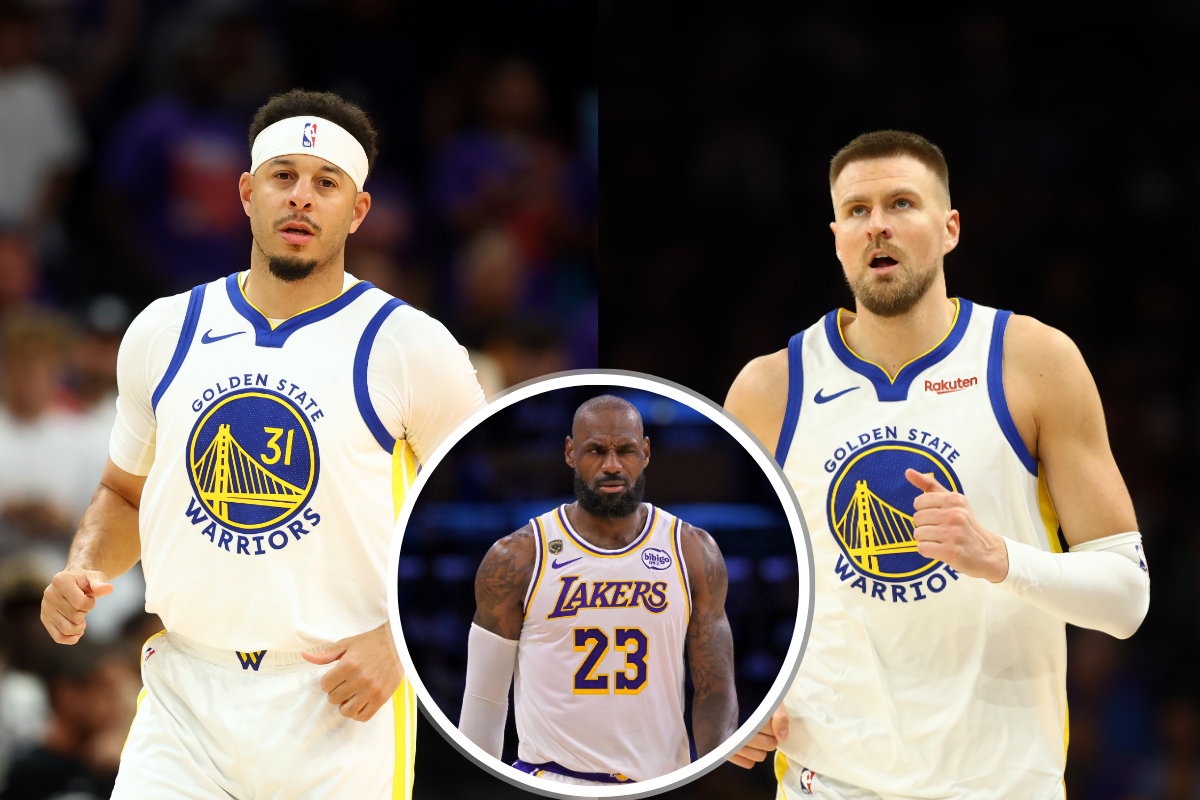
The Golden State Warriors spent the last season learning a brutal lesson about the modern NBA. Talent still matters. Experience still matters. But availability might matter more than anything else now. That realization could end up costing Kristaps Porzingis, Seth Curry, and multiple veteran role players their spots in Golden State this summer. Ironically enough, though, the one aging superstar the Warriors still appear fascinated by is LeBron James.
Watch What’s Trending Now!
According to Tim Kawakami, the Warriors are entering a major philosophical reset around Stephen Curry after a disappointing 37-45 season that ended in the Play-In Tournament. The organization no longer sounds obsessed with repeating “championship, championship, championship.” Instead, the focus has shifted toward getting younger, faster, healthier, and simply more competitive on a nightly basis.
The injury toll that forced this reckoning was staggering even by Warriors standards. Jimmy Butler tore his ACL against the Miami Heat on January 19, ending his season immediately. Stephen Curry missed 27 consecutive games with patellofemoral pain syndrome, also known as “runner’s knee,” in his right leg, returning only in a late-season game against the Houston Rockets.
Then, on March 23 in Dallas, rising wing Moses Moody ruptured his left patellar tendon on a breakaway attempt and was stretchered off the court, ending his career-best season (12.1 points, 3.3 rebounds per game) in an instant.
Al Horford and Quinten Post also missed significant time with their own ailments. As Brandin Podziemski put it after Moody went down: “Same as what happened with Jimmy. No words. You just hate to see it.” The Warriors used 22 different lineup combinations trying to stay afloat – a figure that daunts the franchise’s darkest modern chapter.
This is not the first time injuries have forced Golden State into an involuntary roster rebuild. In 2019-20, the Warriors lost Kevin Durant to free agency, Klay Thompson to a torn ACL, and then Stephen Curry to a broken hand just four games into the season. The team cycled through 22 players that year, finished 15-50, and emerged from the wreckage with the No. 2 pick, which turned out to be James Wiseman.
The lesson from that era: injury-driven roster disintegration can quietly accelerate a generational roster reset. The 2025-26 season appears to be writing a similar chapter, only this time, the franchise believes the core around Curry is still worth preserving.
Porzingis may be the biggest name unlikely to return. The Warriors brought him in hoping his size and floor spacing could elevate the offense around Curry, but the partnership never truly stabilized. The 7-foot-2 big man appeared in just 15 games for Golden State while battling illness and recurring lower-body problems.
Porzingis himself has been candid about the uncertainty. “It’s hard to say,” he told The Athletic after a late-season loss to the Cleveland Cavaliers.
“Of course, it would be nice for me to say I want to continue here. But the reality is I didn’t have a good year at all. I barely showed what I’m capable of. So I have to see what’s out there.”
The Warriors, for their part, have signaled genuine interest in retaining him. GM Mike Dunleavy Jr. has been publicly supportive and has held his Bird Rights, meaning they can exceed the salary cap to re-sign him.
The internal tension is real: paying for potential that injury keeps suppressing versus letting him walk and absorbing the roster hole.
The talent was obvious when he played. The problem was that Golden State rarely knew when he would actually be available. That uncertainty matters even more now, as the Warriors try to survive in a Western Conference suddenly dominated by younger, more explosive teams like the Oklahoma City Thunder and San Antonio Spurs.
The Porzingis acquisition itself came at a significant price. Golden State surrendered Jonathan Kuminga, a former lottery pick and one of its few young, cost-controlled building blocks, to acquire him at the trade deadline.
Steve Kerr spoke enthusiastically about the vision at the time:
“For us right now with no Jimmy and no Steph, we’re just going to him constantly, and he’s really handling that well. That makes it exciting when you think about Steph’s return, to have two guys who can create an advantage for us in any possession.”
The Curry-Porzingis pairing never got enough shared minutes to validate the trade’s cost.
The same logic applies to Seth Curry. The emotional appeal of the Curry brothers sharing a roster always sounded better than the basketball reality. Seth appeared in only 10 games this season due to severe sciatica, logging just 133 total minutes.
At this stage of his career, his defensive limitations already made him a difficult fit inside Kerr’s system. Once the injuries piled up, too, the equation became even tougher to justify.
De’Anthony Melton and Al Horford Facing Similar Questions
Then there is De’Anthony Melton, who may be the hardest decision of the group.
When healthy, Melton is exactly the type of player Golden State wants around Curry — versatile defense, secondary ball-handling, transition energy, and reliable perimeter shooting. But after returning from ACL rehab, the Warriors may hesitate to enter a major bidding war for another player carrying significant injury risk.
Even Al Horford feels increasingly unlikely to stick around as the Warriors prioritize younger legs and more athletic depth. That is what makes the LeBron situation so fascinating.
On paper, pursuing a player who turns 42 in December sounds completely contradictory to everything Golden State is supposedly trying to become. But LeBron is no longer operating on a normal aging curve.
While the Warriors spent the season managing injuries across the roster, LeBron quietly logged 1,989 regular-season minutes. That would have ranked second on Golden State’s entire roster behind only Brandin Podziemski.
He played more total minutes than Curry. More than Draymond Green. More than Butler. That is the contradiction the Warriors may ultimately accept. They are not necessarily trying to get younger just for the sake of getting younger. They are trying to get more durable. And somehow, unbelievably, LeBron still qualifies.
NBA insider Jake Fischer reported as early as January that “the Warriors naturally do plan to feature prominently in the offseason market for LeBron James once he becomes an unrestricted free agent on June 30.”
Marc Stein of The Stein Line added that the Warriors have “maintained a longstanding interest in bringing James to Northern California.”
This interest has genuine historical roots: in February 2024, Warriors owner Joe Lacob personally contacted Lakers owner Jeanie Buss and James’s agent, Rich Paul, to explore a trade, a move that team insider Monte Poole of NBC Sports Bay Area confirmed was partly motivated by James’s own publicly stated desire to play with Curry.
On HBO’s The Shop, James had named Curry as the active player he’d most want to share a court with: “In today’s game — Steph Curry. Steph Curry’s the one.” Golden State and Cleveland are now described by multiple insiders as the frontrunners if James does not retire or return to Los Angeles.
But the financial reality is severe enough to make this more an aspiration than a blueprint.
Curry and Jimmy Butler will combine to make over $119 million in 2026-27.
Draymond Green holds a $27.7 million player option. Moses Moody is owed $12.5 million. According to Warriors cap analysts at The Third Apron, Golden State will have no traditional salary-cap space this offseason – they are projected to operate above the first apron, where the non-taxpayer mid-level exception (estimated around $15 million) is their primary tool.
LeBron, who earned over $52 million from the Lakers this past season, has publicly ruled out taking a veteran minimum.
The Warriors also know the basketball fit is no longer hypothetical. Curry and LeBron developed strong chemistry during their Olympic run with Team USA under Kerr, and Golden State has considered pairing them dating back to previous trade discussions.
Meanwhile, Curry himself appears fully aligned with the organization’s larger reset. Rather than demanding desperate win-now moves, the franchise icon has openly talked about rebuilding the Warriors’ foundation with better athleticism, sharper execution, and more sustainable roster construction.
That shift could define Golden State’s entire offseason. The Warriors’ dynasty is gone. The league has changed too much for them to simply recreate it. Now the challenge becomes building a roster that can survive the physical demands of the modern Western Conference while still maximizing whatever elite years Curry has left.
And if that process means moving on from veterans like Porzingis, Seth Curry, Horford, and possibly Melton while still keeping the door open for LeBron James, the Warriors suddenly seem comfortable living with that contradiction.