
The Utah Jazz entered the 2026-27 season hoping to take a step forward after finishing last year with a disappointing 22-60 record. Instead, injuries have left them scrambling for answers, and their 3-13 start has pushed them toward the bottom of the Western Conference. Yet, just when it seemed like Utah’s focus would be entirely on developing its young talent, an unexpected name has entered the picture.
Watch What’s Trending Now!
The Jazz have already invested heavily in their future, with Keyonte George, Ace Bailey, and Darryn Peterson expected to play important roles in the team’s rebuild. They also have established stars in Lauri Markkanen and Jaren Jackson Jr., although injuries have kept them away from the court. But Utah might be considering a move that could change the direction of its roster much sooner than expected.
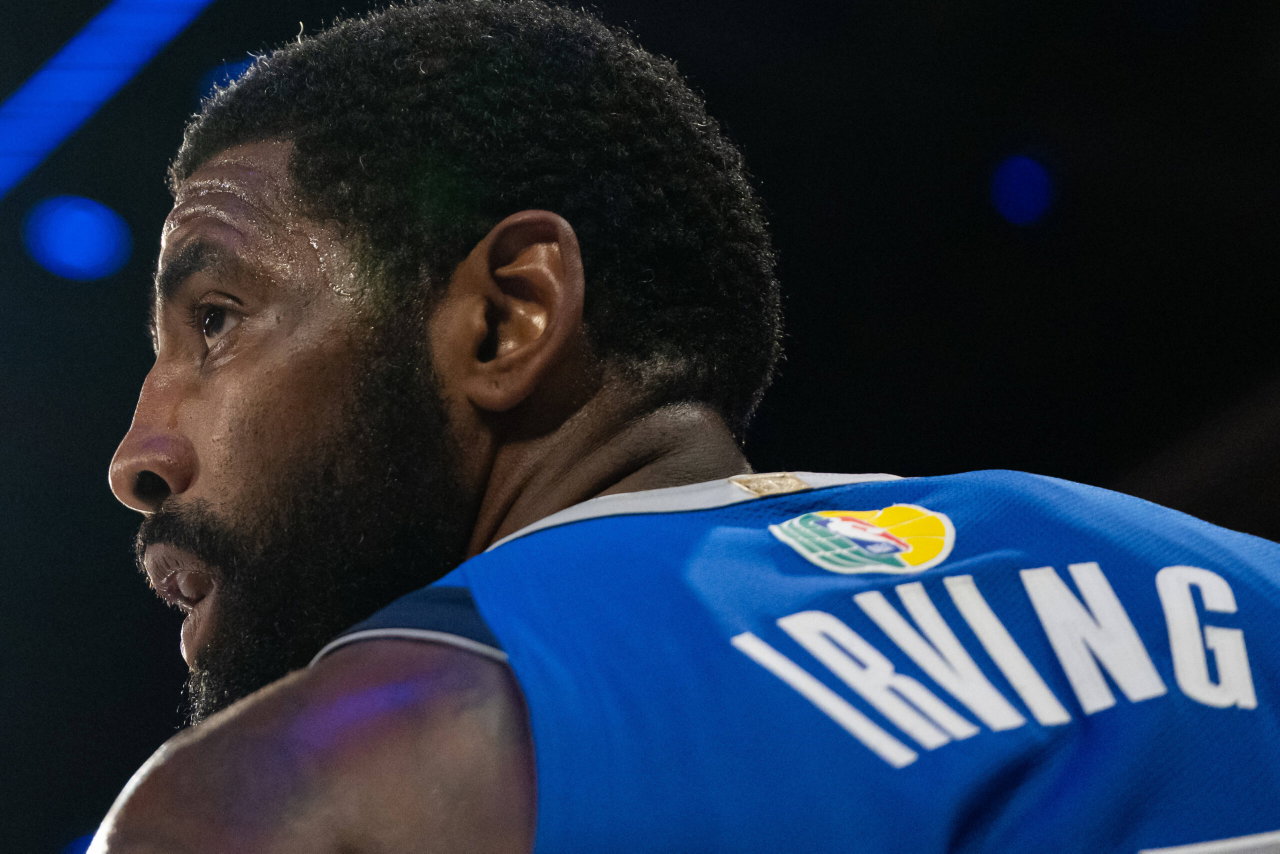
According to NBA insider Ian Begley, the Jazz have internally considered trading for Dallas Mavericks guard Kyrie Irving. Speaking on The Putback, Begley revealed:
“The thing that I’ve heard recently that kind of piqued my interest was Utah doing so with Kyrie Irving, just internally, kind of going through some things and giving him internal consideration as a potential trade candidate.”
Begley also raised the question of what Dallas intends to do with its star guard as the trade deadline approaches.
“Irving, obviously, with the Mavs, so many teams are waiting to see what Dallas does there at the trade deadline. Do they trade Irving?”
The report is certainly intriguing, especially considering Utah’s current position. However, there is an important distinction: the Jazz have internally considered Irving, but there is no confirmed offer, formal inquiry, or ongoing negotiation with Dallas. So why would a rebuilding team even entertain the idea of acquiring a 34-year-old guard?
Utah’s Injuries Could Be Changing Its Plans
The Jazz’s record does not tell the entire story of their season. Their intended starting frontcourt of Markkanen, Jackson Jr., and Jusuf Nurkic has yet to play a single minute together, leaving the team without three important pieces of its rotation.
Markkanen suffered a non-displaced fracture in his right hand on October 30 against Dallas and was scheduled for reevaluation after a month. Jackson Jr., meanwhile, suffered a torn MCL in his right knee during Utah’s fourth game and was ruled out for six to eight weeks without requiring surgery.
Nurkic has also been unavailable throughout the season after suffering a partial plantar plate tear in his right foot during the preseason. He was making progress toward returning to on-court activities in early November, although the Jazz had not provided a confirmed return date.
That leaves Utah relying heavily on its younger players, who have had to take on responsibilities that were not necessarily part of their original development plans. George has emerged as the team’s primary offensive engine, averaging 21.6 points and 7.1 assists in 15 appearances, while Peterson has averaged 16.3 points and 3.9 assists.
Bailey, who averaged 13.8 points and 4.2 rebounds during his rookie season, is another important part of the team’s future. However, Utah’s offense has struggled, ranking 27th in offensive rating, and the team has lacked a reliable late-game creator to take pressure off its inexperienced backcourt.
That is where Irving could become an interesting option. Rather than asking George and Peterson to carry the entire offensive burden, Utah could bring in a player who has spent years creating shots against some of the best defenses in the league.
Kyrie Irving Could Give Utah Something Its Young Core Lacks
Irving is still producing at a high level despite approaching his 35th birthday in March 2027. He is averaging 22.3 points, 3.7 rebounds, and 4.4 assists per game, while shooting approximately 47.4% from the field and maintaining a 57.6% effective field goal percentage.
His value, however, goes beyond the numbers. Irving can create his own shot, attack defenders in isolation, and take responsibility when an offense struggles to find an answer late in games. Those are qualities Utah has struggled to find consistently with its current young rotation.
There is also the possibility that Irving could help the younger players develop without having to shoulder every offensive responsibility themselves. George could continue developing as a primary creator, while Peterson would have an experienced guard to learn from as he adjusts to the demands of the NBA.
Mavericks head coach Jason Kidd has previously spoken about the influence Irving has had on younger players in Dallas.
“When you talk about Kai’s leadership… soft-spoken but powerful. When you look at what he’s done up to this point, he’s a champion… Everyone respects his game. When you talk about him being able to help the younger generation, they all respect the dribbling, the scoring, his competitiveness. So they all want to pick his brain of how they can all get better. He takes the time out to spend with the young group to try to make the game easier for them. That’s just who he is.”
That kind of experience could be valuable for a team trying to develop several young players simultaneously. However, there is another side to the equation that Utah cannot ignore: George is already its primary ball-handler, and adding another high-usage guard could complicate his development rather than accelerate it.
The Jazz have internally emphasized giving George, Peterson, and Bailey plenty of opportunities to develop. Irving’s arrival could change those responsibilities, particularly with George entering an important contract-extension period. Utah would need to decide whether the immediate offensive improvement is worth potentially changing the roles of its most promising young players.
The Financial Commitment Could Make This Even More Complicated
Even if Utah believes Irving could improve the team, acquiring him would require a significant financial commitment. The Mavericks guard is earning approximately $39.5 million this season and holds a $42.4 million player option for 2027-28, which he has yet to exercise or decline.
That is a considerable amount for a team already paying substantial salaries to its established stars. Jackson Jr. is earning $49 million this season, while Markkanen is making approximately $46.1 million, with both players’ salaries increasing next season.
Their combined salaries already account for approximately $95.1 million in 2026-27. If Irving exercises his player option, Utah would be committing roughly $142 million to the three players in 2027-28, before accounting for the rest of its roster.
Utah does have considerable draft capital and enough contracts to explore a potential trade structure. However, that does not mean Dallas would be interested in accepting whatever package the Jazz put together.
Players such as Nurkic, Josh Green, and Jaxson Hayes could enter hypothetical trade discussions, while Utah could also use some of its future draft capital. But any such package remains speculation, and there is no reporting that either franchise has discussed those players or picks.
There is also a bigger question about whether Utah should surrender valuable assets for a player who might not fit its long-term timeline. Irving could improve the team’s offense, but he would not automatically turn a 3-13 roster into a championship contender.
And even if Utah were willing to make that commitment, there is one major obstacle standing between the Jazz and their potential target.
Dallas Has Little Reason to Let Kyrie Irving Go
While Utah might be considering Irving internally, the Mavericks have their own reasons to keep him. Dallas has started the season 8-7 and has found an encouraging partnership between Irving and Cooper Flagg, giving the franchise a veteran star who can help its young centerpiece develop.
The two have already shown what they can accomplish together. They combined for 68 points in a win over Houston on October 30, while their November 9 victory over Indiana saw them put up 78 points together, with Flagg scoring 43 and Irving adding 35.
Flagg is averaging 26.8 points, 6.6 assists, and 6.0 rebounds in the early season. Having Irving alongside him gives Dallas another player capable of creating offense, allowing the rookie to focus on his own game without having to shoulder every responsibility.
Irving has also spoken positively about their partnership.
“He’s a very diverse threat, I’m a very diverse threat. We just play off each other well.”
ESPN’s Tim MacMahon has also explained why moving Irving would be difficult for Dallas, particularly given the way he has fitted into the locker room and alongside Flagg.
“The more I see the team, the more I’m around the team, the more I think it’s going to be awfully hard to trade him… as much as he means to that locker room, as well as he’s working with Cooper. It was beautiful basketball and, basketball-wise, they are a phenomenal fit.”
Marc Stein has reported that the Mavericks have consistently told other teams they do not even want to field calls regarding Irving. That is hardly encouraging news for Utah if its internal consideration ever develops into an actual attempt to acquire him.
Irving himself has also addressed the trade speculation, making it clear that he does not want the rumors affecting what Dallas is building.
“I let the team know out of my own mouth that these trade rumors, anything that’s going on with me, do not let this infiltrate our locker room. Don’t let this get in the way of what we have building here.”
That statement makes Utah’s potential interest even more complicated. The Jazz might see Irving as a player who could help accelerate their plans, but Dallas appears to view him as an important part of its own future.
Utah Might Have More Questions Than Answers
Begley acknowledged that Utah has plenty of trade capital and suggested that the franchise wants to start winning. He also explained why the Jazz considering Irving caught his attention.
“A lot of trade capital there in Utah, and I think they want to win. And so, it’s just interesting to me to hear about that with Utah.”
He added:
“Again, teams around the league are doing similar things, but you’re not gonna spend a lot of time on a player if you don’t even [have] any interest in them.”
That is perhaps the most interesting part of this entire development. Utah’s consideration of Irving does not necessarily mean it is abandoning its rebuild, but it does raise questions about how quickly the franchise wants to become competitive.
The Jazz have the young talent, draft capital, and established players to build something meaningful. Whether they should sacrifice some of that flexibility for a 34-year-old guard is an entirely different question, especially when Dallas has shown little indication that it wants to move him.
For now, there is no confirmed trade offer or negotiation between the two teams. But the fact that Utah has even considered Irving suggests its front office could be thinking about a much faster path back to winning than its current record would suggest.