
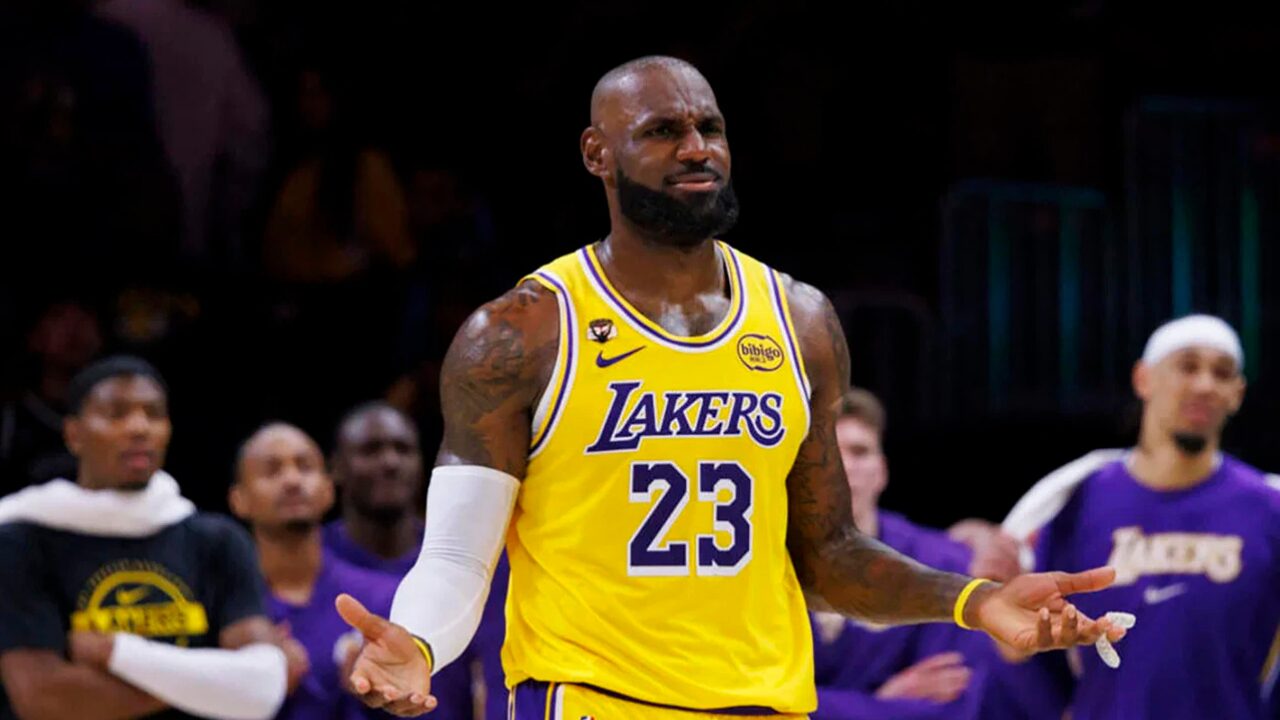
Since LeBron James joined Polymarket, the partnership has kept him in the middle of the conversation. But the noise took a more personal turn when Kyrie Irving briefly reposted criticism tied to the campaign, raising eyebrows over whether he was taking a shot at his former Cavaliers teammate.
Watch What’s Trending Now!
The repost did not stay up for long, but it was enough to get people talking. Was Kyrie simply agreeing with a random criticism, or was there something more behind it?
It started when Eli Manning shared Polymarket’s promotional post on X. A user named Nick quoted it with, “I miss when there was a stigma to selling out.” Kyrie then briefly reposted the criticism before removing it. Omer Osman, another user, captured a screenshot before Irving removed the repost and shared it with the caption, “W repost, Kyrie Irving.”
The interaction stood out because James is one of the biggest names attached to Polymarket’s new campaign. The commercial is set inside a fictional “Polymarket HQ” and features Eli Manning, Sue Bird, Spike Lee and several other athletes and celebrities promoting the platform ahead of football season. James announced the partnership himself, although the exact nature of his deal with Polymarket has not been disclosed.
James has previously questioned the growing influence of sports betting. In 2023, he said betting had “taken some of the integrity out of the game” because some fans cared more about parlays than basketball. A year later, he signed an endorsement deal with DraftKings, and now he has partnered with Polymarket, a prediction-market platform where users put money behind sports and other real-world outcomes.
The timing added another layer. More than $273 million in prediction-market contracts were traded around James’ recent free-agency decision, including more than $43 million on Polymarket’s international platform. Weeks later, James publicly announced his partnership with the company.
The repost also came while Irving and James were already back in the spotlight over Cleveland’s 2016 championship reunion. James organized a European trip marking the title’s 10-year anniversary, with former Cavaliers teammates including J.R. Smith, Kevin Love and Tristan Thompson joining the gathering.
Irving did not attend. Smith later said the group had tried to invite him and claimed Irving had effectively “ghosted” the group chat.
Irving eventually addressed the situation during a livestream, saying he had prior commitments at the NBPA Top 100 Camp. He also pushed back against the coverage surrounding his absence, calling the narrative “psychotic.”
None of that proves there is a feud between Irving and James, but it gave the deleted repost more weight. With the reunion episode still fresh, even a brief repost tied to criticism of James’ latest partnership was bound to draw attention.
And that leads to a bigger issue: why are active NBA players allowed to promote prediction-market platforms at all? The league bans players from wagering on NBA games, but its rules around endorsements are far less restrictive, a gap that has already drawn criticism from fans.
Fans Question NBA’s Rules After LeBron’s Polymarket Deal
The NBA bans players from wagering on league games, with penalties ranging from fines and suspensions to expulsion. But there is no blanket rule preventing an active player from promoting a prediction-market company. The NFL and PGA Tour take a stricter approach, barring players from those partnerships.
That difference has become part of the backlash around James. Fans have questioned why an athlete can promote a platform offering markets tied to sports and even to athletes themselves while being prohibited from participating in those wagers. In one Reddit discussion about the campaign, a fan argued that professional athletes should not be allowed to partner with such platforms at all.
That concern becomes harder to ignore when James himself had recently been the subject of a massive prediction market before announcing the partnership. The debate, then, is less about whether James broke an NBA rule and more about whether the league’s rules have kept pace with prediction markets in the first place.