
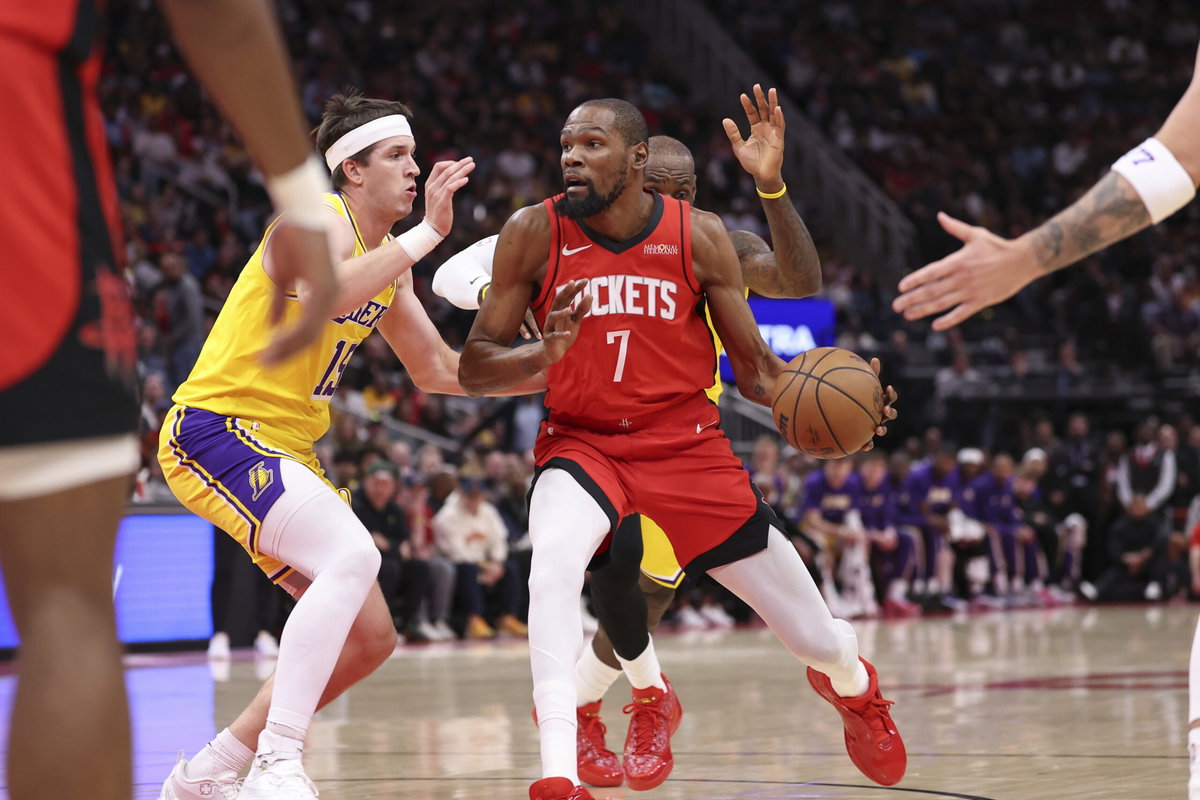
The 2026 NBA Playoffs are here, and few matchups feel more volatile than Lakers vs. Rockets, a series that might ultimately be decided by one question: Can anyone slow down Kevin Durant?
Watch What’s Trending Now!
Even with Luka Doncic and Austin Reaves likely to miss the entire series, we will still have the chance to witness two of the greatest players of their generation (LeBron James and Kevin Durant) go at it for what could be the grand finale of their longstanding rivalry.
Even at their advanced ages (James is 41, Durant is 37), they are both still their team’s leading scorers (among healthy players). In this piece, we break down the best plan for slowing down Durant.
How Will The Lakers Guard Kevin Durant?
The book on guarding Durant has always been pretty straightforward. His release point is too elevated to meaningfully contest. So, the goal should be to disturb his balance by putting a smaller, quicker defender with more meat on his bones. Durant is also incredibly score-focused as an attack, passing on drives at the third-lowest rate of the 97 players who average at least seven drives per game (per NBA.com).
So, you can pre-rotate into the gaps to give his man extra help. Also, Durant’s insane length makes it harder for him to keep a tighter handle (35th percentile turnover rate), which means that shrinking the floor on him will cause him some serious problems.
Durant’s skillset lends itself better to being an on-ball/off-ball hybrid on offense. His best postseason numbers came during his time with the Golden State Warriors, when he was able to play off the likes of Stephen Curry and profit off the marksmen’s unmatched perimeter gravity. This Rockets’ team’s two biggest strengths are ball handling and shooting. On the season, they are 24th in turnover rate and 28th in 3-point attempt rate.
This plays directly into Durant’s weaknesses and gives the Lakers, who aren’t an elite defensive team, a real chance to slow him down. This clip is five years old, but it highlights all the key points we are talking about: quicker/stronger defender (Jrue Holiday), Durant looking to score, defense loaded up on him (which causes him to lose the ball).
Who Specifically Will Be Tasked to Guard Durant?
As for who they’ll task with guarding Durant, that duty will probably go to Marcus Smart. Along with being the team’s best defender (he leads them in Defensive Estimated Plus-Minus, per Dunks & Threes), Smart also has a history of giving The Slim Reaper fits (see the Boston Celtics/Brooklyn Nets first round series in 2022) in the past because he has that rare blend of strength and lateral quickness.
Of course, typical superstar protocol calls for showing different looks. While Smart is, on paper, the perfect foil to Durant, he is still 32 years old and doesn’t yet have access to the same fountain of youth that Durant and James have been bathing in. Look for Rui Hachimura to also have some reps as Durant’s initial defender.
Another wrinkle we’ve seen head coach JJ Redick throw at Durant this season is straight up doubling him every time he touches the ball. We saw this tactic deployed in the fourth quarter of their meeting on March 16, and as a result, the Lakers’ defense held the Rockets to just 12 points with Durant scoring two points on 1-for-3 shooting from the floor and two turnovers. Here are some examples of how this looks:
This strategy preys on Durant’s shaky handle while also gambling that the other guys on the Rockets won’t be able to burn the automatic 4-on-3 situations created by this defense consistently enough to add up to an efficient offense. It worked in that aforementioned game between these two teams. But remember, the Lakers had Doncic and Reaves back then and the Rockets didn’t have Sengun for this one, and the more often a team sees a gimmick defense like that, the greater chance they have of dismantling it.
What Happens Next
A series tends to evolve as the games go on and teams adjust to the terms of engagement. Given Durant’s history of inefficient playoff showings (his career playoff true shooting percentage is over two points lower than his regular season average) and the Rockets’ inability to alleviate that burden from him, I think it will be hard for him to have consistent success in this series.
The real pressure point in this series isn’t Durant’s scoring, it’s decision-making. The more the Lakers can turn their possessions into reads instead of shots, the more they tilt the math in their favor.
Just take a look at NBA.com’s gravity rankings to see how much Durant impacts a defense. According to NBA.com, “Gravity quantifies how much a player pulls defenders towards them above expected, essentially measuring how much attention they draw compared to what the spacing on the floor predicts.”
My guess is the Lakers start with a more traditional defense, centered on Smart guarding Durant and overloading the ball side whenever he touches the ball. As Durant starts hitting tougher shots, Redick’s team will gradually move to more aggressive coverages until they start sending a full-on double team his way any time he touches the ball. At some point, they could start face-guarding Durant and turning half-court possessions into a game of four-on-four. If you’re the Lakers, the idea is simple: dare anyone other than Durant to create efficient offense.
Given how overmatched the Lakers are without Doncic and Reaves, Houston can win this with a below-average showing from Durant.
Even without Steven Adams (who is out for the season with a Grade 3 ankle sprain), Houston is a great offensive rebounding team (1st in offensive rebounding rate). Meanwhile, the Lakers are, at best, an average defensive rebounding team (13th in defensive rebounding rate).
It is one thing for the Lakers to compel Durant into inefficient shots, but it is a whole other thing for them to corral those misses. With all the extra attention being allocated towards Durant, it is unlikely that Los Angeles will consistently be in a proper rebounding position — opening the door for Sengun, Amen Thompson, and the Rockets to feast on second-chance points, the exact margin that can swing a playoff series.