
Imago
Nov 18, 2025; Los Angeles, California, USA; Los Angeles Lakers guard Austin Reaves (15) is congratulated by forward LeBron James (23) and guard Luka Doncic (77) after a three-point basket in the second quarter at Crypto.com Arena. Mandatory Credit: Kirby Lee-Imagn Images
Imago
Nov 18, 2025; Los Angeles, California, USA; Los Angeles Lakers guard Austin Reaves (15) is congratulated by forward LeBron James (23) and guard Luka Doncic (77) after a three-point basket in the second quarter at Crypto.com Arena. Mandatory Credit: Kirby Lee-Imagn Images
The Los Angeles Lakers just offered another glimpse of what their offense looks like when the ball stays in Luka Doncic’s hands. It looked devastating. Los Angeles secured a convincing 110-97 win over the New York Knicks on Sunday night, controlling the game from the third quarter onward. However, the bigger storyline came from who wasn’t on the floor.
LeBron James missed his second straight game. Meanwhile, the Doncic-Austin Reaves backcourt ran the offense almost flawlessly. Doncic poured in 35 points and eight rebounds, while Reaves added 25 points, five assists and four rebounds. Because of their rhythm in the pick-and-roll, the supporting cast thrived.
Watch What’s Trending Now!
Rui Hachimura finished with 13 points, while Luke Kennard added 12 points off the bench as the Lakers stretched their lead to 19 points after three quarters. The Knicks never recovered. However, the bigger question goes far beyond one win. The Lakers have quietly been strong without James all season.
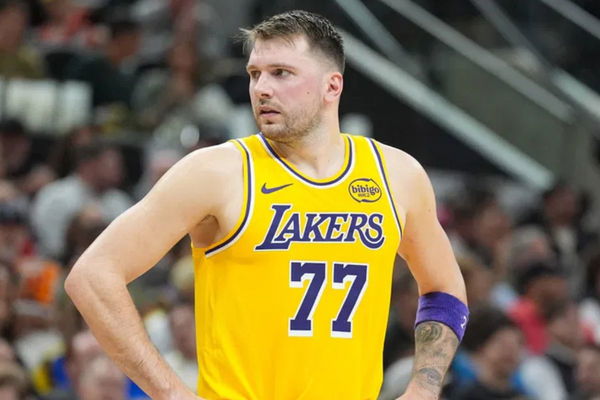
This performance against New York was not an isolated game. The Lakers now hold a 13-7 record without James this season. By comparison, they are 26-18 when he plays. Because of that split, the discussion around the team’s identity has grown louder.
Several of those wins have come against strong competition, including victories over the Minnesota Timberwolves, San Antonio Spurs and New York Knicks. The eye test tells a similar story.
When Doncic and Reaves control the offense together, the ball moves faster and the spacing improves. That dynamic appeared earlier in the season as well. Before James fully integrated into the lineup, the Lakers frequently ran their offense through the Doncic-Reaves pairing. The results were immediate.
Doncic currently leads the NBA in scoring, while Reaves is averaging a career high in points. Their chemistry also showed up in the recent scoring bursts. Against the Knicks, the pair combined for 60 points. Just one game earlier against the Indiana Pacers, they produced 63 points together. Because of that production, the Lakers often look like a modern guard-driven offense when the two share control.
Why the trio fit has been complicated
Despite the offensive firepower, the Lakers have struggled to consistently maximize all three stars. Head coach JJ Redick faces a complex balancing act. Doncic, James and Reaves are all elite shot creators who prefer to operate with the ball in their hands. When they share the floor, the offense can become crowded.
As a result, possessions sometimes slow into isolation basketball. Defensively, the fit raises even more questions. Doncic stands 6-foot-8, Reaves 6-foot-5, and James 6-foot-9. Yet the lineup often plays small defensively because all three spend significant time on the perimeter.
James is now 41 years old, which naturally limits his ability to consistently defend guards or chase wings across screens. Meanwhile, Doncic and Reaves have never been known for their defensive impact. Because of that combination, the Lakers have struggled to protect the perimeter. That defensive vulnerability creates a difficult lineup dilemma.
The Lakers’ offensive ceiling becomes clear when the roster simplifies around Doncic. Without James on the floor, the offense tends to flow through a “Luka-plus-four” alignment. That approach surrounds Doncic with shooters and secondary playmakers.
Reaves thrives in that structure. The undrafted guard has developed into one of the league’s most efficient offensive players this season. He is averaging 23.9 points, 5.5 assists and 4.8 rebounds per game. Even more impressive is his efficiency.
Reaves is shooting 50 percent from the field, 38 percent from three and 87 percent from the free-throw line. His late-game production has been particularly valuable. Reaves ranks third in the NBA in fourth-quarter scoring at 7.6 points per game, trailing only Giannis Antetokounmpo and Donovan Mitchell.
That ability to create offense late in games makes him a natural complement to Doncic’s heliocentric playmaking. When defenses collapse on Doncic, Reaves attacks the rotating coverage. Because of that partnership, the Lakers can generate elite offensive numbers when the two control the offense.
The playoff reality still favors LeBron
Still, regular-season rhythm does not always translate into playoff success. The Lakers remain only two games above the play-in line, which means postseason positioning remains fragile.
In the playoffs, defensive weaknesses become far easier to exploit. Opponents will aggressively target weaker perimeter defenders and hunt mismatches through constant pick-and-roll action.
That reality places renewed importance on James. Even at 41, his postseason experience remains unmatched. James is a four-time NBA champion, four-time MVP and future Hall of Famer. His ability to control pace and manage playoff possessions remains a major advantage.
Doncic reached the 2024 NBA Finals with the Dallas Mavericks, but that experience still ended in defeat. Because of that history, relying entirely on Doncic and Reaves could be risky during a deep playoff run.
Ultimately, Redick must solve one central puzzle. How do the Lakers maximize the Doncic-Reaves offense while still utilizing James effectively?
Reducing James’ offensive workload could unlock the team’s spacing and pace. At the same time, removing him entirely would eliminate the Lakers’ most experienced postseason leader.
That tension reflects a familiar NBA transition. Teams eventually move from an aging superstar to a younger core. The San Antonio Spurs faced a similar evolution when Tim Duncan gradually ceded offensive control to Kawhi Leonard late in his career.
For the Lakers, the shift toward Doncic appears inevitable. However, championship teams rarely rely on only two creators. That is why the Lakers’ postseason hopes likely depend on finding the right balance.
The Doncic-Reaves duo may be the engine driving Los Angeles forward. But if the Lakers want to survive the Western Conference playoffs, the experience of LeBron James could still be the difference between a promising run and an early exit.