Imago
via Imagn
Imago
via Imagn
Imago
via Imagn
Imago
via Imagn
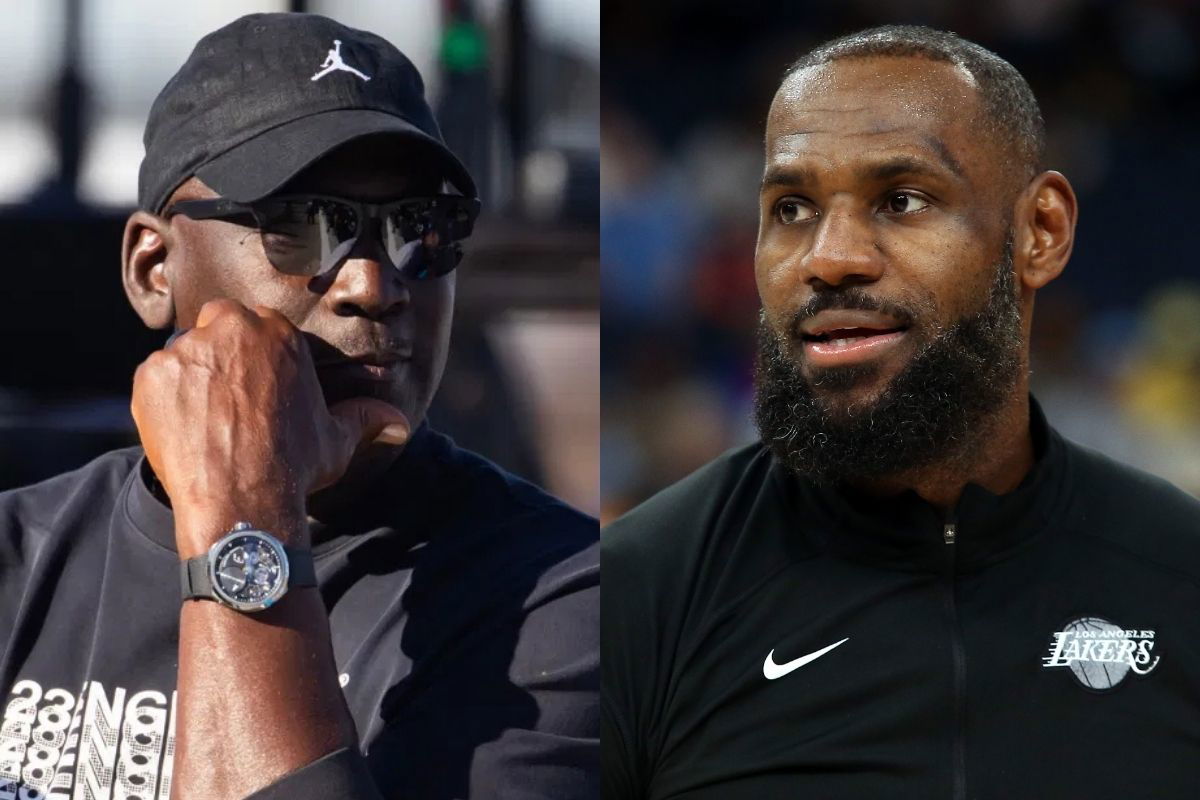
In the high-stakes debate for the superlative NBA legacy, there’s one inarguable category LeBron James can’t compete with Michael Jordan in. That is, of course, the very commercial competition of the sneaker business. While Michael Jordan rakes in at least $330 million for his NIL, so to speak, Bron’s signature Nike kicks just never stood a chance. Not even long after Jordan retired. His old friend claims to know why.
Watch What’s Trending Now!
In this economy, Rich Paul repeatedly bringing up His Airness should be saturating. His last hot take about picking Jordan to take the final shot was not well-received. Especially when fans can’t separate his apparent bias as LeBron James’ friend and agent. But after the last statement, this one hits different.
Paul conceded Jordan rules the sneaker business even two decades after retiring. And he hails the Jordan Brand’s very smart marketing for that.
“People didn’t buy MJs because they wanted to be like Michael Jordan,” he said on Game Over. “That was half of the people. You know what the other half was? They wanted to be like Max who had the BMW and the cute girl, and that had on the Michael Jordan’s.”
Rich Paul on the real reason people wear Michael Jordan shoes 👀
“People didn’t buy MJs because they wanted to be like Michael Jordan. That was half of the people. You know what the other half was? They wanted to be like Max who had the BMW and the cute girl and that had on the… pic.twitter.com/b1FYkPn8b5
— NBA Courtside (@NBA__Courtside) January 2, 2026
If you’re wondering who is Max, that’s no Jordan Brand athlete. He’s referring to Max Kellerman, the veteran sportscaster and the co-host of the Game Over podcast. He’s a diehard Jordan fan who has constantly argued for his greatness.

We don’t know how many Air Jordans Kellerman owns, if he does, but Paul uses him as a metaphor for the influencers. The Jordan Brand has expanded its reach beyond signature athletes like Luka Doncic and Jayson Tatum.
That’s why, after the “final shot” backlash that Paul received, he now doubled down on Jordan’s sneaker empire. He framed that as a business reality and not as his personal choice, staying clear of any further controversy.
As Paul explains later in the podcast, through signees like Travis Scott, college sports, football players and even NIL athletes like Kiyan Anthony, the son of the first Jordan Brand star Carmelo Anthony, the Jumpman brand has maintained its relevance even today. This effective strategy has made billions and Jordan walks away with a cool 5% chunk of it every year.
It can be credited to the Jordan Brand’s marketing evolution as Paul rightfully pointed out.
Air Jordan marketing keeps Michael Jordan relevant
Rich Paul needs to watch his words whenever he takes the name of the Black Cat. Only a few episodes ago, he said he would take Michael Jordan over LeBron James and Kobe Bryant to take a clutch shot. That invited a lot of backlash and forced him to clarify his stance in the next episode.
“No, that got misconstrued,” Paul said. “The internet clips it. What happened was, they asked me a question about the three players. So, I said ‘Yeah, if I’m starting a team, I’m taking LeBron at No. 1.’ I’m still taking LeBron at No. 1, and I would take MJ to take the last shot, but that’s not saying that I’m choosing one over the other.”
You would think that he’d avoid touching upon the 6x NBA champ so quickly after that. But he’s come back to it to assert MJ’s dominance in the sneaker world. His analysis is not wrong either.
The ‘Be Like Mike’ campaign started with Gatorade, but made everything Jordan touched/advertised turn into gold. It became associated with Nike’s marketing of Air Jordan in the ’90s, too, even without them explicitly taking it.
Kellerman and Paul suggest that Air Jordan’s premium price since the first one dropped in 1985 is a type of social signaling. Instead of pure athletic aspiration that perhaps a performance shoe like the Nike Kobes could inspire, the Air Jordan became a lifestyle symbol.
Today, the Jordan Brand occupies the second-largest share of the global sneaker market. Right after Nike itself. James’ signature shoes aren’t bad, but it’s had relatively much lesser sales.
It’s a bit touchy because Bron’s fans have voiced frustrations over the lack of marketing and releases for his sneakers. Yet Paul’s latest comments are already getting “misconstrued” again for implying Jordan doesn’t hold any cultural relevance of his own. He can’t catch a break. Maybe he should just avoid talking about Jordan for a while.