
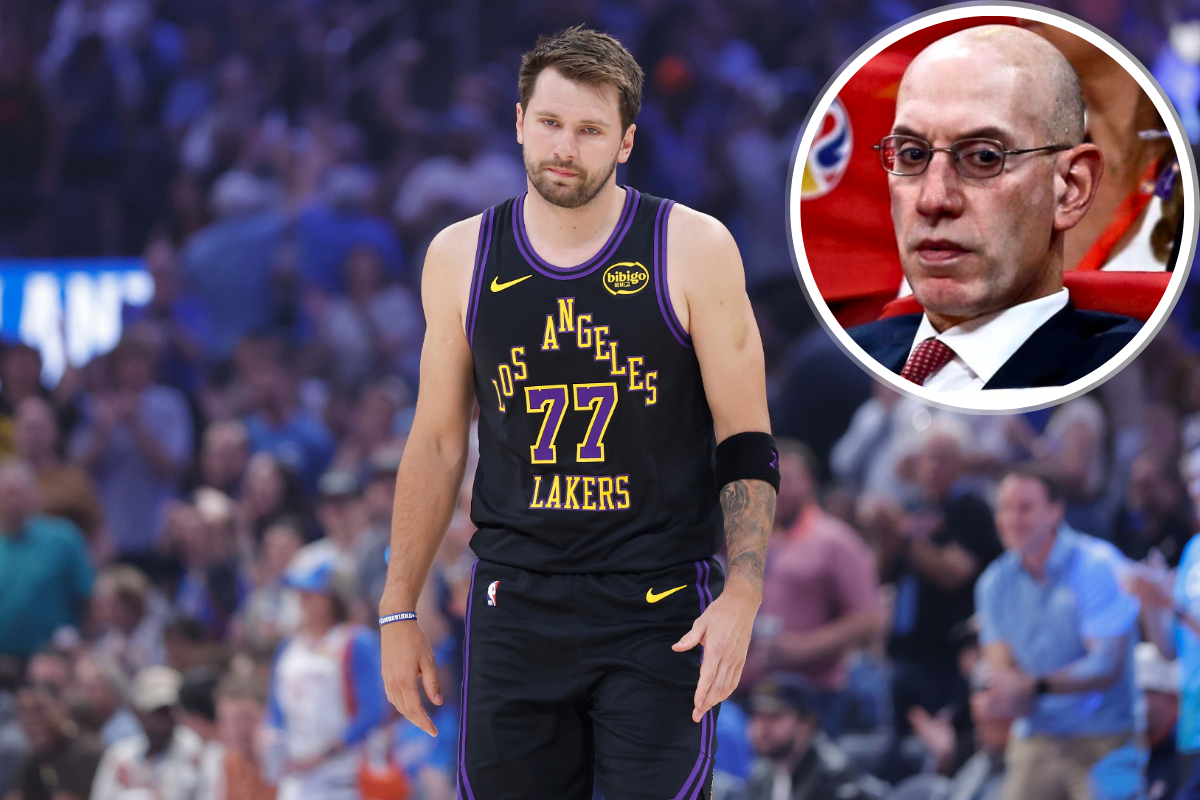
Something about the MVP race felt settled on paper but unsettled everywhere else. The numbers lined up, the lifeline narratives were in place after the unprecedented “Extraordinary Circumstances” exemption was selectively enforced, and the league did what it always does this time of year. It announced its end-of-season award finalists and moved forward as if nothing unusual had happened. Then came the reveal. The NBA officially named Shai Gilgeous-Alexander, Nikola Jokic, and Victor Wembanyama as the three finalists for the 2025-26 MVP award. Noticeably absent from that list was Luka Doncic.
Watch What’s Trending Now!
And that omission did not just raise eyebrows. It lit the entire basketball world on fire. Because this was not just another “he finished fourth” situation. This was a full-blown rejection of a historic statistical season… Before diving into the outrage online, it is important to understand why this became a debate in the first place. Doncic’s season was absurd by almost any traditional MVP standard. He led the league in scoring at 33.5 points per game while adding 8.3 assists and 7.7 rebounds. His usage rate hovered around 38 percent, which basically means every other Lakers possession felt like it ran through him.
Meanwhile, the Lakers won 53 games and secured the fourth seed in the West. That usually checks enough boxes to at least land a finalist spot. So, why did the voters go in a different direction? We don’t have an accurate answer on that yet, but what we can tell you is that the MVP finalists and winner are decided by a panel of 100 media members, not the league office. That means Adam Silver is not picking favorites, even if fans might think otherwise…
It appears that the voters leaned toward a different definition of “value.” Gilgeous-Alexander led a 64-win team with elite efficiency. Jokic put up one of the most complete all-around seasons, averaging a triple-double for two straight years. Wemby anchored a 62-win Spurs team with a dominant two-way impact. In short, team success, efficiency, and defensive value carried more weight than pure offensive dominance. And that is exactly where the disconnect began.
The NBA community explodes in anger as Luka Doncic misses out on the MVP award’s final list, Lakers star yet to break the silence…
Fans did not wait to process this newest piece of information. Why? They felt they were hard done by and reacted instantly. The first wave was pure outrage. “NO LUKA THIS LIST IS INVALID,” a fan wrote. That reaction might sound emotional, but it is rooted in something real. Doncic outscored every finalist while carrying one of the heaviest offensive loads in the league. Historically, seasons like that at least earn a seat at the table. He was eligible for the award after the NBA and NBPA together approved his agent’s challenge of the 65-game rule… Still, frustration did not stop at the snub itself.
For many, the anger quickly shifted toward the league. “Another reason why ADAM SILVER’S NBA IS A JOKE. A pathetic excuse for a league.” Perception matters more than process in moments like this. Fans see the league as one system, and when outcomes feel off, the blame travels upward. That said, Silver’s recent comments on the 65-game threshold aren’t really helping his case.
“I still think the (65-game) rule is working,” Silver said during an appearance on WFAN’s ‘The Carton Show’. “Remember, even when we came together with the union and passed this rule, one-third of all NBA players, the season before we put this rule in place, did not play 65 games, which is crazy. And remember, from the union standpoint, it’s zero-sum. In our collective bargaining agreement, if we pay out 50% of the revenue, we pay out 50% of the revenue.”
“Where this becomes important is not just, I think, for players who deservedly want to be eligible for these honors, but it also has an impact on their contract,” Silver continued. “To the extent, one player doesn’t get the money, another player does. So the union’s always on both sides of these things, and we always knew anywhere you drew the line, there would be guys who would both be disappointed, and some people might say it was unfair.”
After seeing a process in which Doncic and Cade Cunningham had to be provided special exemptions to qualify despite their on-court numbers, the community expected the Commissioner to speak about the evolution of the rule to modern-day hoops rather than defending what was fixed during the last CBA.


The three finalists for the 2025-26 Kia NBA Most Valuable Player Award: ▪️Shai Gilgeous-Alexander, @okcthunder ▪️Nikola Jokić, @nuggets ▪️Victor Wembanyama, @spurs

That said, the real target of frustration soon became clearer. A larger section of fans pointed directly at the voting structure. “The media should not be allowed to vote in MVP races anymore…” And this is where things get interesting. The MVP has always been a media-driven award. That system has produced controversial results before. Think LeBron James losing MVPs during peak dominance or James Harden falling short despite historic scoring runs. The pattern is consistent. MVP is not just about numbers. It is about narrative, team success, and sometimes voter fatigue. Still, some pushed the argument even further.
Others argued the issue was not just voting, but shifting the criteria. “Mvp was always given to the best offensive player… until Luka…” There is some truth buried in that frustration. Offensive dominance used to carry more weight. But today’s MVP conversation includes efficiency, defense, and impact on winning. Look at the contrast:
- Doncic brings unmatched offensive volume
- Jokić delivers efficiency and total control
- SGA combines scoring with elite team success
- Wembanyama adds generational defense
So, while the criteria have not officially changed, the emphasis has clearly changed. And that shift is what fans are really reacting to. Finally, the frustration spilled into a broader critique of the league itself. “S****y product, s****y media voters… you wonder why your league is viewed as a joke.” That might be over the top, but it reflects a real tension.
The NBA is thriving globally, and Doncic is one of its biggest stars. When a player driving billions of views gets left out of the MVP finalists, it creates a perception problem. Fans start questioning whether the product they are watching aligns with the awards being handed out.
Here is the reality. This is not the first time an MVP race has sparked backlash, and it will not be the last. From Kobe to Harden to LeBron, the award has always balanced stats, storylines, and winning in ways that leave someone unhappy. But this situation hits differently because of how obvious the numbers feel. Doncic did everything fans associate with MVP dominance. He scored, created, carried, and won. Yet he still fell short of even making the finals.
That disconnect is where the real issue lies. Because once fans stop trusting how “value” is defined, the award itself starts to lose clarity. And when that happens, every future MVP race gets a little harder to believe in.
The final voting results have yet to be released. The playoffs will shift narratives again. Someone will lift the trophy. But one thing is already clear. This conversation is not going away anytime soon.