
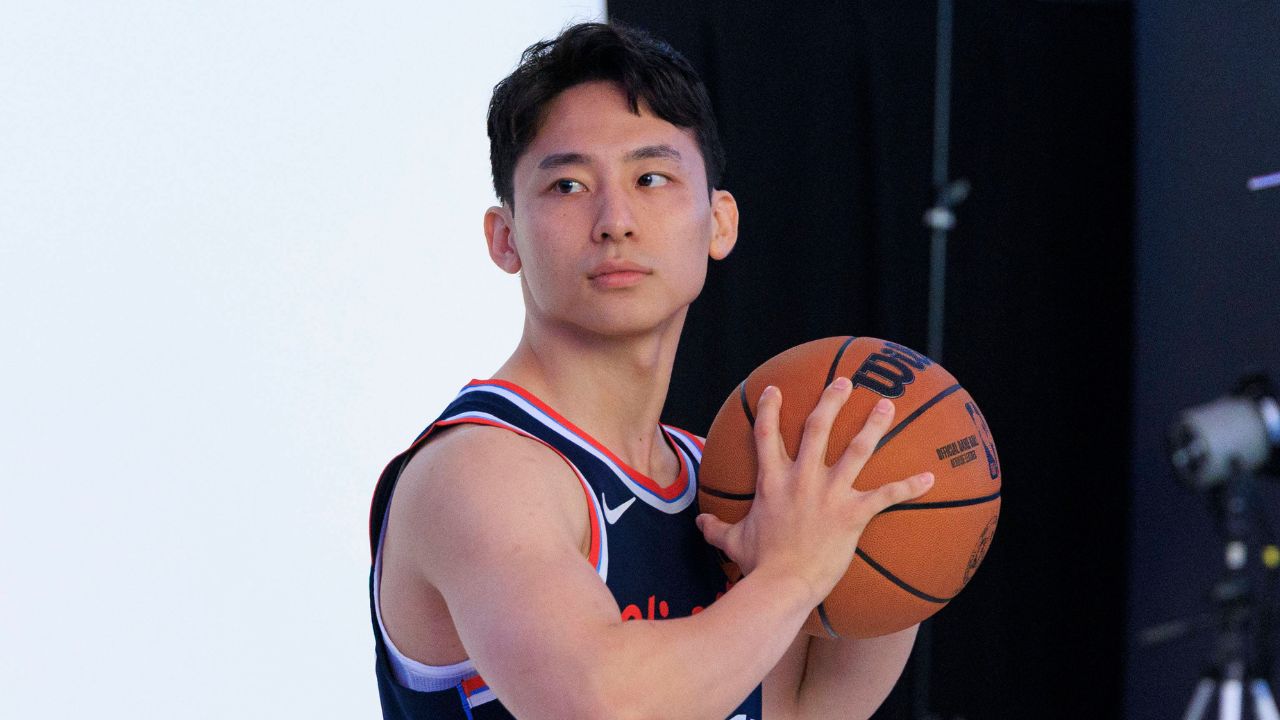
At 5-foot-7, Yuki Kawamura was never going to have an easy time making his mark in the NBA. Yet during his first training camp with Memphis, he drove straight at Zach Edey, the Grizzlies’ 7-foot-4 center. Kawamura was not backing away from the size difference. He was attacking it.
Edey remembered the moment. “He was just driving straight at me, like first possession… He plays bigger than he is. He drives in the paint, he’s trying to make plays, he’s trying to get to the rim. [And] he’s really good,” the Grizzlies center said.
That fearless approach has helped Kawamura reach the NBA, but it has not guaranteed him a place there. The Los Angeles Clippers waived him on October 12, just two days after his 10-point preseason showing against Toronto. At media day, Kawamura had made his goal clear: “It’s always special for me to play in the NBA. But my goal is to get a main contract or a two-way contract. Right now, I have a training camp contract. I’m going to chase my dream, and I’m gonna show everybody who I am during training camp.” His release raises a bigger question: can his playmaking overcome the defensive challenges that come with his size and earn him another NBA opportunity?
The Clippers signed Kawamura to a one-year Exhibit 10 contract in August, giving him a chance to compete for a roster spot while leaving open a potential path to their G League affiliate. It was an opportunity to prove he could offer something different from the guards already in the rotation.
His speed and passing could give a team another way to create offense, particularly when a possession breaks down. But those skills had to be weighed against the defensive matchups he could face and the limited space available on the roster. Marc Stein reported the waiver on October 12, ending Kawamura’s training camp bid in Los Angeles.
Why the Clippers still had a difficult decision to make
The Clippers’ roster situation helps explain why one encouraging performance may not have been enough. Los Angeles had 15 guaranteed standard contracts heading into the regular season, meaning Kawamura’s path to a standard roster spot was limited. Keeping him would have required the team to make another roster decision, rather than simply adding him without consequence.
That did not mean Kawamura had nothing to offer. His ability to run the offense and create for others gave him a different profile from a guard whose primary value comes from defense or playing without the ball. The challenge was finding a role that justified using a roster spot on a player who could also create difficult defensive matchups.
The distinction becomes more important when considering how NBA teams defend. A small guard can use quickness and anticipation to disrupt an opponent, but bigger players may try to force switches and attack the resulting mismatch. Kawamura’s two steals against Toronto were encouraging, but they could not settle the wider question of how he would fare over longer stretches against NBA-level size.
Los Angeles also had options beyond adding another player to its standard roster. The team entered this period with an open Two-Way contract slot, while reporting pointed to an October 15 guarantee deadline involving Cam Christie. That gave the Clippers another decision to weigh as they finalized their roster. The open slot is important context, but it does not establish that Kawamura was the player they intended to use it on.
The available reporting does not establish that one specific player or injury caused the waiver. What is clear is that Kawamura’s preseason performance had to be weighed against the team’s roster needs, not judged on its own. A good night could strengthen his case, but it could not guarantee him a place.
From Japan’s MVP to an NBA roster battle
Kawamura’s NBA pursuit did not begin with the Clippers. Before arriving in the United States, he had already established himself as one of Japan’s leading guards. He won the B.League MVP and Rookie of the Year awards in 2022-23 with the Yokohama B-Corsairs, before leading the league in assists the following season.
His rise also reached a much bigger audience at the 2024 Paris Olympics. Kawamura averaged 20.3 points and 7.7 assists across Japan’s three games, including a 29-point performance against France. Japan eventually lost that game 94-90 in overtime, but Kawamura’s ability to create offense against a team featuring NBA-level size helped draw international attention to his game.
But the NBA presents a different test. Against bigger defenders, a driving lane can close faster, a passing window can disappear, and finishing near the basket becomes more difficult. The same quickness that makes Kawamura dangerous also has to translate into reliable production against longer, more physical opponents.
He received his NBA opportunity with Memphis in 2024-25, appearing in 22 games. He later joined the Chicago Bulls, splitting his time between the NBA and their G League affiliate, the Windy City Bulls. His NBA career has given him valuable experience, but it has also highlighted the gap between creating opportunities in limited minutes and earning a consistent rotation role.
His G League production offers another reason not to dismiss his NBA chances. Kawamura averaged 18.7 points and 11.0 assists in 11 games for the Windy City Bulls during 2025-26. Those numbers show the level of offensive responsibility he could handle in that setting. The next step is proving that the same playmaking can remain effective when NBA defenses have more size, speed and experience to throw at him.
His NBA shooting numbers underline that challenge. Across 40 appearances with Memphis and Chicago, Kawamura shot 34.1% from the field and 30.0% from three-point range. Those figures do not tell the whole story of his game, especially his passing, but they do show why his scoring needs to become more reliable. For a guard with limited size, making defenses pay for giving him space could be especially important to earning a consistent role.
For the Clippers, the question was not simply whether Kawamura could play basketball at a high level. His career already offers evidence that he can. The question was whether his particular mix of skills could fit into the team’s limited roster space and survive the defensive demands of the NBA.
Why Kawamura’s NBA journey means so much to his fans
Kawamura’s appeal is not difficult to understand. Fans have followed his journey from Japan to the NBA, watched him compete against some of the world’s best players, and seen how much he values their support. For them, his preseason appearances are not just about a box score. They are another chance to see a player they have backed take a step toward establishing himself in the league.
Kawamura has made it clear that he does not take that support lightly. “I truly appreciate their support because I couldn’t have done it without them,” he has said.
At the Clippers’ September media day, he also explained what that attention means to him: “It’s amazing. I really appreciate the fans and the energy they give me. I just want to meet their expectations, bring that energy to the court, and show everybody who I am.”
Those comments help explain why his roster status matters to more than the team deciding who fills its final spots. For fans who have followed him from Japan to Memphis, Chicago and now Los Angeles, every NBA appearance is another chance to see how far his game can go.
The difficult reality is that fan support cannot decide an NBA roster. Teams still have to consider how a player fits into their rotation, what he offers on both ends of the floor, and whether they can justify using a limited roster spot on him. Kawamura’s popularity explains why his release matters to so many people. His next performances will have to make the basketball case for another opportunity.
For Kawamura, the immediate priority is finding a place where he can play regularly, keep developing and show that his playmaking can work against bigger opponents. Another NBA opportunity will depend on what he does with that chance, not simply on whether a roster spot opens up.
What comes next for Kawamura?
The most likely next step is the San Diego Clippers, Los Angeles’ G League affiliate, although the assignment should not be treated as completed until it is officially confirmed. His Exhibit 10 contract provides a potential route to continue developing within the organization after clearing waivers.
The contract also carries a financial incentive. Under the reported terms, Kawamura could earn a bonus of up to $91,000 if he joins San Diego and remains with the affiliate for at least 60 consecutive days. The payment is conditional, not guaranteed simply because the Clippers waived him.
For Kawamura, the G League would offer something he has not always had in the NBA: a chance to play regularly and handle the ball more often. That would give him opportunities to build on his passing and scoring, while working to show that his offensive strengths can translate against the physical demands of NBA competition.
The Clippers could revisit their options during the season, particularly if their needs change. But Kawamura cannot build his next move around the hope that an opening appears. He needs to keep producing, show that his playmaking can translate against tougher competition, and make his defensive limitations less costly for the team playing him.
When Kawamura drove at Edey in Memphis, he showed the confidence to attack a defender who had a huge physical advantage. His next challenge is different. He has to show that his passing, pace and decision-making can give an NBA team enough value to outweigh the matchups opponents may try to exploit. The Clippers’ decision has closed one immediate door, but it has also made the next test clear: Kawamura must turn flashes of NBA potential into a level of play that teams can trust over time.