
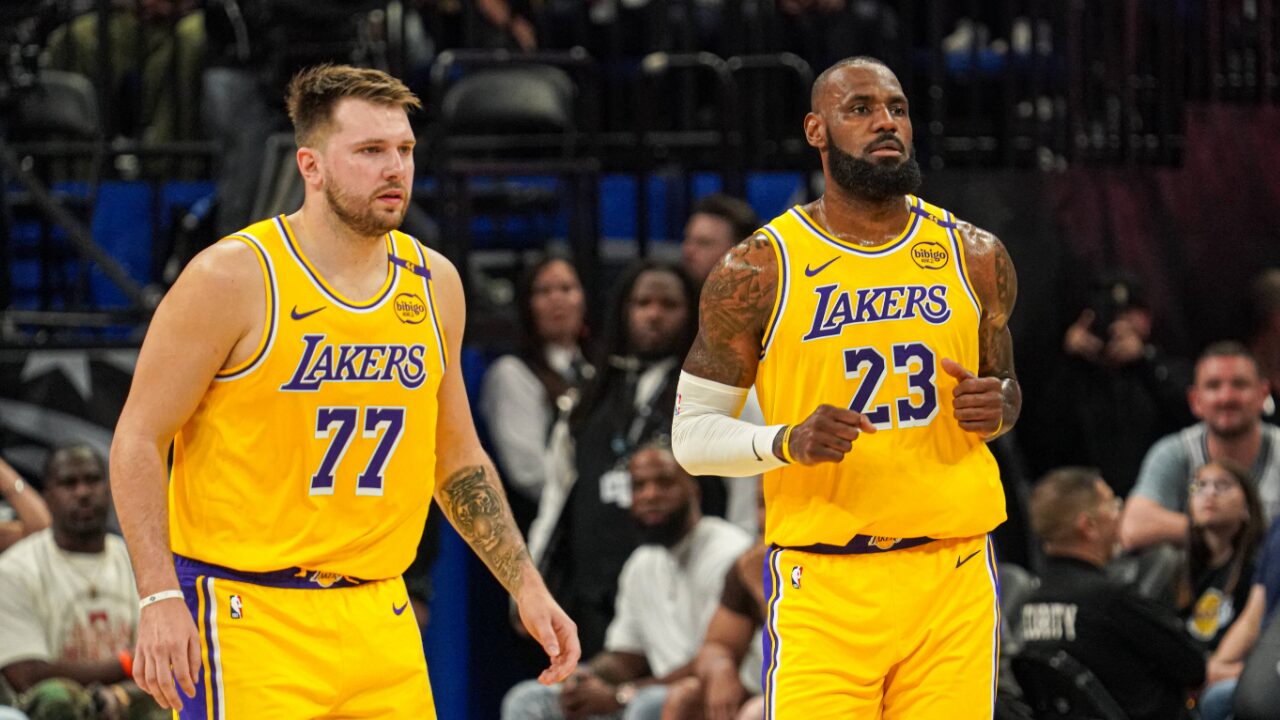
The value of an investment tied to a franchise superstar is once again a talking point after the sports business world was fundamentally upended when Mark Walter abruptly agreed to sell his controlling stake in the Los Angeles Lakers at a reported $12.5 billion valuation, generating a $2.5 billion increase over the prior record mark in roughly 14 months. The arrival of the new ownership group led by former Disney CEO Bob Iger and Thrive Capital’s Josh Kushner coincides with a revamp of basketball operations around Luka Doncic.
Watch What’s Trending Now!
Some report the new-look Lakers at a record-breaking $12.5 billion valuation, while others question whether Walter’s abrupt sale, just 14 months after agreeing to his initial $10 billion purchase from the Buss family (which closed in late October 2025), is a result of LeBron James’s exit. The Odd Couple pointed out that beneath the historic numbers lies a jarring sports reality: Luka Doncic, who arrived in Los Angeles as part of a landscape-shifting trade involving Anthony Davis in early February 2025, has now watched the franchise’s primary ownership change hands multiple times since his last trip to the finals.
The bizarre narrative surrounding Doncic’s rapid team and ownership transitions sparked an intense debate between Rob G and Ephraim Salaam, who questioned the younger star’s ultimate franchise value when stacked against LeBron James’ storied career. Rather than analyzing baseline statistics alone, the duo zoomed in on an unsettling pattern of owners liquidating assets almost immediately after tying their brands to Doncic.
“We don’t want to dive too deep into the conspiracy theories,” Rob G opened with. “In a year, or less than a year, Luka Doncic was traded for nothing, and the team that he has been the face of, which is the Lakers, has been sold twice. What do you make of that?”
The former NFL player, Salaam felt it’s a paradox to the general mindset about sports team management.
“That’s a tough one because when you have a generational talent attached to a franchise, you want to hold on to that because you understand the value in that. You understand what a generational player can do for building the brand, raising the value of it, right?” Salaam observed. “So, case in point, he goes to Dallas. He’s All-NBA from the jump. They get to the Finals, Mark Cuban sells the team, right? The new owner comes in, and they trade Luka. Luka comes to the Lakers, they sell the Lakers, right? Luka’s now the only face of the franchise. They sell it again.”
After Mark Cuban sold a majority stake in the Mavericks to Miriam Adelson and Patrick Dumont’s group in late 2023 at a $3.5 billion valuation (with Cuban retaining a minority stake) and Doncic led them to the 2024 Finals, he was traded to the Lakers in February 2025. Within months, Jeanie Buss agreed to sell a controlling interest in the team to Mark Walter for a record-breaking $10 billion valuation (deal closed October 2025, with the Buss family retaining roughly 15 percent and Jeanie Buss remaining governor for at least five years), only for Walter to top that a year later. While Doncic has publicly stated he’s gotten used to these seismic changes, Salaam pointed to the stark difference in how owners have invested in LeBron James.
“So, you know, my question would be: who has more value, or who represents more value for a franchise, Luka Doncic or LeBron James, right? What LeBron James did for Cleveland, it raised the value of not only the region, but that team to heights to where if Dan Gilbert was like, ‘Hey, I want to get out of this thing,’ it would have been a heck of a come-up. Then LeBron comes to the Lakers. Of course, the value of the Lakers is already what it is, but he’s there, it sells for $10 billion, right? They bring in Luka and all of that. I just, for me, I question the fact that it seems like everyone in an ownership or power position is trying to get away from Luka. And I’m wondering why. Like, is Luka someone you can build a franchise around and add value to said franchise? Because as you map those things out, it doesn’t look like it.”
Salaam emphasized that this is completely unique to Doncic while other teams cling to their superstars at all costs.
“Are they itching to sell Golden State Warriors while Steph is there? Are the San Antonio Spurs… looking to get rid of it with Victor Wembanyama there? No. OKC, Shai Gilgeous-Alexander, are they looking to get rid of it? The Denver Nuggets with Nikola; no. Or is anybody looking to get rid of the team with those current faces of the franchise? No. So where does that leave Luka in terms of value to a franchise?”
Interestingly, even Warriors owner Joe Lacob, who has confirmed his long-term commitment to Steph Curry, publicly expressed shock at the Lakers’ sale, telling Tim Kawakami on The TK Show that he was “shocked,” adding:
“Who wouldn’t be? The only thing I can imagine is there’s something going on … that we don’t know about it yet … This isn’t flipping a house. Or maybe it is. … I don’t think that is the story. There must be more to it.”
Rob G backed him up while explaining how King James has historically commanded an immediate economic boost, as seen in the surge in interest and merchandise around his recent move to the Philadelphia 76ers. But his career trajectory is also a reason why a young star like Doncic or Victor Wembanyama warrants a multi-decade investment.
“I think one of the reasons why, in the long term, a Luka-led team would actually be more valuable than a LeBron team is because you know that LeBron is not tied long-term to anybody or anything. LeBron James is a vagabond. He is a mercenary. He is in the business of LeBron James. He has never and will never be in the business of the Cavs, the Heat, the Lakers, the Sixers—whatever your team is, whatever your business is,” Rob G explained. “Like, if you’re saying, ‘Hey, Beats by Dre, this is LeBron James’ brand of headphones,’ I promise you that the minute JBL comes up with a better deal, he’s like, ‘I’m gone.’ … Like, I just think that he is a business. He’s a businessman. Like, he’s not just a businessman. Like, he is the business. Wherever he goes is going to be profitable because he is that big of a deal.”
While it’s farfetched to assume that owners are buying and selling franchises based on one player, Rob G does give the new Iger and Kushner ownership something to look forward to – the longterm stability in a 27-year-old Doncic that an aging James simply cannot guarantee.
The financial reality of Luka Doncic’s Lakers vs LeBron James
While Rob G and Salaam broke down the basketball optics of the deal, most credible reporting suggests Mark Walter’s troubles at his parent company, TWG Global, had a lot more to do with the quick sale of his Lakers stake than anything to do with Doncic’s brand.
Public disclosures show that TWG Global and some related insurance entities have been under federal scrutiny – the U.S. Attorney’s Office in Manhattan and the SEC are both looking into concerns around related-party private-credit loans and disclosures tied to roughly $16 billion in transactions.
On top of that, TWG has reportedly been scrambling to manage loans connected to its insurance divisions.
Circumstances like these don’t leave much room for cash flow in a sports franchise. Analysts have also pointed to broader financial pressures elsewhere in the league. Mat Ishbia’s Phoenix Suns ownership group, for instance, has faced its own reported challenges.
On the flip side, Rob Pelinka is making a clear long-term bet around Doncic, committing serious multi-year money, including a major sign-and-trade for Walker Kessler and free-agent deals for Quentin Grimes, Sandro Mamukelashvili, and Collin Sexton, while also retaining Austin Reaves. The result is a supporting cast built with intention- something Rob G makes a point of highlighting, and something LeBron, frankly, never got in any sustained way during his late Lakers years.
“The guys you mentioned, whether it’s Wemby, SGA, Jokic, and in this case, Luka, not only because of their ages, but because none of those guys are the singular entity that is LeBron James. A lot of their value, not all of it, but a lot of it, is tied to the fact that they play basketball, and they play basketball for this specific franchise or this specific team. And if you are Luka Doncic, I’m willing to bet that you probably still would have got the $10 billion, you know, whether he was there or not if it was just LeBron and not Luka… Because what you’re buying is not just the international appeal of Luka Doncic now, you’re buying it for the next five, six, seven years. And LeBron James, whether he retires or not, could play for three different teams in five or six or seven years if he wanted to.”
Some even note that the new-look Lakers presented Walter an ideal exit strategy to realize a $2.5 billion valuation uplift in about a year.
Now Iger and Kushner appears focused on capitalizing on Doncic’s prime competitive years while most continue to tie the superstar guard to the rapidfire sales of the Mavericks and Lakers.