

Essentials Inside The Story
- A forgotten piece of Timberwolves history helped inspire the franchise's newest look.
- Kevin Garnett wasn't chosen for the reveal by accident.
- The rebrand says as much about Minnesota's future as it does about its past.
On September 17, 1987, the Minnesota Timberwolves unveiled their first logo in an unusual way. The design appeared on an oversized $20,000 charity check presented to the United Way after a public contest that drew more than 2,600 submissions from across the United States and beyond. The winning entry featured a calm wolf sitting inside a basketball, a character fans would later nickname “Old Shep.”
Watch What’s Trending Now!
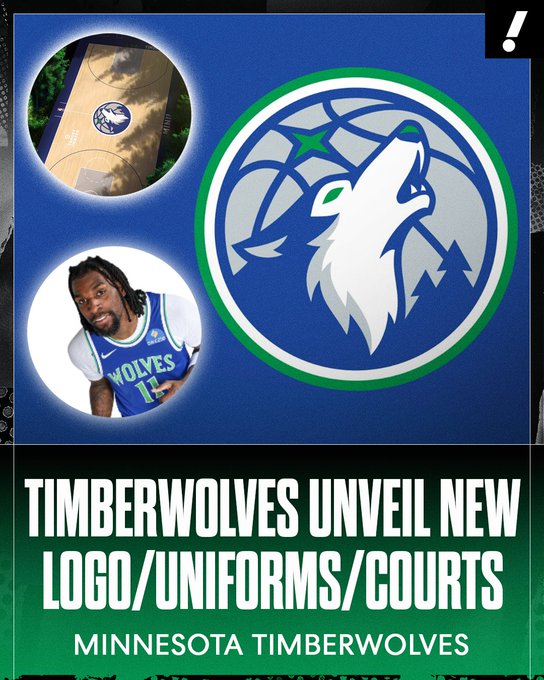
Nearly four decades later, the Timberwolves are once again reshaping their visual identity. On Sunday, the franchise unveiled a sweeping rebrand featuring redesigned logos, new uniforms, updated colors and refreshed court designs as the organization enters a new era under owners Marc Lore and Alex Rodriguez.


The Timberwolves unveiled a franchise rebrand, featuring new logos, color schemes, uniforms, and court designs 🐺 What do you think about this new look? 👀
“This franchise means something different to every generation of fans. We wanted this new look to reflect the pieces of Timberwolves basketball fans have always connected with,” Caldwell said. “While also feeling true to the team and culture surrounding this franchise today. More than anything, we wanted to create something that reflects where this organization is headed and what the entire state can rally behind.”
The timing is notable. The redesign marks the first major franchise-wide branding initiative under Lore and Rodriguez, who officially completed their $1.5 billion purchase of the Timberwolves in June 2025. It is also the organization’s first full primary uniform refresh since the 2017-18 season.
The refreshed uniforms lean heavily on the franchise’s roots while introducing several modern design elements. The refreshed Association and Icon uniforms bring back the white, blue, and green color combination that first appeared during the franchise’s debut season in 1989 and 1990. Meanwhile, their Statement edition revives the beloved black aesthetic tied to the Pine Tree years. The return of the Pine Tree aesthetic is particularly significant because it remains closely associated with the Kevin Garnett era, the most successful sustained period in franchise history.
Rather than fully recreating a previous look, the Timberwolves blended elements from multiple eras. The uniforms borrow from the franchise’s original 1989 color palette while incorporating design cues from the iconic Pine Tree era of the late 1990s and early 2000s. The “Wolves” wordmark and jersey numbers feature sharp edges inspired by wolf fangs, while the familiar three-stripe trim returns as a nod to Minnesota’s landscape.
The Association uniform, precisely, features the cherished Old Shep logo on the shorts. It is their nod to the 35th anniversary milestone, which they celebrated in the 2023-24 season. What’s more intriguing is that every uniform in the collection carries two brand-new touches. A custom Tree M emblem sits on the waistband, while a row of five trees above the jock tag quietly represents the starting five.
The emphasis on historical elements reflects years of fan demand. In recent seasons, classic Timberwolves throwback jerseys repeatedly sold out, while fans regularly pushed for the franchise to bring back the Pine Tree aesthetic on a permanent basis. The popularity of those retro designs made it increasingly clear which era of Timberwolves basketball resonated most strongly with supporters.
The rebrand extends beyond the uniforms. Minnesota also introduced new Core and Statement court designs, while updating its primary logo with the franchise’s original blue-and-green color palette. The result is a visual identity that pulls from multiple generations of Timberwolves basketball rather than a single era.
Franchise legend Kevin Garnett served as the face of the launch, modeling the new uniforms during the reveal. His involvement was symbolic. Garnett’s presence also carried extra meaning because his relationship with the franchise had only recently been repaired following years of tension with former owner Glen Taylor. By placing him at the center of the reveal, the Timberwolves effectively connected the franchise’s most celebrated era with its future under Edwards.
The First Major Statement of the Lore-Rodriguez Era
Beyond the visual changes, the project serves as an early indication of how Lore and Rodriguez intend to position the franchise. Rather than introducing a completely new identity, the ownership group chose to reconnect the organization with some of the most beloved chapters in Timberwolves history.
The move also reflects a broader shift taking place across the NBA. Recent rebrands have generally been most successful when they evolved existing identities rather than abandoning them entirely. Instead of pursuing a dramatic departure, Minnesota opted to build upon the visual elements that already carried the strongest emotional connection with fans while updating them for a new generation led by Edwards.
More importantly, the redesign restores many of the visual elements that supporters have been asking to see return for years. The Pine Tree motif, original blue-and-green color palette and historical references throughout the uniforms all draw directly from eras that continue to resonate strongly with Minnesota fans. That approach suggests the organization viewed nostalgia not as a marketing tool, but as a foundation for its next chapter.
After finishing the 2025-26 campaign with a 49-33 record, the franchise chose a moment of on-court momentum to unveil a completely refreshed identity. The timing suggests Minnesota wanted the rebrand to complement its basketball trajectory rather than distract from it.
For a franchise attempting to build sustained championship contention around Edwards, the message is clear: the Timberwolves are embracing their past while trying to define what the next great era of Minnesota basketball will look like.