
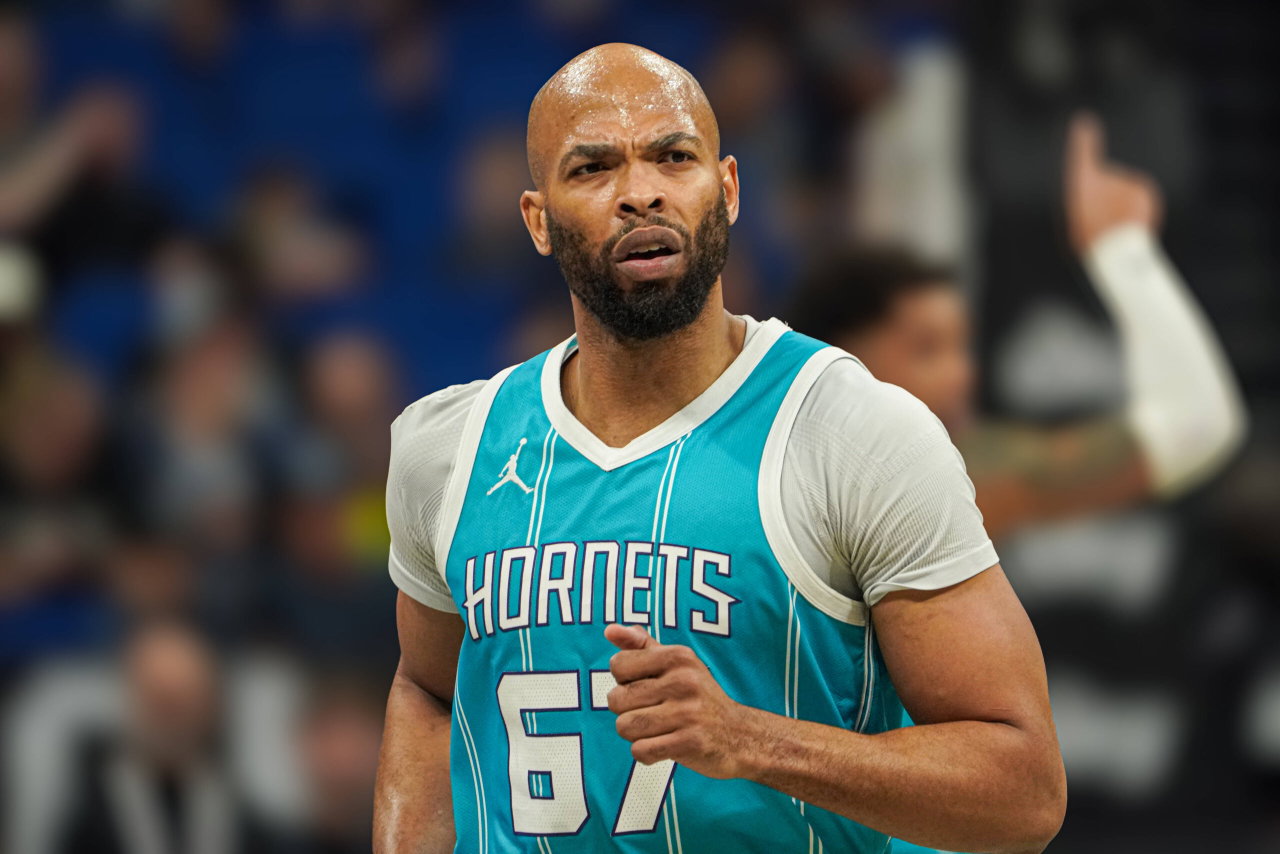
On May 15, 2011, a 25-year-old forward was playing in the biggest series of his young NBA career. In Game 1 of the Eastern Conference Finals, an Ömer Aşık free throw bounced off the rim late in the fourth quarter. He went up over Miami’s interior defense, grabbed the offensive rebound with one hand and finished with a put-back dunk over Dwyane Wade.
Watch What’s Trending Now!
It was the kind of play that fit the Chicago Bulls of that era: physical, loud and relentless. The player was still young, still fighting for his place in the league, and still years away from becoming the veteran who would eventually see the NBA change around him. Tom Thibodeau put it simply: “He plays with relentless passion, and those are the energy plays that define who we are.”
That player was Taj Gibson. More than 15 years later, he is still in the NBA at 41. Miles Bridges called him “one of the best teammates, one of the best OGs in the game right now,” while Thibodeau said in 2023, “Taj gives you everything he has. He’s the ultimate pro, he knows our system inside out, and he sets the tone for how a professional operates every single day, whether he plays 30 minutes or zero minutes.” This week, that same 1,012-game veteran became a $148,828 piece of the Pelicans’ financial plan.
New Orleans acquired Gibson from the Memphis Grizzlies on Tuesday as part of a four-player, two-pick trade. By Wednesday morning, the Pelicans had waived him. He never played for New Orleans, never logged a minute and, according to the research surrounding the transaction, never even reported to the team’s facility.
For a player who had spent 17 seasons building a career in NBA locker rooms, his latest stop lasted less than 24 hours. The reason had almost nothing to do with basketball. It had everything to do with the value of his contract.
The trade itself was bigger than Gibson. New Orleans sent Jordan Hawkins, Micah Peavy, a future second-round pick and a future second-round pick swap to Memphis for AJ Johnson and Gibson. The 41-year-old veteran was there for a very different reason: his contract helped make the larger transaction work.
Gibson’s contract had a very specific use. He had signed a two-year minimum deal with Memphis in February, with the second season worth $3,815,861 but not guaranteed. To help make the trade work under the NBA’s salary-matching rules, Memphis increased the guaranteed portion of Gibson’s contract from $0 to $148,828, with the guarantee reportedly able to reach $200,000.
That small adjustment helped make the larger transaction possible. New Orleans could then clear about $5.7 million in payroll room, giving the Pelicans the space they needed to complete Bennedict Mathurin’s two-year, $16 million deal.
So Gibson was not simply a player who got traded and then cut. For a brief moment, his contract was the mechanism that helped New Orleans make a much larger move.
There was another detail hiding behind the timing.
Memphis had acquired AJ Johnson from Dallas on July 10 as part of the trade that sent Santi Aldama to the Mavericks. Under the NBA’s Collective Bargaining Agreement, a newly acquired player’s salary could not be aggregated with other salaries in another trade for 60 days.
That clock expired on September 8.
It was also the day Memphis and New Orleans completed their trade.
The timing mattered. New Orleans had already agreed to a two-year, $16 million deal with Bennedict Mathurin on August 26, but the Pelicans were near the first luxury tax apron and needed additional room under their hard cap. Once Johnson’s restriction expired, the trade could happen, Gibson’s contract could satisfy the salary-matching math, and New Orleans could create the room it needed.
By the next morning, his part in the transaction was over.
17 Seasons Changed Gibson’s Role, Not His Value
Gibson entered the NBA in 2009, when the game looked very different from the one he is trying to remain in today.
The Chicago Bulls selected him 26th overall after his three seasons at USC. He played all 82 games as a rookie, averaging 9.0 points and 7.5 rebounds, and earned a spot on the NBA All-Rookie First Team.
Chicago quickly became more than Gibson’s first stop. He became part of Tom Thibodeau’s physical Bulls teams alongside Joakim Noah and Derrick Rose, eventually starting 70 games as a rookie. Across 562 games with Chicago, he averaged 9.4 points, 6.4 rebounds and 1.2 blocks.
His career also produced a number of moments that now feel like they belong to another NBA.
Gibson was still in Chicago when the team was built around Rose and the Bulls’ physical “Bench Mob” became one of the defining parts of that era. In 2017, after nearly eight seasons with the franchise, he was traded to Oklahoma City alongside Doug McDermott. His goodbye sounded less like a routine trade and more like the end of an era.
“Just a lot of good fights, brotherly love with Joakim, Jimmy, Luol,” Gibson said at the time. “Just a lot of good times competing at a high level and winning.”
Then came another chapter.
Gibson played for Oklahoma City, Minnesota, New York, Washington, Detroit, Charlotte and Memphis. He started all 82 games for Minnesota in 2017-18, averaging 12.2 points and 7.1 rebounds. He later returned to New York for a second stint, becoming the kind of veteran presence younger players could lean on as the league around him continued to change.
By the time Gibson reached Memphis in February 2026, his role had changed again. He played only 10 games, starting one, and averaged 3.4 points, 2.7 rebounds and 0.6 assists in 9.7 minutes.
Those numbers tell you what Gibson was doing on the floor. They do not fully explain why teams kept finding a place for him.
In 2025, Miles Bridges offered part of the answer when he talked about Gibson’s experience.
“Taj, he’s played with two MVPs in Derrick Rose and Russell Westbrook, so that means a lot coming from him. He’s seen a lot. He sees my work ethic, he sees what I put into the game. Shouts out to Taj, he’s one of the best teammates, one of the best OGs in the game right now. So I’m happy to be part of his journey.”
By then, Gibson’s value had become less about carrying an offense and more about everything that comes with being a veteran who has already seen almost every version of the NBA.
That was visible in New York in 2021, when Gibson reunited with Derrick Rose and Thibodeau during the Knicks’ playoff run. The rookie who had once dreamed about playing for the Knicks was now a veteran telling younger players to trust their own path.
“This is some magical stuff right now. I don’t know how to explain it. I don’t take anything for granted, but every day I come in, it’s just surreal,” Gibson said. “Like I tell the young guys, they may not know where the path’s gonna lead them, where the game’s gonna take them, just trust your heart.”
1,012 Games Later, Gibson Is Still an NBA Player
Gibson has played 17 NBA seasons and appeared in 1,012 regular-season games, starting 462 of them. He has also played 71 postseason games across six playoff runs.
At 41, that puts him in a very small group. Fewer than 30 players in NBA history have appeared in an NBA game after turning 40, and Gibson ranks 14th on the all-time list for oldest players to appear in a game.
Before his waiver, Gibson was also the second-oldest active player in the NBA behind LeBron James. Gibson was born June 24, 1985. James was born December 30, 1984.
There is another way to understand Gibson’s longevity.
Look at the league he entered.
During his 2009-10 rookie season, NBA teams averaged 18.1 three-point attempts per game and 92.7 possessions per 48 minutes. By 2025-26, those numbers had risen to 35.8 three-point attempts and 99.4 possessions.
The game did not simply get faster. It changed what was expected from big men, too.
Gibson entered the league as an interior player whose game was built around rebounding, defense and scoring near the basket. In his rookie season, 88% of his attempts came inside 16 feet and he made no three-pointers. By 2026, he had shown enough of a perimeter adaptation to shoot 50% from three on limited attempts.
The player changed with the league.
He entered the NBA alongside the generation that included Stephen Curry and James Harden. He played against Shaquille O’Neal, Allen Iverson and Jason Kidd. In 2026, he was mentoring players born in 2005 and 2006.
The NBA kept moving forward. Gibson kept finding a way to move with it.
Gibson Wasn’t the First Veteran to Become a Salary Piece
The strange part of Gibson’s week is that the NBA has seen versions of this before.
Veteran contracts can sometimes become useful pieces in trades because teams need salaries to match under league rules. In 2015, Luke Ridnour was traded four times in six days as teams moved his non-guaranteed contract around before he was waived.
Gibson’s situation was different in one important way. He was not some anonymous end-of-roster player with no history in the league.
He was a 17-year veteran with six playoff runs behind him.
For a player with that résumé to become the contract piece in a trade is a reminder of how differently the NBA can value a veteran at different points in his career. The same player who once started playoff games alongside Derrick Rose and Russell Westbrook could eventually become useful because of the structure of his contract.
That sounds cold. It is also part of how veteran careers survive.
Gibson’s recent contracts included non-guaranteed second seasons, giving teams flexibility while keeping a path open for him to find another roster if they no longer needed him.
And that brings the story back to what has kept Gibson around for so long: his value inside an NBA locker room.
The Numbers Have Changed. Gibson’s Reputation Has Not.
Gibson’s Memphis numbers were modest, but his reputation around the league survived the decline in his minutes.
Thibodeau once said Gibson could “set the tone for how a professional operates every single day, whether he plays 30 minutes or zero minutes.”
That may explain his unusual career better than any box score.
He no longer needs to score 15 points or start 70 games to have a role. His value can come from knowing how to prepare, knowing systems, helping younger players and understanding what a long NBA season demands.
When Gibson reflected on his career in New York, he talked about not taking the opportunity for granted. When he left Chicago, he spoke about the relationships he had built there. The common thread was not a single statistic or award.
It was that he kept finding reasons to stay in the league.
By Wednesday morning, Gibson was back on the market.
He was gone before he ever had the chance to become part of the Pelicans’ season.
That is the unlikely place Gibson’s career has reached.
In 2011, he was flying over Miami’s defense and putting a dunk on Dwyane Wade in the Eastern Conference Finals. In 2017, he was saying goodbye to Chicago after nearly eight seasons. In 2021, he was standing beside Derrick Rose in New York and talking about how surreal the journey had become. In 2026, at 41, he became a $148,828 piece of salary math for 24 hours.
Yet none of those moments ended the story.
Gibson has already lasted 17 seasons, played 1,012 regular-season games and made it into an age group fewer than 30 NBA players have reached. He has watched teammates become stars, stars retire and the game itself change around him.
Now there is only one question left.
Will another team give him one more NBA chapter?
For the moment, the answer is unknown. But with Gibson waived, LeBron James once again stands alone as the NBA’s oldest active player.
And Gibson, somehow, is still waiting for the next call.