
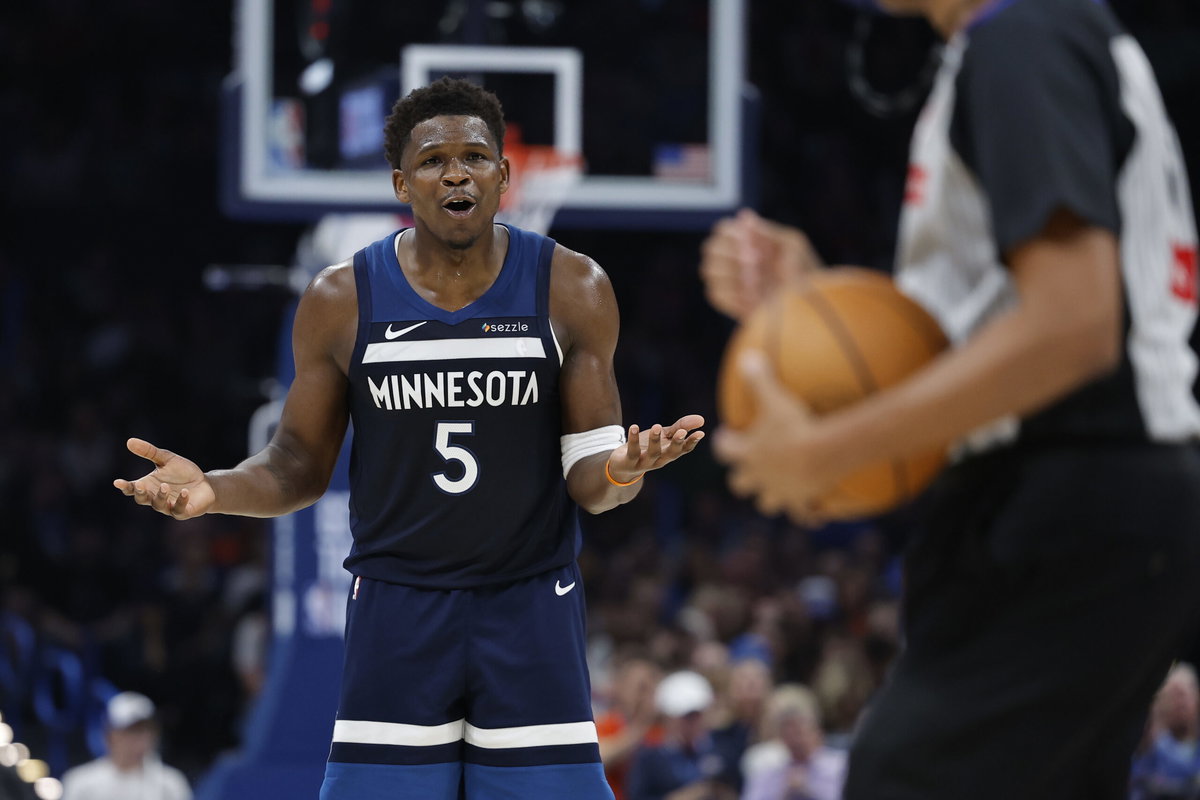
More memorable than the Timberwolves‘ dominant 113-96 playoff victory was the sight of Anthony Edwards limping toward the locker room after his fourth foul, and the chair that bore the brunt of his frustration. Even in a dominant home performance, the 24-year-old star’s early exit painted a troubling picture of a player battling injury concerns during the postseason’s most critical stretch.
Watch What’s Trending Now!
The Minnesota Timberwolves made the most of their first home game of the postseason with a blowout win, but all eyes remained on Edwards, who had been questionable before every game in this series yet continued to produce results. However, tonight’s showing at the Target Center told a different story. Appearing in just 24 minutes, Edwards managed just 17 points while struggling with foul trouble that would define his night.
The turning point came early in the third quarter, when Edwards picked up his fourth personal foul. As he left the court, observers noticed a pronounced limp in his gait. In frustration, he kicked a chair on the bench as he headed to the locker room. Edwards had 15 points at the time he was whistled for the foul and later returned to play, but his impact proved minimal.
Edwards appeared in both the third and fourth quarters afterward, contributing just four minutes in each. He collected his fourth and fifth personal fouls during this stretch, and with foul trouble mounting and the Nuggets unable to mount a serious comeback threat, head coach Chris Finch opted to give the star player an early rest. After the game, Finch addressed the decision to keep Edwards on the sideline for the remainder of the contest.
“He was in foul trouble,” said Chris Finch to the media. “Every time I turned around I had to take him out of the game. We didn’t need him in the end, thankfully. So he gets the chance to get some rest, and we need him back. I know he’s happy, he doesn’t care when we win.” The coach declined to offer any further update on Edwards’ physical condition.

Anthony Edwards goes to the locker room after picking up his 4th foul early in the 3rd. He appears to limp and kicks a chair on the Wolves bench on his way to the back.
The contrast between Edwards’ performances in back-to-back games could hardly be starker. In the Wolves’ stunning 119-114 comeback victory over Denver in Game 2, Edwards was the driving force behind Minnesota’s 19-point rally. He recorded 30 points and 10 rebounds across 40 minutes, guiding the team from a massive deficit to an improbable victory.
Tonight’s showing was the inverse. Edwards finished with 17 points on 40% shooting efficiency, adding five rebounds and three assists. In his absence, Jaden McDaniels anchored the Timberwolves’ starting unit with 20 points and 10 rebounds, while bench contributor Ayo Dosunmu provided a spark with 25 points and nine assists on highly efficient 10-15 shooting.
Can injured Anthony Edwards distract the Wolves’ momentum?
Edwards’ injury struggles have defined his season. The All-Star Game MVP has appeared in just 61 games- a career low. With a persistent right knee injury limiting his availability down the stretch. A right knee injury forced him to miss 11 of the Timberwolves’ final 13 regular-season games, and Edwards has been playing through it as the team navigates its postseason run.
Even after returning to action, Edwards has been managing the injury while competing at the highest level. Following the Game 1 loss, head coach Chris Finch characterized his sluggish 7-of-19 shooting performance as “a rusty game back.” Edwards himself acknowledged the challenge of returning from an extended absence.
“I mean, a little fatigued. I didn’t I haven’t played in like a month, a month and a half, so a little fatigued, but that was expected. Other than that, I felt good.”
For Game 2, Edwards entered as a game-time decision, yet he rose to the occasion with his dominant performance. Early in that contest, he made contact with Denver’s Nikola Jokic and began to visibly hobble. Despite this visible discomfort, he would finish with a game-high 30 points.
However, the trajectory of his production raised questions: he scored 20 points by the midway point and another 8 in the third quarter, but managed just 2 points in the final quarter despite playing 9 minutes. He shot just 1-for-4 from the field in that closing period.
Tonight’s performance mirrored that decline. In the final quarter, Edwards went 0-for-2 from the field, suggesting that fatigue or injury—or both—may be affecting his availability as the series progresses.
If Minnesota’s medical staff is indeed managing Edwards’ injury strategically, the organization will hope the issue fully resolves before Game 4 tips off. The Timberwolves cannot afford to have their most dynamic scoring threat hampered as the postseason intensifies.