
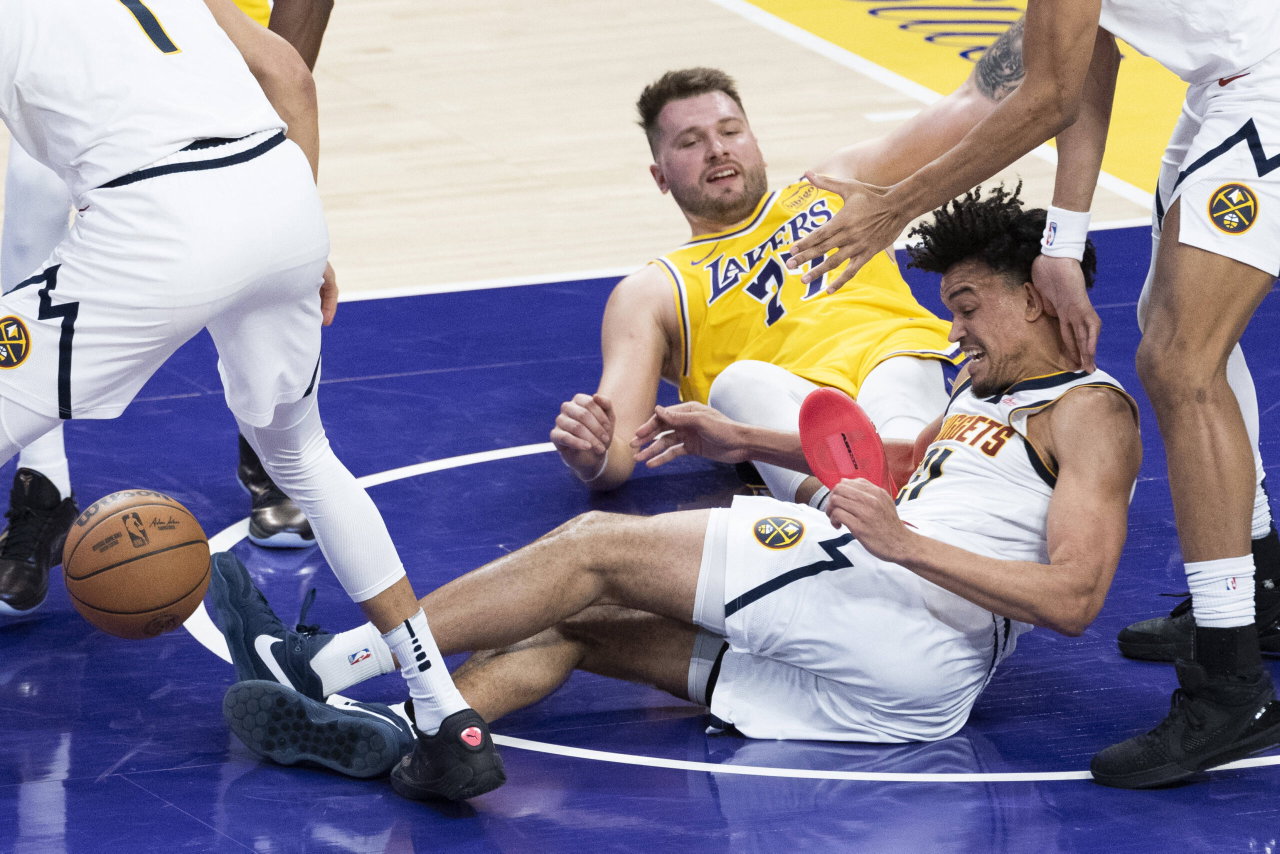
Denver Nuggets forward Spencer Jones handled the ball 3.5 percent of the time he was on the court last season, which is the lowest for any of the other 400-plus rotation players in the league. That number just bought him a second contract.
Watch What’s Trending Now!
“Imaging getting paid 6M dollars a year to basically not touch the basketball,” Jones wrote in a LinkedIn post that spread quickly among NBA fans. “Some may say that stat is for scrubs. Others may say this guy figured out how to be worth 6M w/o needing the ball in his hands. That’s a skill that works in any room.”
Jones held the top spot as the league’s least ball-dominant player at just 3.5 percent of ball usage ahead of Philadelphia 76ers center Adem Bona at 4.8, New York Knicks center Mitchell Robinson at 4.9 and big man Jaxson Hayes at 5.0, all players who normally require even less ball possession than shooters.
The journey Jones took to secure his contract shows why his post was more than just another post. First, he signed a two-year, $12 million offer sheet with the Oklahoma City Thunder, and the Nuggets responded within 48 hours, matching him, a move that enraged fans thinking he was going to leave.
“I get it. But I also need people to understand something,” Jones wrote in a separate LinkedIn post addressing that criticism. “This is a business. Front offices treat it that way every day, and players have to do the same.”
This contract also went down in history quietly. This is the biggest fully guaranteed offer sheet ever made by an undrafted player after turning from a two-way contract, with 20 games and 6.2 minutes per game when he was a rookie in 2024-25 season until he turned into a 22-minute starter player.
The move to match the offer had its price for the Nuggets, putting them for the first time since the last collective bargaining agreement into the second luxury tax apron, where the anticipated tax payment more than doubled to $68 million from $36 million, according to ESPN.
The front office still valued Jones despite the cost. In the regular season, he had an efficiency rating of 50.4 percent shooting and 39.6 percent three-point shooting, but managed to maintain this efficiency in the playoffs as well, where he started three games for the Minnesota Timberwolves, scoring at 68.4 percent and 69.2 percent.
However, the team roster also changed just as quickly. In the off-season, Denver traded its forward Peyton Watson to Cleveland, waived veteran center Jonas Valanciunas, while bringing in veterans such as guard DeMar DeRozan, point guard Tyus Jones and forward Marvin Bagley III, believing that shooters like Jones will open up the game for three-time MVP center Nikola Jokic.
For an undrafted player who came out of Stanford in 2024, the numbers work. Jones doesn’t have to have the ball for him to be effective, and Denver just paid him $6 million per year to show that not playing with it is a profession in itself.