
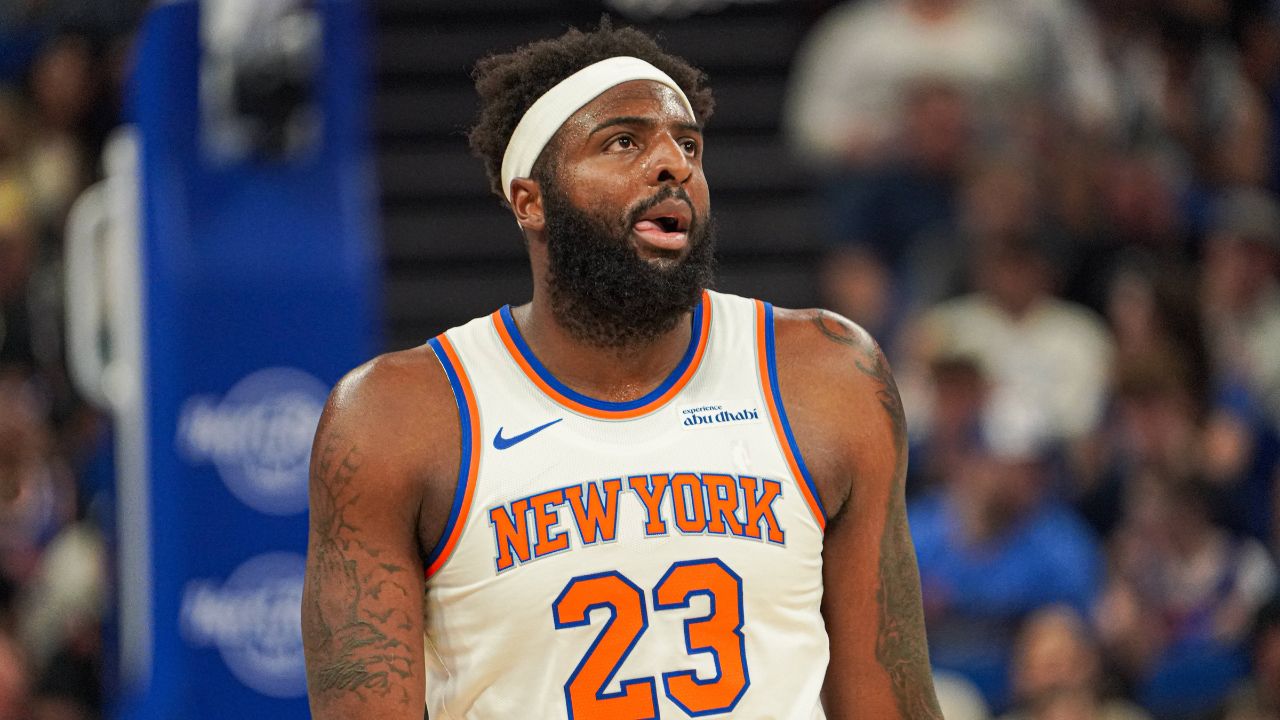
The New York Knicks spent the offseason trying to preserve a roster capable of making another deep playoff run. But the NBA’s financial rules have made that job increasingly difficult. After already sacrificing Mitchell Robinson’s long-term future with the team, the franchise could soon face another painful decision.
Watch What’s Trending Now!
With Mitchell Robinson gone, Miles McBride is now the longest-tenured Knick. He enters the final year of his three-year, $13 million extension, and the club is yet to agree on a new deal with the 25-year-old guard. That uncertainty could eventually push him toward the trade market, especially if New York decides it needs to address a bigger weakness elsewhere on the roster.
The situation was highlighted by The Athletic’s James L. Edwards III in a recent mailbag, where he discussed McBride’s future and the Knicks’ roster challenges. “Unless the Knicks and McBride reach an agreement before the start of the season, it feels like we’re heading toward a departure. Mitchell Robinson was a casualty of the second apron, and McBride could likely be too,” Edwards wrote.
The New York Post’s Stefan Bondy previously added an important note about the contract situation. He clarified that McBride could still sign a meaningful extension without immediately losing his trade eligibility this season.
“I edited the story because of my mistake: there is indeed a scenario where McBride can get a decent extension (say, three years, $55 million) while maintaining his trade eligibility,” Bondy wrote on X.
That distinction could give the Knicks some much-needed flexibility. Because McBride’s current salary sits below the league’s average annual salary, an extension can reportedly start at up to 120% of that figure while preserving his trade eligibility under the NBA’s rules.
The Knicks could reward McBride while keeping the option to move him later if a major opportunity emerges because there is plenty to like about the two-way guard’s current value. He averaged career highs of 12.0 points and 2.6 assists last season while shooting 41.3% from three on 6.6 attempts per game. Deuce spent hours in the gym to improve his beyond-the-arc shooting because, as a rookie, the numbers were rising from 25% on 1.7 attempts per game.
McBride’s ability to space the floor and defend opposing guards allows New York to keep another ball-dominant creator on the court without sacrificing too much defensively. That makes him more than just an inexpensive backup. Still, the Knicks have a crowded backcourt. Brunson is firmly entrenched as the lead guard, while Jose Alvarado provides another experienced option. Tyler Kolek is also waiting for a larger role. Plus, the frontcourt problem is hard to ignore.
Karl-Anthony Towns remains the centerpiece for big man duties, while Andre Drummond gives New York a veteran backup. If the Knicks decide they need a younger or more versatile option alongside Towns, McBride’s contract could be the bargaining chip.
Recent estimates have placed his market value around $10 million to $12 million annually, yet his current cap number remains far below that level. But if they cannot reach an agreement, they may have little choice but to consider what his value can bring back. After Robinson, McBride could be on his way out.
Another important contract decision that the Knicks have to make
The Knicks have more than one contract decision hanging over them, and each could shape how long this roster stays together. Karl-Anthony Towns, Josh Hart and Miles McBride are all entering important points in their futures with New York. KAT is the biggest piece.
Towns holds a $61 million player option for next season, but the Knicks would clearly prefer to avoid waiting on that decision. After his strong postseason, a team-friendly extension could benefit both sides.
Something around $50 million annually, below his nearly $70 million max, could keep Towns in New York while giving the front office more room to maneuver under the second apron.
Then there is Hart. His $22.3 million team option for next season remains available, but he is now eligible for an extension. The Athletic has projected a potential three-year deal worth around $20 million per season. That might sound like a lot for a veteran role player, but Hart brings far more than his numbers.
His rebounding, defense and relentless energy have become part of the Knicks’ identity. Now, New York cannot afford to get every decision wrong. So waiting over McBride’s contract gives them more time to think over important roster decisions.