Imago
via: espn
Imago
via: espn
Imago
via: espn
Imago
via: espn
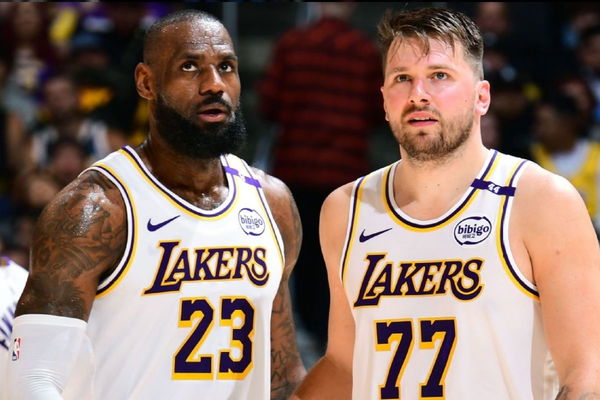
Availability has quietly become the Lakers’ biggest opponent this season. Lineups have rarely stayed intact long enough to build rhythm, and every absence changes how the offense functions. That instability forced the team into a simple reality: the margin for error disappears when one specific player is missing. LeBron James explained that reality on the latest Mind the Game podcast while discussing the team’s health concerns during the season.
Watch What’s Trending Now!
“We haven’t been set up to the point where we have a lot of room for error… when AD goes down, we don’t have enough to pick that up.” That context led directly to his clearest evaluation yet of Luka Doncic’s role. “So, obviously, Luka is in the MVP race… leading the league in points… top two, three in assists. We can’t… no one’s gonna replace that.”
The statement was not praise. It was a roster diagnosis.
Imago
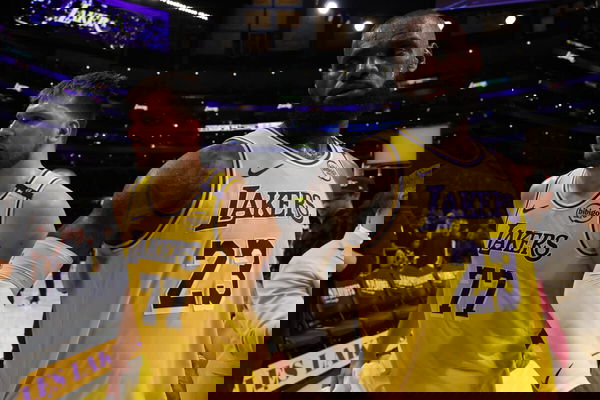
Apr 22, 2025; Los Angeles, California, USA; Los Angeles Lakers guard Luka Doncic (77) and Los Angeles Lakers forward LeBron James (23) leave a court after defeating the Minnesota Timberwolves 94-85 in game two of first round for the 2024 NBA Playoffs at Crypto.com Arena. Mandatory Credit: Kiyoshi Mio-Imagn Images
Injuries created the evidence. Austin Reaves missed extended time after a Grade 2 sprain around Christmas. Shortly after his return, Doncic missed games with a hamstring injury. Each stretch exposed the same issue. Production falls sharply when the primary creator sits.
The numbers reinforce it. The Lakers win roughly 64.3 percent of games with Doncic playing and about 50 percent without him. He averages 32.8 points per game while ranking near the top of the league in assists and contributing rebounds as well.


Because of that workload, replacing his scoring alone would be difficult. Replacing his playmaking structure is impossible within the current roster. That is what James clarified. The team is not built to absorb a Doncic absence.
The franchise already adjusted around Luka Doncic
Last August, Los Angeles committed to that reality. Doncic signed a three-year $165 million extension that positioned him as the long-term centerpiece after Anthony Davis’ departure. From that moment, roster decisions began aligning with his strengths as a high-usage initiator.
The trade deadline confirmed the direction. The Lakers made only one move, sending Gabe Vincent and a 2032 second-round pick for Luke Kennard, prioritizing shooting while preserving flexibility.
At the same time, league reporting indicated Doncic supported the patient approach rather than pushing for immediate star additions. That matters because it allows the organization to plan beyond short-term fixes.
Building around a player you cannot replace forces a specific type of roster construction. The Lakers now project about $51 million in cap space and hold three tradable first-round picks in 2026, 2031, and 2033. However, that flexibility depends on future salary decisions, including LeBron James’ contract status.
Because of that, every offseason scenario connects back to the same principle. Maintain a structure that amplifies Doncic instead of duplicating him. League executives believe the team would pursue another elite star only if the fit complements his usage rather than competes with it. That possibility exists, but it remains conditional on availability across the league.
LeBron’s comment ultimately clarified hierarchy, not chemistry. The Lakers no longer operate as a shared-load offense that can survive any absence. They operate through one engine. As long as that engine stays healthy, the team functions normally. If it stops, there is no internal replacement.