
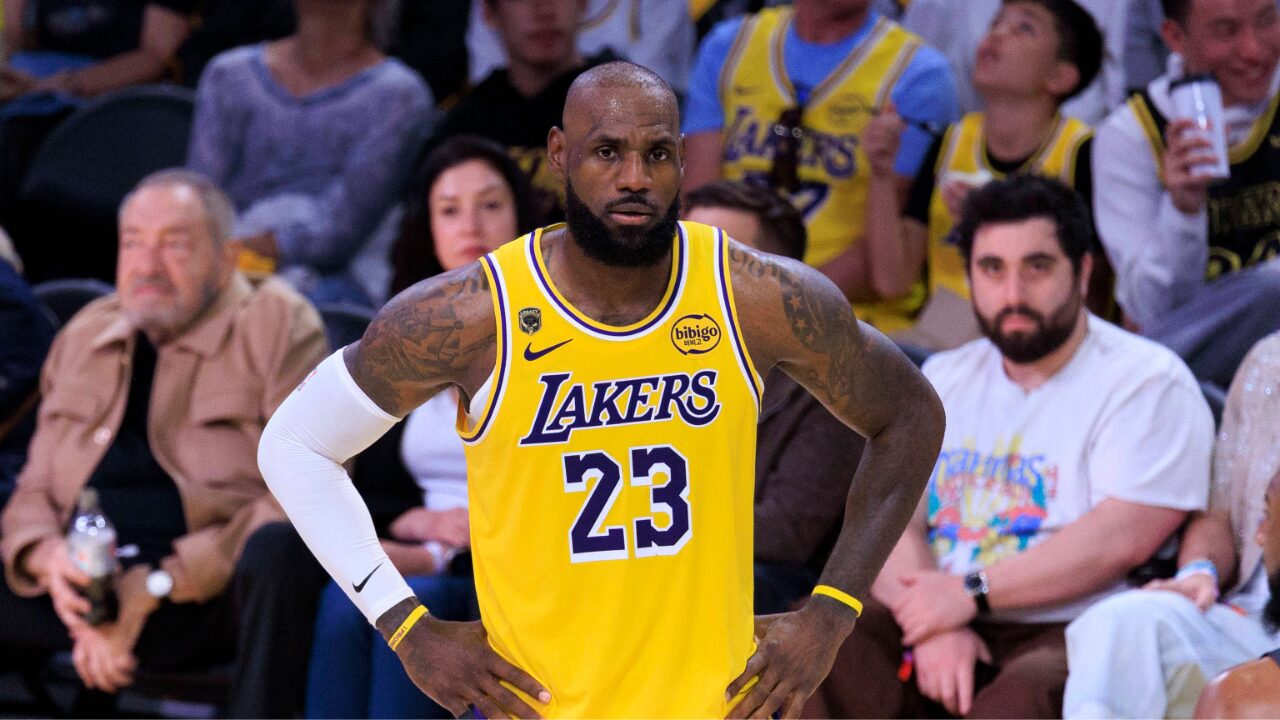
In July 2004, the Lakers made one of the biggest changes in franchise history. After three straight championships with Shaquille O’Neal and Kobe Bryant, Los Angeles traded O’Neal to Miami and handed the team to a 25-year-old Bryant. The Lakers were no longer the same team. The face had changed, and everything around him had to change with it.
Watch What’s Trending Now!
More than two decades later, another Lakers era has reached that point.
LeBron James is gone. Luka Doncic is now the 26-year-old centerpiece of the franchise, and Rob Pelinka spent the offseason reshaping the roster around him. But the most revealing part of the Lakers’ season-opening press conference was not Pelinka explaining what happened to James. It was JJ Redick explaining what he believes has happened to the team.
“I think with this group, probably the first time in my three years here that I feel like the pieces actually fit together,” Redick said.
That is a striking assessment from a coach entering his third season in Los Angeles. And it raises the bigger question around the Lakers now: what changed enough for Redick to believe this version finally makes sense?
Pelinka Makes LeBron’s Exit Officially a Chapter of the Past
Pelinka did not try to make James’ departure sound insignificant. Instead, he opened his comments by making it clear that the Lakers understood what the eight-year run meant to the franchise.
“I thought it would be appropriate to express gratitude for the LeBron era here. We as an organization are still grateful for the run that we had with him here. The Lakers have become, as they should, a perennial playoff team. It was a great era and we’re grateful for it,” Pelinka said.
He also described the way the two sides handled the split.
“We’re grateful for the LeBron era, and I think the communications with him this offseason were held diplomatically and professionally and honestly. It was done amicably, professionally, gracefully, and we look at the whole thing with gratitude.”
James’ eight seasons in Los Angeles included the 2020 championship and six playoff appearances. His final season ended in the Western Conference semifinals against Oklahoma City, bringing the Lakers’ LeBron era to a close.
But Pelinka’s comments quickly moved away from what the Lakers had lost and toward what they had spent the summer trying to build.
And that is where the real story starts.
The Three Things Pelinka Wanted
The Lakers did not enter free agency looking for a replacement for James. Pelinka described a much more specific plan.
“We wanted to retain Austin Reaves. That was a really big, big thing for us. We wanted to find a way to acquire a franchise center. And then we wanted to develop a roster of JJ Redick dribble, pass, shoot players that were younger and add depth to our roster.”
That plan explains several of the biggest moves of the offseason.
Reaves remained in Los Angeles on a four-year, $184.8 million extension. The Lakers then acquired Walker Kessler from Utah, committing two first-round picks and a four-year, $130 million deal to the 25-year-old center.
The rest of the roster was built around the same idea. Quentin Grimes, Collin Sexton, Sandro Mamukelashvili, Matisse Thybulle, Ziaire Williams and Kevon Looney gave Redick more options across the wing and frontcourt.
Pelinka also made it clear that age was part of the plan, not a coincidence.
“Luka is the world’s greatest offensive player, and for us to have an opportunity to have that player in our building every night as a 26-year-old is special, and it requires us to do special things to build a team around it,” Pelinka said.
He added:
“One of the things we really wanted to lean into was a team that lined up in age with Luca and AR. We want this team to grow together, and I think we were very intentional to get younger and deeper. I think if you look at our roster, that thesis was consistent throughout.”
But the biggest offseason addition may not simply be the player wearing No. 24.
It may be what Kessler allows the entire team to do.
Walker Kessler Changes the Picture Around Luka
Redick was particularly clear about why the Lakers wanted Kessler next to Doncic and Reaves.
“I think Walker is a perfect fit for Luka and AR, just in terms of his rim protection and really being an anchor for our defense. That’s an area we’ve struggled with… He’s been an excellent rebounder throughout his career, both offensively and defensively. And then he’s very capable, both playing in the pocket and playing at the rim with lobs, and we know both our guys love throwing lobs.”
That gives the Lakers something their previous roster construction lacked: a center whose biggest value does not come from needing the ball.
Kessler can protect the rim, rebound and finish around the basket while Doncic controls the offense. His presence also gives Redick the option to lean into drop coverage rather than asking the entire defense to survive through constant switching.
The Lakers did not spend two first-round picks and $130 million on Kessler just to add another name to the roster.
They were trying to change how the roster works.
And Redick’s next comments showed just how much depth he believes that change has created.
Suddenly, Playing Time Is a Problem
One of the clearest signs that this Lakers team is different is that Redick now has too many players competing for minutes instead of too few.
He made the message to his wings very simple.
“I’ll give you the wings, like there’s a very clear ask for you to be able to play, and if you don’t do those things, then you’re not going to play. That’s just the reality. We’ve already had some of those conversations this week with our players. We have high, high confidence in these guys that they’re going to buy into that. So it’s going to naturally create a lot of healthy competition, and everybody at some point inevitably will get a chance to impact our team and impact winning.”
That competition is not limited to the end of the bench.
Redick said he was already confident in three starting spots, leaving two positions open entering camp.
“I’m pretty confident in three of the spots. The other two spots will not be two white guys.”
With Doncic, Reaves and Kessler forming the three spots Redick is confident about, the remaining positions give players such as Grimes, Ziaire Williams, Mamukelashvili, Vanderbilt, Thybulle and others a chance to force their way into the starting group.
That could make training camp far more important than a normal preseason tune-up.
There are actual jobs to win.
But before the competition began in Los Angeles, Doncic had already taken another step toward making the team his own.
Luka Started Building the Team Before Camp
From August 20 to August 24, Doncic hosted Lakers players and two-way players in Ljubljana, Slovenia, for a four-day minicamp.
Doncic organized and funded the trip. The group worked out, lifted weights, had dinners together, toured Ljubljana and even played golf at Lake Bled. With nine new teammates joining the roster after the offseason turnover, the trip gave the group a chance to spend time together before official training camp.
The gesture apparently meant enough to the players that they later wrote individual handwritten thank-you letters to Doncic for hosting them.
Redick put the value of that trip in simple terms.
“The best teams are the most connected teams … I really believe this team will be connected from Day 1 and they already are.”
There was another leadership development waiting for the Lakers when they returned to Los Angeles. Reaves emerged as a vocal leader during summer pickup sessions, giving the team another voice alongside Doncic.
That matters because the Lakers are not simply replacing James’ production.
They are creating a new leadership structure.
And Redick does not believe that process requires the Lakers to tear everything down.
This Is Not a Full Rebuild
The Lakers lost one of the most accomplished players in NBA history. Yet Redick rejected the idea that his team is entering a traditional rebuild.
“To me, this has not been — and it never will be — a full rebuild around Luka in one offseason. That’s not the way the NBA works, and particularly with free agency the way it is now. But I like everything we did this summer to build around him, to build around A.R., and to provide us with a ton of depth.”
That distinction explains the offseason better than simply calling it the post-LeBron era.
The Lakers did not hit reset.
They kept Reaves. They found the center they wanted in Kessler. They added younger wings and secondary creators. They built more depth around Doncic while trying to give Redick clearer roles to work with.
Now comes the part nobody in the front office can control.
The pieces have to fit when the games count.
Redick believes they finally do. Training camp will show how quickly that belief turns into an actual rotation.