
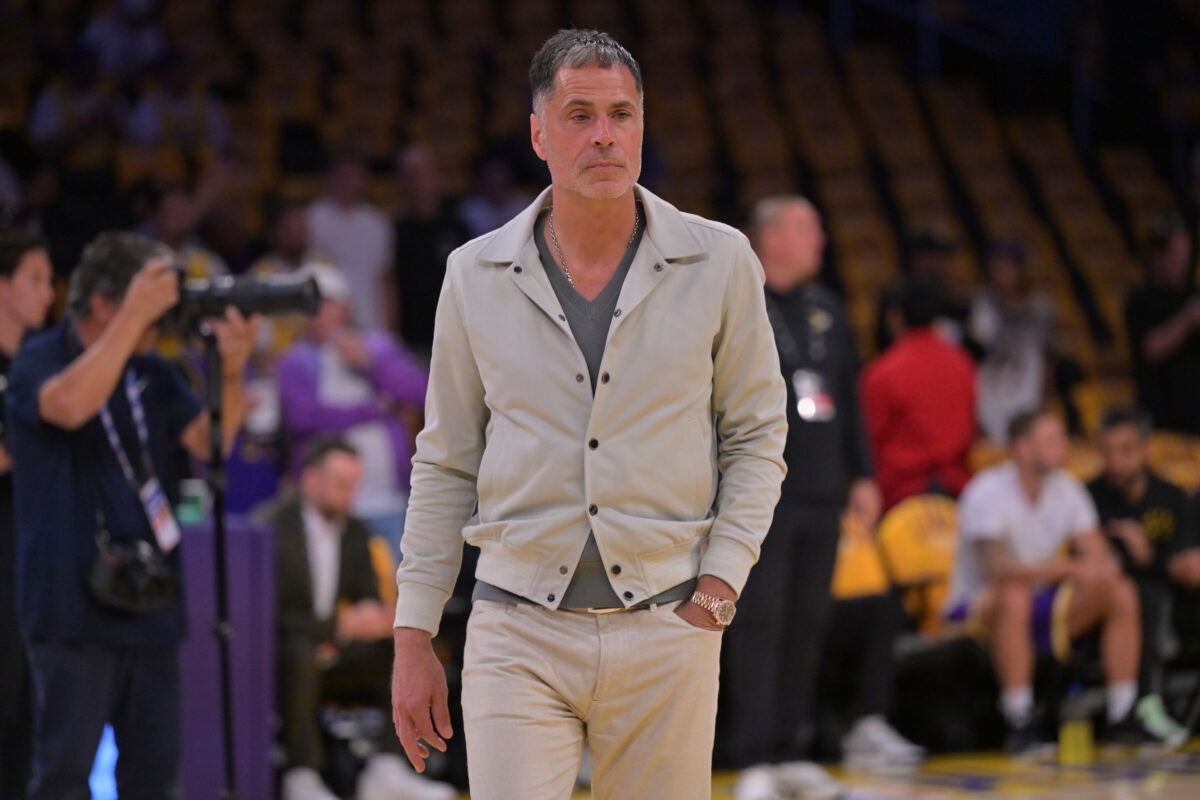
In May 2023, Rob Pelinka turned a 2-10 start and a Russell Westbrook albatross into a legitimate championship contender through a sweeping trade deadline overhaul. He finished 11th in Executive of the Year voting for their trouble. The pattern has become something close to an institution. This year, the NBA executives’ work, done around LeBron James and Luka Doncic, has been underrated, a characterization that the voting results released Tuesday have done little to contradict. Pelinka received just one vote in the 2025-26 Executive of the Year award, and once again found himself far from the top of the ballot despite a playoff surge built substantially on decisions he made before the season began.
Watch What’s Trending Now!
The Boston Celtics president, Brad Stevens, was named the 2025-26 NBA Executive of the Year, receiving 11 of 28 first-place votes and 69 total points, finishing clearly ahead of Atlanta Hawks general manager Saleh Onsi in second and Detroit Pistons president Trajan Langdon in third. It marks Stevens’ second time receiving the award in the last three seasons, making him the 12th executive in NBA history to win it multiple times.
Five points were awarded to first-place vote-getters, three to second-place vote-getters, and two to third-place vote-getters; the voting committee consisted entirely of executives from NBA teams. Rob Pelinka did not land on the podium. His summer signings, however, have been the story of the Lakers’ playoff run, three moves that cost little in cash or assets and have since reframed what this roster is capable of doing without its two leading stars.


The voting panel for the 2025-26 NBA Basketball Executive of the Year Award consisted of basketball executives from NBA teams. Complete voting results ⬇️

The clearest validation has come from Marcus Smart and Luke Kennard, both signed or acquired in low-profile transactions, who have taken on lead roles in Luka Doncic and Austin Reaves’ absence (both sidelined since early April with a Grade 2 hamstring strain and Grade 2 oblique strain, respectively, and expected to miss the bulk of the first round).
Heading into the postseason, Smart was viewed as a streaky shooter hampered by injuries at age 32 who averaged just 3.0 assists during the regular season, the fewest of his 12-year career; Kennard was characterized as a 29-year-old journeyman whose value was understood to begin and end with his three-point shooting.
In three playoff games, Smart averaged 20.3 points and 8.3 assists, shooting 52.9% from the field with 3.7 steals per game. Kennard, for his part, averaged 21.3 points on 55.3% shooting, 52.9% from three, with 5.3 rebounds and 3.7 assists.
Smart, signed in July on a one-year deal, and Kennard, acquired from the Atlanta Hawks in February for Gabe Vincent and a future second-round pick, have been the primary reasons the Lakers hold a 3-1 series lead over the Houston Rockets.
The individual performances tell the story directly. Kennard dropped a career-high 27 points on 9-of-13 shooting, hitting all five of his three-point attempts in Game 1, a performance Silver Screen and Roll described as doing more for the Lakers in one night than Gabe Vincent had done across multiple postseasons.
He followed it with 23 points, six rebounds, two assists, and three steals in Game 2, giving him back-to-back playoff performances that carried the offense while Luka Doncic remained sidelined. Smart’s highest-profile stretch in Game 2 produced 25 points, seven assists, and five steals across 35 minutes, a showing that prompted the broader conversation about what both players will cost in free agency this summer.
Smart also scored 15 points in Game 1 alongside Kennard’s career night, with Deandre Ayton, who Pelinka signed to a two-year deal in the offseason after his buyout from Portland, contributing 19 points and 11 rebounds as the reliable starting center.
Pelinka’s Signing, Jake LaRavia’s Durability Were the Overlooked Factors Behind the Lakers’ Regular Season
Of Rob Pelinka’s three quietly effective summer additions, Jake LaRavia has generated the least noise and has arguably been the most important to the Lakers’ structural stability across 82 games. LaRavia was the only player on the roster to appear in all 82 regular-season games this year, becoming the 45th player in franchise history to accomplish the feat.
For a team that battled numerous injuries to star contributors and navigated an intensely tight Western Conference playoff race, where every win in the final stretch proved decisive in clinching the fourth seed over several contenders, LaRavia’s ironman consistency provided crucial stability.
That consistency was not incidental. The Wake Forest alum himself acknowledged that playing a full schedule was one of his primary goals at the start of the year, crediting a combination of mindset and health for getting there.
The 24-year-old came to the Lakers as an unknown x-factor at the start of the season, which even prompted Anthony Edwards shouting from the bench, “Who is Number 24?” The answer to that was instantaneous when LaRavia dropped 27 on the Minnesota side back in October.
Since then, he’s been the X-factor, the underrated pick up for the LA side. Head coach JJ Redick’s trust in LaRavia’s defensive reliability and energy made him a fixture in the rotation throughout the season’s most turbulent stretches.
Imago
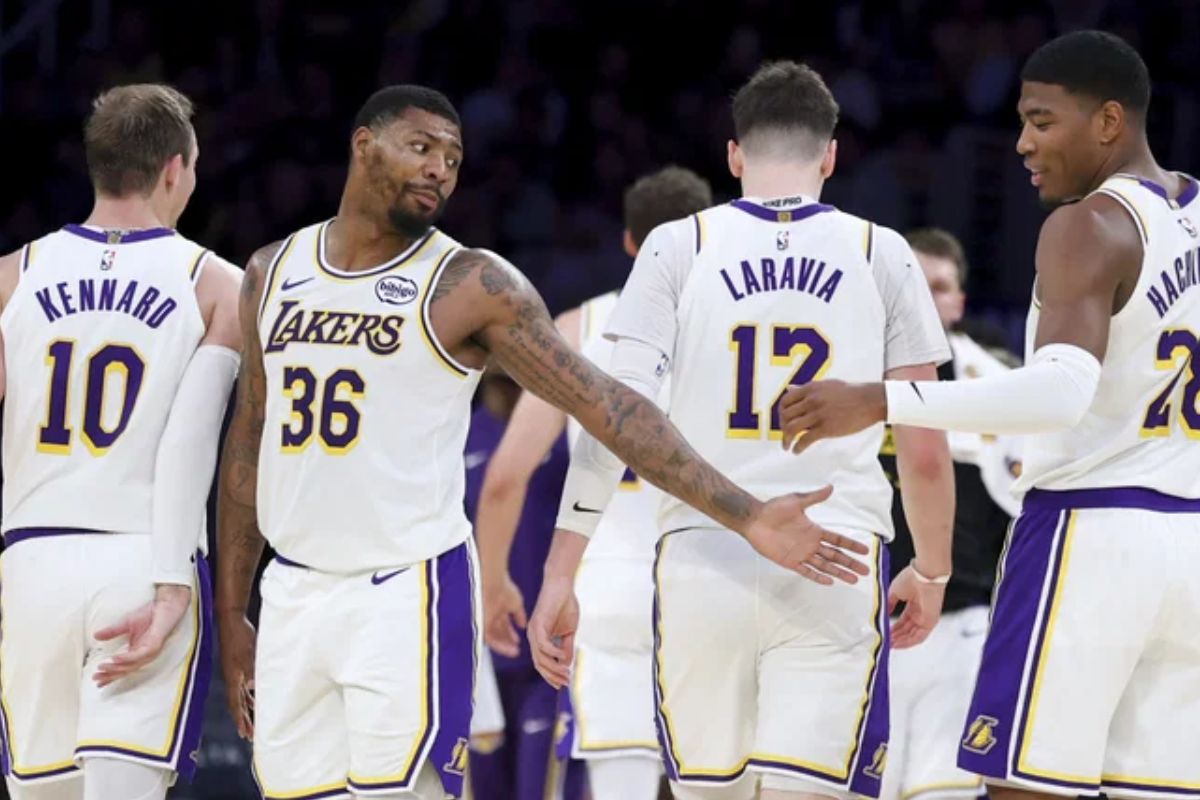
Mar 1, 2026; Los Angeles, California, USA; Los Angeles Lakers guard Marcus Smart (36) and forward Rui Hachimura (28) high five during the fourth quarter against the Sacramento Kings at Crypto.com Arena. Mandatory Credit: William Navarro-Imagn Images
“It’s been huge,” Smart said about LaRavia in January. “I mean, we talk every day, but me and Jake coming from Memphis together, having that, that connection that we built over there, to bring it over here…He doesn’t get a lot of credit for his defense, but he’s a really good defender, and we just got to continue to feed his confidence on that end because we’re definitely gonna need him…We’re so gifted and talented on the offensive end that we, on the defensive end, have to do some things to kind of balance that out for us and that starts with us to come out and bring that energy.” And that is exactly what Pelinka envisioned in the summer.
Signed to a two-year, $12 million deal in July, a cost that would rank among the better role-player contracts in the league, given the durability and defensive output he provided. He averaged 8.2 points, 4.0 rebounds, and 1.8 assists per game across the season.
His length and switchability have kept him in the playoff rotation even as his offensive limitations have been exposed at times against Houston, a tradeoff Redick has accepted given the Lakers’ ball-handling depth with both Doncic and Reaves unavailable. The Lakers held on to the fourth seed, winning their last three regular-season games to secure home court in the first round.
Stevens’ winning case was built on a Celtics roster that was widely expected to take a step back after Jayson Tatum’s torn Achilles. Yet, Boston finished 56-26 as the No. 2 seed in the Eastern Conference, the byproduct of offseason trades that shed $301 million in projected payroll and tax payments while keeping the core of a title-winning team competitive.
The argument for Rob Pelinka ran along different lines, not a retooled contender, but a series of low-cost additions quietly delivering returns well above their market price, now on full display against the Rockets. The voting panel, made up of fellow NBA executives, looked elsewhere. The tape from the first round has told a different story.