
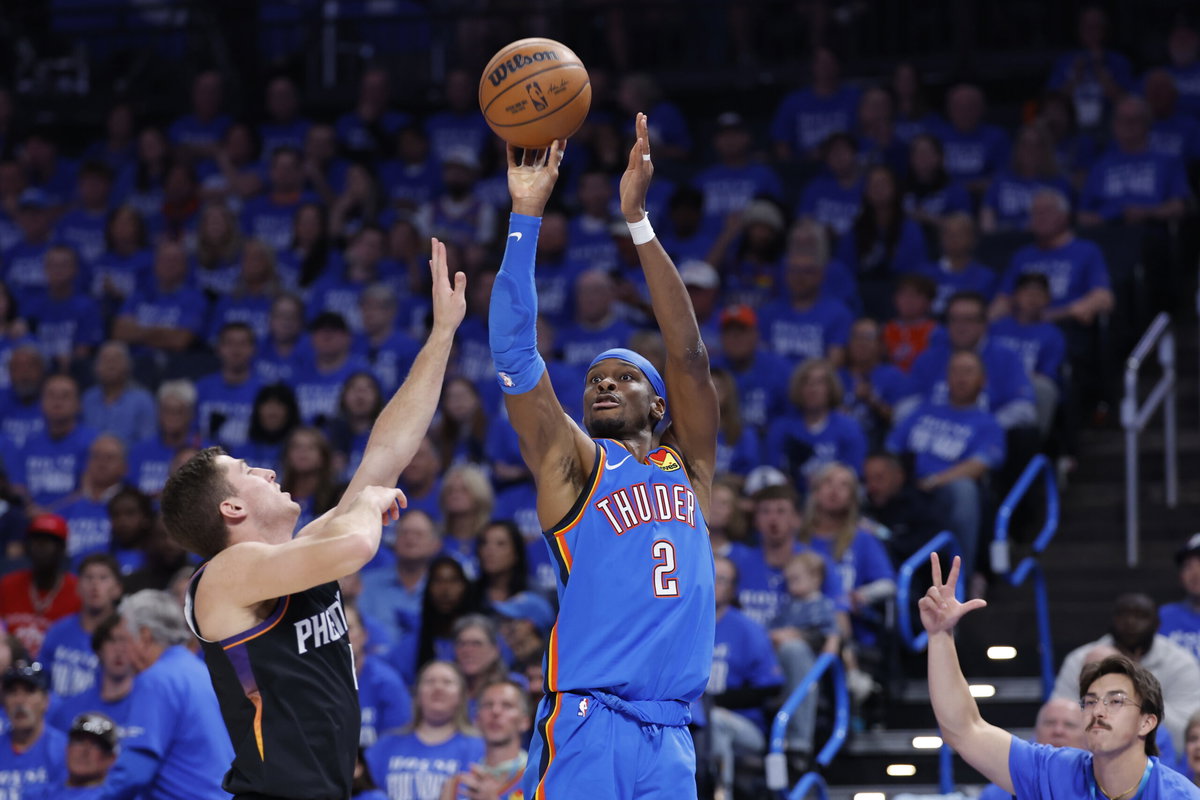
There are playoff wins… and then there are statements. What unfolded inside the Paycom Center on April 19 wasn’t merely Oklahoma City claiming Game 1. It felt like a declaration to the entire league. Unmistakable, resounding, and admittedly unsettling if you’re facing them.
Watch What’s Trending Now!
Because for stretches, this resembled a battle. Then it transformed. By the final buzzer, the Thunder hadn’t simply defeated the Suns. They had dismantled everything Phoenix envisioned for this matchup.
And at the heart of it all was Shai Gilgeous-Alexander quietly etching his name into history once more. He extended his streak to 13 consecutive 25-point playoff performances at home, the longest run since Giannis Antetokounmpo’s 17-game stretch from 2020 to 2022. What’s remarkable is how effortlessly he made it look.
To properly understand how this game unfolded, it’s worth walking through it step by step.
The Setup: A Contender vs A Survivor
Coming into the game, everything pointed one way.
| Category | Thunder | Suns |
|---|---|---|
| Record | 64-18 | 45-37 |
| Playoff Status | No. 1 seed, defending champs | No. 8 seed via play-in |
| Net Rating | +11.1 | +1.4 |
| Identity | Elite defense, system basketball | Shot creation, perimeter-heavy |
Looking at the end-of-season picture: OKC came into this playoff matchup as the clear top seed, rested and locked in. Phoenix, on the other hand, had been grinding through the play-in gauntlet, using every last drop of energy just to earn a spot in the bracket.
That wear-and-tear narrative is a classic playoff dynamic- the difference between a team that’s been waiting versus a team that’s been fighting.
The First Punch: Suns Come Out Swinging… Then Everything Changes
Phoenix struck first. Dillon Brooks connected on a three-pointer, Devin Booker answered with a thunderous dunk, and the Suns found themselves ahead 5-0 before Oklahoma City could establish a rhythm. Not commanding, but sufficient to momentarily silence the arena. Enough to suggest the contest might prove competitive.
Then came the pivotal instant that shifted momentum entirely. Dillon Brooks, true to form, crossed the line into physicality. Excessive physicality. He swung and caught Chet Holmgren square in the face. Forcefully.
The play was originally called a loose-ball foul, then reviewed, and ultimately upgraded to a Flagrant 1. And just like that, the tone of the entire game shifted. The crowd went from tense to furious. Holmgren calmly knocked down the free throws. Oklahoma City locked in. That was the last time this game felt even remotely normal.
And then the game flipped fast. It started with Jalen Williams tying the game with a three-pointer, then immediately jumping a passing lane for a steal and a dunk that gave Oklahoma City the lead for good.
You hear “good defense” all the time in the playoffs. This wasn’t just good. This was suffocating. The Thunder didn’t just guard the Suns- they made every possession feel like work, with every dribble contested, every passing lane crowded, and every decision rushed.
Here’s what that looked like on paper:
| Stat | Suns | Thunder |
|---|---|---|
| FG | 29-83 | 42-93 |
| FG% | 35% | 45% |
| 3PT | 13-39 | 14-46 |
| 3PT% | 33% | 30% |
| FT | 13-18 | 21-23 |
| FT% | 72% | 91% |
| Rebounds | 45 | 54 |
| Offensive Rebounds | 14 | 19 |
| Turnovers | 19 | 8 |
| Points Off TO | 2 | 34 |
| Fast Break Points | 2 | 18 |
| Points in Paint | 24 | 52 |
That “points off turnovers” number doesn’t even feel real. 34 to 2. That’s not a gap. That’s a completely different level of control. And it wasn’t random either. It was systematic. Every mistake Phoenix made turned into instant offense the other way, and the numbers back it up in a brutal way.
Chet Holmgren Sets the Tone Early
Before we even get to SGA or J-Dub, we’ve got to talk about Chet. Because the first quarter was his. His impact showed up everywhere- putbacks, tip dunks, free throws, and rim protection- before he capped it off with a three at the buzzer. He didn’t just score. He made Phoenix rethink going anywhere near the paint. By the end of the quarter, it was already leaning heavily toward OKC. And the Suns looked uncomfortable.
This is where Oklahoma City broke the game. Oklahoma City’s pressure didn’t let up. Fresh bodies came in and kept the same intensity, turning mistakes into easy points and quick scoring opportunities. One sequence said it all. Possession after possession, it was the same story- stops on one end followed by quick offense the other way before Phoenix could get set. That wasn’t just a stretch of good basketball. It was exactly how Oklahoma City wants to play.
Phoenix had moments. A deep three from Dillon Brooks. A shot from Gillespie. But they felt isolated. Oklahoma City felt inevitable. Early in the second quarter, that pressure turned into separation.
Ajay Mitchell knocked down back-to-back threes, and a few possessions later, Cason Wallace finished a dunk off a Jalen Williams assist, pushing the lead past 20 and forcing another Suns timeout. Halftime came with a massive gap.
There’s always a “game within the game” in the playoffs. This one was brutal. Lu Dort didn’t just guard Devin Booker. He lived with him. Every cut. Every catch. Every dribble. Suddenly, nothing came easily for him. And you could see it getting to Booker. The frustration. The conversations with refs. The forced shots. By the fourth quarter, it got worse.
Nothing came easy anymore, as Oklahoma City contested every look, crowded every drive, and forced him to fight through traffic for even the smallest openings. That’s not just a bad stretch. That’s what happens when a defense takes away your rhythm completely.
Phoenix tried to push back. Jalen Green got aggressive. Attacked the rim. Tried to shift momentum. For a moment, it felt like maybe they could make it interesting. Then Jalen Williams happened.
Mid-range. Drives. Control. Confidence. And then the shot. And then came the stretch where he just took over- scoring from multiple spots and keeping Oklahoma City firmly in control. That was it. You could feel it in the building. The game wasn’t just slipping from Phoenix. It was gone.
Phoenix’s offense stalled late, as the Suns rushed shots, turned the ball over, and showed visible frustration. Meanwhile, Oklahoma City stayed sharp. No relaxing. No sloppy possessions. Just clean, controlled basketball- exactly what championship teams do.
The Stars vs The System
Let’s break down the key performances.
Player Impact Table
| Player | Team | Line | What Actually Happened |
|---|---|---|---|
| Shai Gilgeous-Alexander | OKC | 25 / 7 AST | Controlled tempo, lived at the line |
| Jalen Williams | OKC | 22 / 6 AST | Took over 3rd, hit dagger |
| Chet Holmgren | OKC | 16 / 7 | Dominated early, protected rim |
| Devin Booker | PHX | 23 / 6 REB | Struggled late once Lu Dort shut him down |
| Jalen Green | PHX | 17 / 5 REB | Aggressive in bursts, faded |
The biggest difference? Oklahoma City didn’t need one guy to carry them. Phoenix did. And when Booker was shut down, the Suns had no reliable Plan B.
You can’t talk about this game without mentioning Dillon Brooks. He came in talking about foul baiting. About physical playoff basketball.
Then he:
- Picked up a flagrant
- Shot 6-for-22 from the field
Let’s be real. Game 1 didn’t just give Oklahoma City a 1-0 lead. It gave them control of the series.
Key Takeaways
| Factor | Game 1 Result | What Suns Need |
|---|---|---|
| Turnovers | Destroyed (34-2 pts) | Clean ball handling |
| Paint | Lost badly (52-24) | Interior presence without Mark Williams |
| Booker vs Dort | One-sided | Find ways to free Booker |
| Depth | OKC dominant | More from role players |
Right now, this looks like a mismatch. Not because Phoenix doesn’t have talent. But because Oklahoma City has answers for everything Phoenix wants to do. Some playoff games feel like coin flips.
This game didn’t feel like one. This felt like a team that knows exactly who it is… against one still trying to figure it out. The Thunder didn’t just win. They controlled. They dictated. They overwhelmed. And if Game 1 is any indication, this series might not be about whether Oklahoma City advances. It might be about how quickly they do it. The road to the title still runs through OKC.
And after this, it looks like a pretty tough road for anyone else.