

In 2003, NBA award voters crowned LeBron James as the Rookie of the Year, outpacing Carmelo Anthony by 38 first-place votes. Almost 25 years later, few Rookie of the Year races feature two players of that caliber, but the decision between first-overall pick Cooper Flagg and his college teammate Kon Knueppel could rival the best races in league history.
Watch What’s Trending Now!
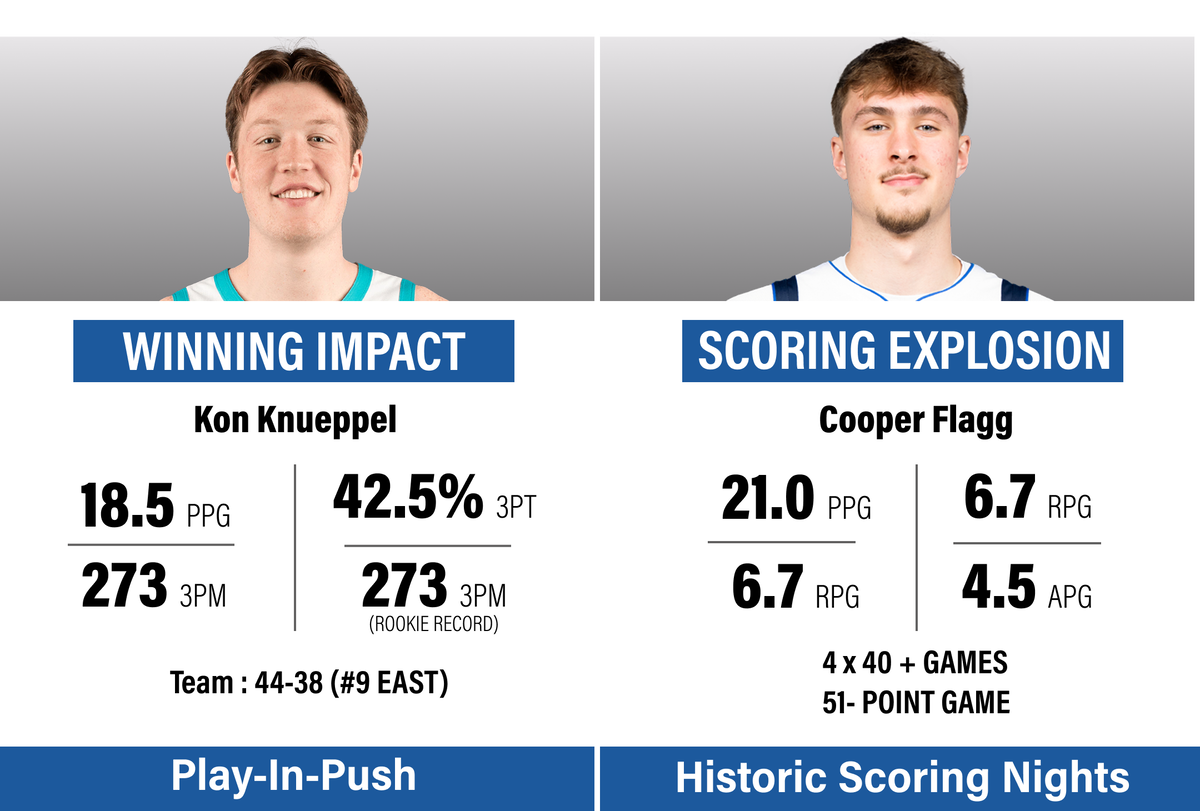
Regardless of which young star claims the hardware, Flagg and Knueppel are two of the NBA’s most productive and impactful rookies across the last few decades. Flagg authored rare 40 and 50-point scoring outbursts as a teenager. He averaged 21 points per game, the fourth-highest rookie mark of the 21st century (behind Blake Griffin, Zion Williamson and Victor Wembanyama).
Advanced metrics regard Knueppel as a near-star-level player already, something rarely found in rookie profiles. He scored on excellent efficiency (+5.6 relative true shooting) and led his class in Estimated Plus-Minus (+2.6). That mark ranks him eighth among all rookie seasons since 2001, trailing a list of eventual stars like Chris Paul and Nikola Jokic, along with recent standouts like Victor Wembanyama and Chet Holmgren.
Which former Blue Devil should win the 2025-26 Rookie of the Year trophy? Let’s build a case for both players before ultimately deciding a victor. One has been the engine behind winning basketball. The other has been asked to carry everything.
Strip away the numbers, and this race comes down to two very different rookie archetypes. Knueppel has been the driver of winning basketball, scaling his efficiency into a real team context that produced results. Flagg, on the other hand, has operated as a one-man offense, tasked with creating everything on a nightly basis while still delivering historic scoring highs. Both paths are incredibly rare for rookies and both show up clearly when you lay their seasons side by side.
Imago
Credits: Imagn
The contrast is stark. Knueppel’s case is built on efficiency, scalability and winning impact—traits that tend to translate seamlessly into team success. Flagg’s argument leans on difficulty, creation and offensive burden, the kind of responsibility usually reserved for established stars. Neither path is inherently more valuable, but they rarely coexist in the same rookie class, which is exactly what makes this race so compelling.
The case for Kon Knueppel
If not for a slump towards the end of the season, Knueppel may have run away with this award. Even considering his poor final 15 games, averaging nearly six fewer points with stark dips in efficiency across the board, the case for Knueppel is simple. Few rookies score efficiently on any sort of volume and impact winning for teams in the playoff hunt. Kon achieved both this season.
Knueppel’s scoring, dropping 21.6 points per 75 possessions on his sparkling efficiency, places him among the NBA’s best bucket-getters. Only 13 players this season averaged above 20 points per 75 and +5 relative true shooting. Aside from Knueppel and Austin Reaves, every other member of the list has at least one All-Star berth under their belts.
Imago
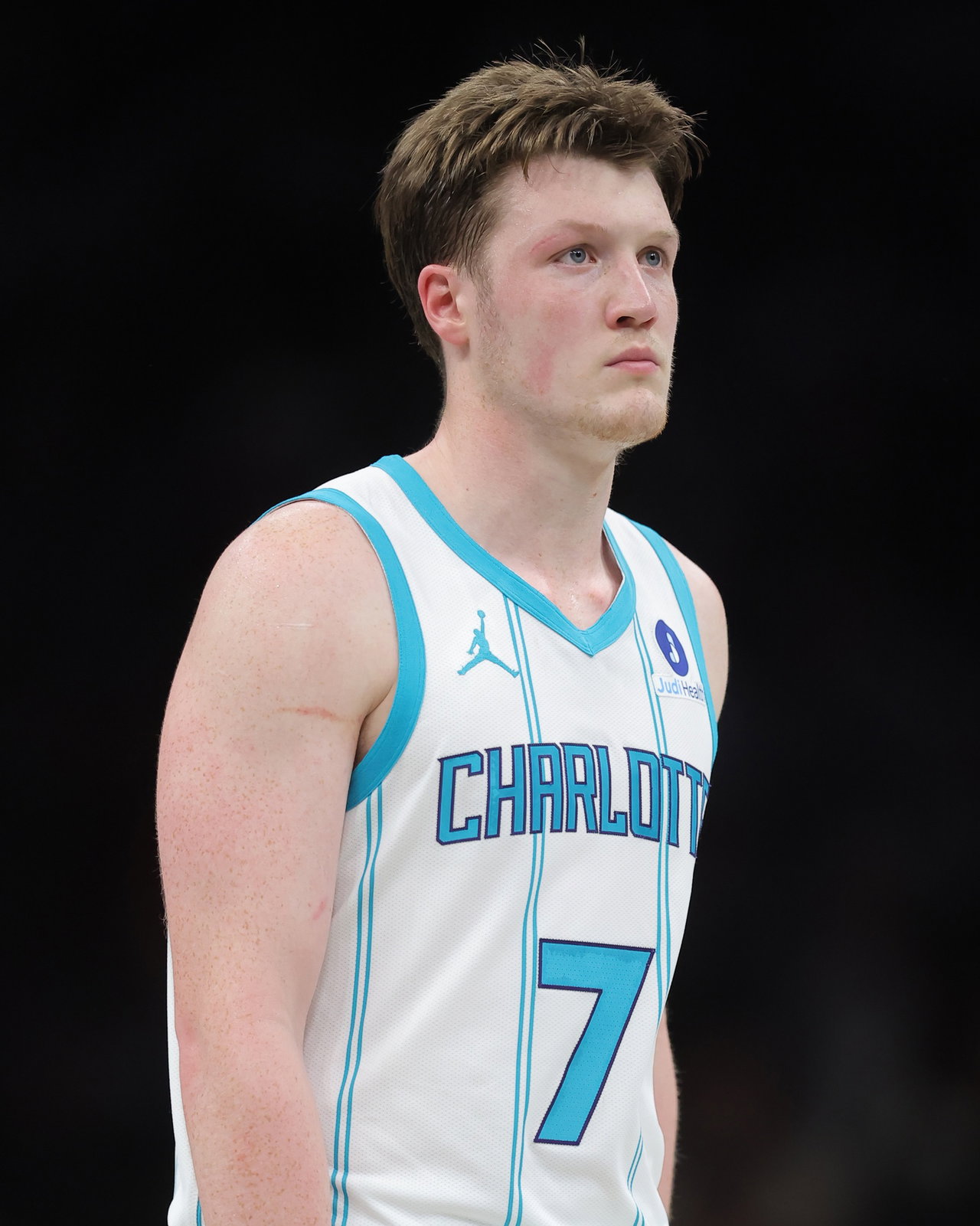
Mar 31, 2026; Brooklyn, New York, USA; Charlotte Hornets guard Kon Knueppel (7) during the fourth quarter against the Brooklyn Nets at Barclays Center. Mandatory Credit: Brad Penner-Imagn Images
Special outside shooting fuels his offensive production; Knueppel shattered the rookie 3-pointers made record, canning 273 triples. He converted 42.5% of his 9.2 threes per 75 possessions. Of the 41 players to match or exceed his volume, nobody topped Kon’s efficiency from downtown.
His offensive impact extended beyond his deep-range sharpshooting, imprinting himself on a Charlotte team that surged to a 44–38 record and a play-in spot after winning just 19 games the year prior. His elite feel for the game drove that leap. Quick off-ball movement, excellent screening and snappy passing decisions quickly turned Knueppel into an elite complementary offensive weapon. Lineups featuring Knueppel and LaMelo Ball posted an offensive rating 10.6 points above the league average.
For a rookie, Knueppel held up fairly well on the defensive end, grading out around average according to metrics like EPM. His lack of athleticism flashes against top-flight physical talents, but size and savvy were enough to round out his massively positive impact. We don’t often see rookies like Knueppel and his singularity represents a compelling Rookie of the Year case.
The case for Cooper Flagg
While the all-in-one and efficiency metrics tend to favor Knueppel in this discussion, those statistics struggle to accurately represent rookie seasons. An NBA player’s first year in the league brings inherent volatility that more experienced players don’t face and, critically, these metrics can’t fully account for a team’s environment.
This year’s Hornets roster and coaching quality far exceed that of a typical team selecting in the top five. Dallas, however, fit the description of a typical number-one pick team, fielding a barren roster with plenty of high-profile injuries. Despite a far inferior roster and schematics around him, Flagg thrived in that challenging environment.
Flagg led all rookies in usage rate (26.7%) and his enormous shot creation load explains his positive offensive impact (69th percentile O-EPM) in spite of poor efficiency (-3 relative true shooting). His 13 creation true shot attempts per 100 possessions, stemming from pick-and-rolls, isolations and post-ups, lead the rookie class by a mile.
The gap between Flagg’s volume and that of second-place Jeremiah Fears equals the distance between Fears and 10th-place Will Riley. Without reliable handling or creation on the roster, Flagg shouldered primary responsibilities and adapted to that role remarkably, especially considering his age.
As Flagg settled in as a scorer, especially thriving in the mid-range, his efficiency climbed. It’s even rarer to find players of Flagg’s passing caliber on the wing and he created shots at a high clip for others, ranking above the 80th percentile positionally in potential assists (11.4) and rim assists (2.1) per 100 possessions.
His playmaking toolkit, featuring live-dribble ambidexterity, vision on the move and manipulation, will help Flagg achieve offensive engine status. His defensive impact lagged behind his college production, but that shouldn’t come as a surprise considering his offensive responsibility and lack of NBA experience.
That responsibility didn’t just translate to volume; it produced real takeover moments. In early April, Flagg dropped 51 points against the Orlando Magic (19-of-30 shooting, 6-of-9 from three), becoming the youngest player in NBA history to reach the 50-point mark. It was his third 40-point game of the season, a reminder that his scoring ceiling already borders on the absurd.
If the award were decided purely on momentum, this race wouldn’t have a clear answer. The final NBA Kia Rookie Ladder placed Knueppel narrowly ahead of Flagg after the two swapped the top spot multiple times throughout the season. Betting markets slightly favored Flagg, while league sentiment leaned toward Knueppel’s efficiency, availability and team success. In other words, this isn’t a runaway—it’s a genuine coin flip.
Choosing a Winner
Both Flagg and Knueppel present reasonable cases for Rookie of the Year, though I’d vote for Knueppel if I had a ballot. Ultimately, this comes down to what you value more: efficiency and scalable impact, or difficulty and offensive burden. If Flagg landed on a team with offensive stars and great spacing in place, would he have fared even better than Knueppel did?
This isn’t a debate about who was better; it’s a debate about what matters more.
I’d side with Knueppel because his production isn’t just great for a rookie; it already mirrors that of established stars while directly translating to winning. If Kon’s season landed closer to good rather than great, this wouldn’t be a conversation. But Knueppel has a case as one of the NBA’s better offensive players today, something very few can claim after their first NBA seasons.
Twenty-three years ago, NBA voters comfortably chose a player with slightly worse efficiency, advanced metrics and team success over one with a slightly higher creation load. Voters today would be reasonable to vote for Flagg over Knueppel, like they did James over Anthony. Flagg isn’t LeBron James and Knueppel isn’t Carmelo Anthony. But if their inaugural NBA seasons provide any indication, we’ll feel their footprint on the league for the foreseeable future.
Either way, this is the rare Rookie of the Year race where the future matters just as much as the present, and both players look like they’re just getting started.