
The debate never really went away. It just waited for the right stage to return. For the first time in nearly a decade, Stephen A. Smith and Skip Bayless shared a platform again. It did not take long for their most polarizing subject to reappear. As expected, LeBron James was at the center of it.


This reunion was not nostalgic. It was confrontational. Appearing together on The Arena Gridiron, Bayless went straight to a familiar argument. He questioned LeBron’s late-game reliability and framed it as an inherent flaw rather than a situational issue.
Watch What’s Trending Now!
“Game 2 at Denver, he had a wide open three and he Lebricked it,” Bayless said. “The man was born without clutch genes.” Bayless extended the criticism to last season’s first-round loss to Minnesota, arguing that LeBron faded across multiple fourth quarters as the Lakers exited in five games. In his telling, those moments reinforced a long-standing belief that James comes up short when games tighten.
That framing set the tone. It also set up the response. Smith did not immediately push back. In fact, he opened by conceding part of Bayless’ argument. “Everything that he said was totally true,” Smith said. However, the agreement ended there. Smith pivoted to historical context Bayless had skipped, pointing directly to LeBron’s biggest moments under maximum pressure.
“Didn’t we see LeBron James show up in Game 7 against your San Antonio Spurs?” Smith asked, referencing the 2013 NBA Finals performance that helped seal a championship. Bayless countered by crediting Ray Allen’s iconic Game 6 shot, but Smith stayed focused on the broader point. The absence of a perfect late jumper, he argued, does not equate to an absence of clutch impact.
Smith’s strongest rebuttal came when he separated LeBron’s late-game profile from a different type of postseason criticism entirely. “All I am saying is when you say LeBron doesn’t have a clutch gene, this is not like a James Harden situation,” Smith explained. “LeBron is not a shooter. He is a scorer.”
Smith outlined the nuance. LeBron’s hesitation appears when defenses force jump shots or free throws, not because he avoids responsibility. He referenced James’ career free-throw percentage and emphasized that impact does not always come from scoring alone, citing the iconic chasedown block on Andre Iguodala in the 2016 Finals.
For Smith, the distinction mattered. LeBron’s late-game influence has often arrived through defense, playmaking, and momentum-shifting moments rather than pull-up jumpers.
LeBron James holds an underwhelming playoff record with the Lakers
Still, Bayless’ argument does not exist in a vacuum. LeBron’s postseason record with the Lakers provides real ammunition.
Since joining Los Angeles, James owns a 28–25 playoff record. The 2020 championship run produced a dominant 16–5 postseason. Everything since has been uneven. The Lakers lost in the first round to Phoenix in 2021, missed the playoffs entirely in 2022, reached the Western Conference Finals in 2023 before being swept by Denver, and exited in the first round in both 2024 and 2025.
Last season’s loss to Minnesota added fuel to the criticism. LeBron averaged 25.4 points, 9.0 rebounds, and 5.6 assists in that series, but late-game execution remained the focal point of debate. That context explains why the ‘clutch gene’ narrative continues to surface, especially as James navigates his 23rd season at age 41.
Imago
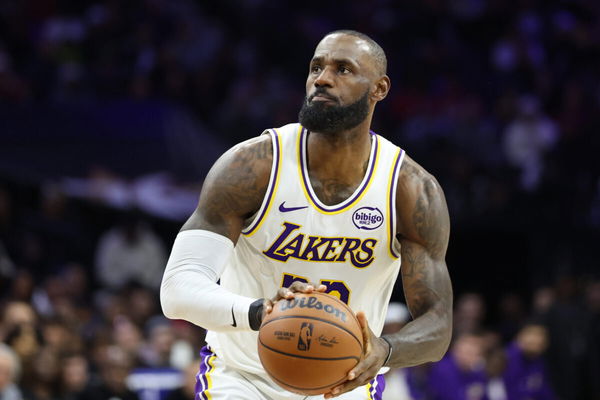
Dec 7, 2025; Philadelphia, Pennsylvania, USA; Los Angeles Lakers forward Lebron James (23) shoots against the Philadelphia 76ers during the fourth quarter at Xfinity Mobile Arena. Mandatory Credit: Bill Streicher-Imagn Images
The exchange between Smith and Bayless was not about rewriting LeBron’s career. It was about framing the final chapter. Bayless focused on recent outcomes. Smith zoomed out, arguing that selective memory cannot erase two decades of defining moments. Neither position was entirely dismissed. However, Smith’s point was clear. Reducing LeBron’s legacy to missed jumpers ignores the full scope of how championships are actually decided.
As the Lakers push toward another postseason, the debate will resurface again. Late shots will be scrutinized. Free throws will be counted. And moments beyond the box score will either be remembered or ignored, depending on the argument being made. For now, one thing is certain. A decade later, the LeBron debate remains powerful enough to pull Stephen A. Smith and Skip Bayless right back into familiar territory.
Written by

Edited by

Ved Vaze